
Animation Demonstrating Planes, Equilateral Triangles, and Integrals
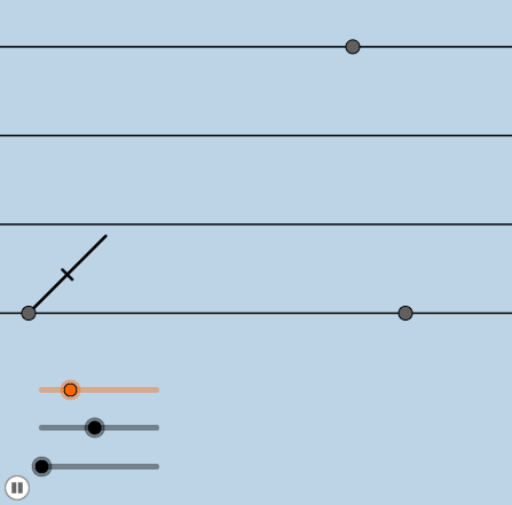
Loading the math board and drawing, please wait…
This example visually demonstrates the geometric relationships between planes, equilateral triangles, isosceles triangles, means, and definite integrals through animation. Key math concepts include properties of equilateral/isosceles triangles, rotation, vectors, function graphs, and definite integral calculations. GeoGebra commands like Point, Line, Rotate, Angle, Ray, Circle, OrthogonalLine, Intersect, Segment, CircleSector, Dilate, Vector, and Translate are used in construction. Suitable for high school and above mathematics education to intuitively understand geometric transformations and calculus applications.
GeoGebra Commands & Parameters
Point(y = 0) → ALine(A, B) → fRotate(B, α, A) → B'Angle(B, A, B') → βLine(A, B') → gRotate(B', γ, A) → B''Angle(B', A, B'') → δRay(A, B'') → hCircle(A, a) → cOrthogonalLine(A, g) → iIntersect(c, i, 2) → CCircle(C, a) → dIntersect(d, i, 2) → DCircle(D, a) → eIntersect(e, i, 2) → ELine(C, g) → jLine(D, g) → kLine(E, g) → lIntersect(h, j) → FIntersect(k, h) → GIntersect(l, h) → HSegment(A, F) → mCircle(A, (0.3 * m)) → pPoint(l) → IPoint(g) → JSegment(I, J) → nIntersect(k, n) → KIntersect(j, n) → LIntersect(p, g, 2) → MIntersect(p, h, 1) → NCircleSector(A, M, N) → qDilate(A, If[0 < b ≤ 1, 1 - b, 0], F) → A'Segment(A, A') → rDilate(F, If[1 < b ≤ 2, 2 - b, 0], G) → F'Segment(F, F') → sDilate(G, If[2 < b ≤ 3, 3 - b, 0], H) → G'Segment(G, G') → tDilate(A, If[3 < b ≤ 4, 4 - b, 0], F) → A'_1Vector(A, A'_1) → uTranslate(q, u) → q'Dilate(F, If[4 < b ≤ 5, 5 - b, 0], G) → F'_1Vector(F, F'_1) → vTranslate(q', v) → q''Dilate(G, If[5 < b ≤ 6, 6 - b, 0], H) → G'_1Vector(G, G'_1) → wTranslate(q'', w) → q'''Rotate(q''', If[6 < b ≤ 7, ((-(b - 6)) * π), (-π)], H) → c_1Rotate(A, If[7 < b ≤ 8, ((b - 7) * π), π], F) → A'_2Rotate(A', If[7 < b ≤ 8, ((b - 7) * π), π], F) → A''Segment(A'_2, A'') → r'Rotate(A'_2, If[8 < b ≤ 9, ((b - 8) * π), π], G) → ORotate(A'', If[8 < b ≤ 9, ((b - 8) * π), π], G) → A'''Segment(O, A''') → r''Dilate(I, If[11.5 < b ≤ 12.5, 12.5 - b, 0], K) → I'Segment(I, I') → f_1Dilate(K, If[12.5 < b ≤ 13.5, 13.5 - b, 0], L) → K'Segment(K, K') → g_1Dilate(L, If[13.5 < b ≤ 14.5, 14.5 - b, 0], J) → L'Segment(L, L') → h_1Rotate(I, If[14.5 < b ≤ 15.5, ((-(b - 15.5)) * π), (-π)], K) → I'_1Rotate(I', If[14.5 < b ≤ 15.5, ((-(b - 15.5)) * π), (-π)], K) → I''Rotate(I, If[14.5 < b ≤ 15.5, ((-(b - 14.5)) * π), (-π)], K) → I'_2Rotate(I', If[14.5 < b ≤ 15.5, ((-(b - 14.5)) * π), (-π)], K) → I''_1Segment(I'_2, I''_1) → i_1Rotate(I'_2, If[15.5 < b ≤ 16.5, ((-(b - 15.5)) * π), (-π)], L) → PRotate(I''_1, If[15.5 < b ≤ 16.5, ((-(b - 15.5)) * π), (-π)], L) → QSegment(P, Q) → j_1
AI Drawing Prompt Reference
Create an animation to demonstrate the relationships between planes, equilateral triangles, isosceles triangles, means, and definite integrals. Start by taking point A on the y-axis and drawing line f through A and B. Rotate B around A to get B', then draw angle β and line g through A and B'. Continue by rotating B' to get B'', drawing angle δ and ray h. Draw circle c with center A, and through the intersection of c and h, draw circle d. Draw circles e and f, and find points D, E, F, G, H, I, J, K, L, M, N. Draw arc q, and through D, E, F, G, H, I, J, K, L, M, N, draw line segments p, r, s, t. Draw sector q', and through A, A', F, G, H, draw line segments u, v, w. Finally, draw sector q'', and through A, A'_1, F, G, H, draw line segments u, v, w, and rotate q''' and c_1.
The prompt above was compiled from the original drawing commands and is for reference only.