
Animation Demonstrating Isosceles Triangle and Derivative
Loading the math board and drawing, please wait…
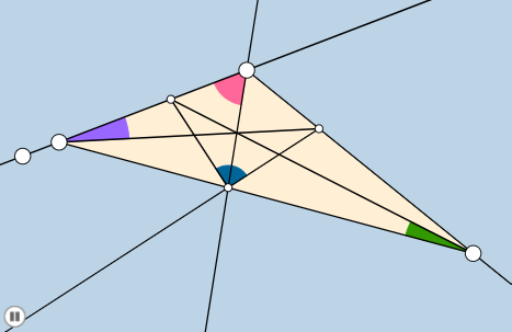
This example demonstrates the dynamic relationship between an isosceles triangle and its derivative through animation. Key math concepts include derivatives, tangent functions, and slopes. GeoGebra commands like Rotate, Ray, Point, Line, and Polygon are used in construction. Suitable for high school mathematics education to understand the geometric meaning of derivatives in calculus.
GeoGebra Commands & Parameters
Rotate(B, π / 3, A) → B'Ray(A, B') → hPoint(h) → CLine(A, C) → eRotate(B', π / 3, A) → B''Ray(A, B'') → gPoint(g) → URay(A, B) → jPoint(j) → DSegment(A, D) → sAngle(A, U, D) → ζRotate(A, ζ / 2, U) → A'_1Ray(U, A'_1) → g_1Intersect(g_1, e) → KSegment(A, K) → i_1Intersect(g_1, s) → ISegment(A, I) → h_1Angle(U, D, A) → εRotate(U, ε / 2, D) → U'Ray(D, U') → f_1Intersect(f_1, g) → GSegment(A, G) → bMin({h_1, i_1, b}) → oLine(A, B) → fAngle(B, A, B') → αAngle(B', A, B'') → βMirror(B, A) → B'_1Segment(C, D) → iRay(A, B'_1) → kSegment(A, D) → lSegment(A, C) → mCircle(A, (0.55 * o)) → cIntersect(c, k, 1) → EIntersect(c, g) → F,CircleSector(A, F, E) → dRotate(d, If[0 < a ≤ 1, ((-a) * π / 3), ((-π)) / 3], A) → d'Polygon(A, U, D) → poly1, a_1, c_1, d_1Rotate(d', If[2 < a ≤ 3, ((-(a - 2)) * π / 3), ((-π)) / 3], A) → d''Line(A, C) → nOrthogonalLine(D, n) → pIntersect(n, p) → JLine(A, D) → qOrthogonalLine(C, q) → rIntersect(r, q) → HLine(A, C) → n_1Circle(C, 1) → e_1Intersect(e_1, n_1, 2) → NCircle(A, 1) → p_1Intersect(p_1, n_1) → O, PRay(C, N) → q_1Ray(A, O) → r_1Ray(A, D) → s_1Circle(D, 1) → t_1Intersect(t_1, s_1) → Q, RRay(D, R) → b_1Ray(D, U) → j_2Ray(A, C) → tAngle(U, D, U') → ηAngle(A, U, A'_1) → θIntersect(e, j_2) → LSegment(D, U) → j_1Segment(D, I) → k_1Segment(D, L) → f_2Segment(D, K) → g_2Segment(U, L) → h_2Segment(U, K) → i_2Segment(U, G) → k_2Line(A, D) → l_2Min({s, f_2, g_2, h_2, i_2, k_2}) → uCircle(D, (0.4 * u)) → c_2Circle(U, (0.4 * u)) → d_2Intersect(d_2, g) → S, TIntersect(d_2, g_1) → V,Intersect(c_2, j_1) → W,Intersect(c_2, f_1) → Z,CircleSector(D, W, Z) → e_2CircleSector(U, S, V) → p_2Dilate(D, If[3 < a ≤ 4, 4 - a, 0], G) → D'Segment(D, D') → m_2Dilate(U, If[4 < a ≤ 5, 5 - a, 0], I) → U'_1Segment(U, U'_1) → n_2Rotate(e_2, If[5 < a ≤ 6, ((a - 5) * η), η], D) → q_2Rotate(p_2, If[6 < a ≤ 7, ((a - 6) * θ), θ], U) → r_2Ray(G, L) → s_2Ray(I, L) → t_2Intersect(n_2, s_2) → A_1Line(U, I) → a_2Intersect(e, a_2) → B_1Intersect(t_2, m_2) → C_1Segment(L, A_1) → b_2Segment(L, B_1) → f_3Segment(L, C_1) → g_3Min({b_2, f_3, g_3}) → vCircle(L, (0.4 * v)) → c_3Intersect(c_3, s_2) → D_1, E_1Intersect(c_3, t_2) → F_1, G_1CircleSector(L, D_1, F_1) → d_3Dilate(G, If[7 < a ≤ 8, 8 - a, 0], L) → G'Dilate(I, If[7 < a ≤ 8, 8 - a, 0], L) → I'Segment(G, G') → l_1Segment(I, I') → m_1Rotate(d_3, If[9 < a ≤ 10, ((a - 9) * π / 2), π / 2], L) → e_3