
Animation Demonstrating Circumcircle and Incircle
Loading the math board and drawing, please wait…
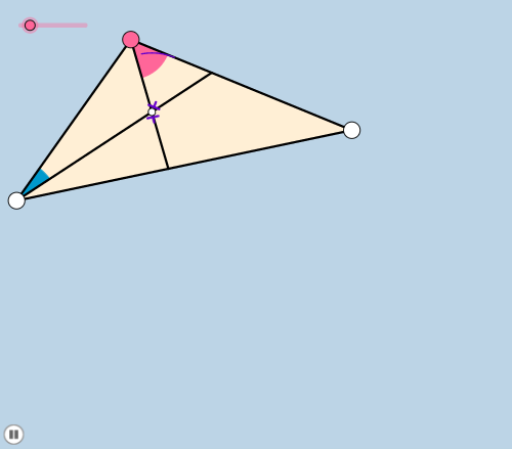
This example demonstrates the construction and properties of circumcircles and incircles of a triangle through animation. It involves core mathematical concepts such as circumcircle, incircle, congruence, median value, quadratic functions, and planes. The construction utilizes commands like Rotate, Angle, Segment, Ray, Point, Intersect, LineBisector, OrthogonalLine, Min, Circle, CircleSector, Dilate, CircleArc, Vector, Translate, Line, and Polygon from GeoGebra. It is suitable for high school mathematics education, helping students understand the geometric relationships between polygons and circles, as well as function graphs.
GeoGebra Commands & Parameters
Rotate(A, a°, B) → A'Angle(A, B, A') → αSegment(B, A) → fRay(B, A') → gPoint(g) → CSegment(A, C) → hSegment(B, C) → iRotate(A, α / 2, B) → A'_1Angle(A, B, A'_1) → βRay(B, A'_1) → jAngle(C, A, B) → γRotate(C, γ / 2, A) → C'Angle(C, A, C') → δRay(A, C') → kIntersect(k, j) → DLineBisector(h) → lLineBisector(i) → mIntersect(l, m) → EOrthogonalLine(D, i) → nOrthogonalLine(D, h) → pIntersect(n, i) → FIntersect(p, h) → GAngle(D, G, A) → εAngle(D, F, C) → ζMin(f, i) → bCircle(A, (0.2 * b)) → cCircle(B, (0.2 * b)) → dIntersect(c, h, 1) → HIntersect(c, k, 1) → IIntersect(d, f, 1) → JIntersect(d, j, 1) → KCircleSector(A, H, I) → eCircleSector(B, J, K) → qIntersect(i, k) → LIntersect(h, j) → MDilate(A, If[0 < o ≤ 1, 1 - o, 0], L) → A'_2Segment(A, A'_2) → rDilate(B, If[1 < o ≤ 2, 2 - o, 0], D) → B'Segment(B, B') → sDilate(D, If[2 < o ≤ 3, 3 - o, 0], M) → D'Segment(D, D') → tRotate(e, If[3 < o ≤ 4, ((o - 3) * γ / 2), γ / 2], A) → e'Rotate(q, If[4 < o ≤ 5, ((o - 4) * α / 2), α / 2], B) → q'Circle(D, F) → c_1Rotate(F, If[5 < o ≤ 7, ((o - 5) * π), π], D) → F'CircleArc(D, F, F') → d_1Dilate(E, If[8 < o ≤ 9, 9 - o, 0], C) → E'Segment(E, E') → f_1Circle(E, C) → e_1Rotate(C, If[9 < o ≤ 11, ((o - 9) * π), π], E) → C'_1CircleArc(E, C, C'_1) → g_1Min({y(E), y(A), y(B), y(C)}) → uOrthogonalLine(E, h_1) → j_1Intersect(h_1, j_1) → NIntersect(i_1, j_1) → OOrthogonalLine(E, h) → k_1OrthogonalLine(E, i) → l_1OrthogonalLine(E, f) → m_1Intersect(l_1, i) → PIntersect(k_1, h) → QIntersect(m_1, f) → RDilate(E, If[11 < o ≤ 12, 12 - o, 0], P) → E'_1Dilate(E, If[11 < o ≤ 12, 12 - o, 0], Q) → E'_2Dilate(E, If[11 < o ≤ 12, 12 - o, 0], R) → E'_3Segment(E, E'_1) → n_1Segment(E, E'_2) → p_1Segment(E, E'_3) → q_1Angle(E, Q, C) → ηAngle(E, P, C) → θAngle(E, R, B) → ιDilate(E, If[12 < o ≤ 13, 13 - o, 0], N) → E'_4Vector(E, E'_4) → vTranslate(E, v) → E'_5Translate(E', v) → E''Segment(E'_5, E'') → r_1Line(E, h_1) → s_1Intersect(e_1, s_1, 2) → TAngle(T, E, C) → κRotate(E'_5, If[13 < o ≤ 14, ((-(o - 13)) * κ), (-κ)], N) → URotate(E'', If[13 < o ≤ 14, ((-(o - 13)) * κ), (-κ)], N) → E'''Segment(U, E''') → t_1Dilate(D, If[5 < o ≤ 6, 6 - o, 0], F) → D'_1Segment(D, D'_1) → a_1Dilate(D, If[5 < o ≤ 6, 6 - o, 0], G) → D'_2Segment(D, D'_2) → b_1Dilate(D, If[14 < o ≤ 15, 15 - o, 0], E''') → D'_3Vector(D, D'_3) → wTranslate(D, w) → D'_4Translate(D'_1, w) → SSegment(D'_4, S) → f_2Line(D, i_1) → g_2Intersect(c_1, g_2, 2) → VAngle(V, D, F) → λRotate(D'_4, If[15 < o ≤ 16, ((-(o - 15)) * λ), (-λ)], E''') → WRotate(S, If[15 < o ≤ 16, ((-(o - 15)) * λ), (-λ)], E''') → S'Segment(W, S') → h_2Circle(O, t_1 + h_2) → c_2Intersect(c_2, i_1, 2) → ZCircle(O, 1) → d_2Circle(Z, 1) → e_2Intersect(d_2, i_1, 1) → A_1Intersect(e_2, i_1, 2) → B_1Ray(O, A_1) → i_2Ray(Z, B_1) → j_2Circle(O, q_1) → k_2Intersect(k_2, i_1, 2) → C_1Circle(C_1, n_1) → p_2Intersect(i_1, j_2) → D_1Intersect(i_1, j_2) → E_1Intersect(p_2, i_1) → F_1, G_1Ray(O, A_1) → l_2Segment(N, S') → m_2Dilate(N, If[16 < o ≤ 17, 17 - o, 0], O) → N'Vector(N, N') → u_1Translate(N, u_1) → N'_1Translate(S', u_1) → S''Segment(N'_1, S'') → n_2Segment(N, N'_1) → q_2Segment(O, C_1) → r_2Segment(C_1, Z) → s_2Circle(G_1, 1) → t_2Intersect(t_2, j_2, 2) → H_1Ray(G_1, H_1) → a_2Segment(Z, G_1) → b_2Dilate(O, If[17 < o ≤ 18, 18 - o, 0], Z) → O'Vector(O, O') → v_1Translate(N, v_1) → N'_2Translate(N'_1, v_1) → I_1Segment(N'_2, I_1) → f_3Dilate(R, If[18 < o ≤ 19, 19 - o, 0], O) → R'Vector(R, R') → w_1Translate(E, w_1) → E'_6Translate(E'_3, w_1) → J_1Segment(E'_6, J_1) → g_3Line(R, h_1) → h_3Intersect(e_1, h_3, 2) → K_1Angle(E, R, K_1) → μRotate(E'_6, If[19 < o ≤ 20, ((o - 19) * μ), μ], O) → L_1Rotate(J_1, If[19 < o ≤ 20, ((o - 19) * μ), μ], O) → M_1Segment(L_1, M_1) → i_3Dilate(E, If[20 < o ≤ 21, 21 - o, 0], C_1) → E'_7Vector(E, E'_7) → u_2Translate(E, u_2) → E'_8Translate(E'_1, u_2) → N_1Segment(E'_8, N_1) → j_3Angle(T, E, P) → τRotate(E'_8, If[21 < o ≤ 22, ((-(o - 21)) * τ), (-τ)], C_1) → O_1Rotate(N_1, If[21 < o ≤ 22, ((-(o - 21)) * τ), (-τ)], C_1) → P_1Segment(O_1, P_1) → k_3Intersect(e_1, s_1, 1) → Q_1Segment(Z, G_1) → m_3Segment(C_1, Z) → n_3Dilate(E, If[22 < o ≤ 23, 23 - o, 0], G_1) → E'_9Vector(E, E'_9) → v_2Translate(E, v_2) → E'_{10}Translate(E'_2, v_2) → R_1Segment(E'_{10}, R_1) → p_3Angle(Q, E, Q_1) → χRotate(E'_{10}, If[23 < o ≤ 24, ((o - 23) * χ), χ], G_1) → S_1Rotate(R_1, If[23 < o ≤ 24, ((o - 23) * χ), χ], G_1) → T_1Segment(S_1, T_1) → q_3Polygon(A, B, C) → poly1, c_3, a_3, b_3
AI Drawing Prompt Reference
Draw a triangle ABC and construct its circumcircle and incircle. First, determine point C using rotation and angle calculations. Then, find the circumcenter E and incenter F using midlines and angle bisectors. Next, draw the circumcircle and incircle with E and F as centers. Finally, use rotation and scaling to dynamically show the changes in the circumcircle and incircle.
The prompt above was compiled from the original drawing commands and is for reference only.