
Animation 108: Dynamic Transformation of Equilateral Triangles and Circles
Loading the math board and drawing, please wait…
In collections
CCSS High School: Geometry (Congruence) Volume 2
CCSS High School: Geometry (Congruence) Volume 2
CCSS High School: Geometry (Congruence) Volume 2
CCSS High School: Geometry (Congruence) Volume 2
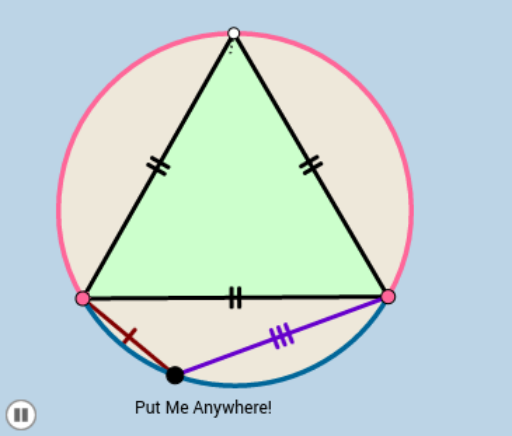
① This GeoGebra example presents a dynamic geometric animation involving equilateral triangles, circles, vectors, and centroids, illustrating transformations such as translation, rotation, and scaling. ② Core mathematical concepts include properties of equilateral triangles, circle geometry, vector operations (translation and rotation), centroid computation, area and frequency distribution, and the unit circle. ③ Construction highlights: using Polygon to create triangles, Dilate for scaling, Segment and Circle for edges and circles, Intersect for intersection points, Rotate for rotation, Vector and Translate for vector-based movement, Centroid for center of mass, CircleArc for arcs, Point for key markers, and a button (button1) to control the animation; objects include A, B, poly1, C, D, E, and many derived points. ④ Suitable for high school to early college students, this example serves as an interactive tool for teaching geometric transformations, vector algebra, and dynamic mathematics, and can be adapted by teachers for classroom demonstrations.
GeoGebra Commands & Parameters
Polygon(A, B, 3) → poly1, a, b, c, CDilate(A, If[0 < d ≤ 1, 1 - d, 0], B) → A'Segment(A, A') → eDilate(B, If[1 < d ≤ 2, 2 - d, 0], C) → B'Segment(B, B') → fDilate(C, If[2 < d ≤ 3, 3 - d, 0], A) → C'Segment(C, C') → gSegment(A, B) → hSegment(A, C) → iSegment(B, C) → jCircle(A, (0.15 * h)) → kIntersect(k, i, 1) → DIntersect(k, h, 1) → ERotate(A, If[3.5 < d ≤ 4.5, ((d - 3.5) * π / 3), 1.0471975511965976], A) → A'_1Rotate(A', If[3.5 < d ≤ 4.5, ((d - 3.5) * π / 3), 1.0471975511965976], A) → A''Segment(A'_1, A'') → e'Rotate(A, If[4.5 < d ≤ 5.5, ((-(d - 4.5)) * π / 3), -1.0471975511965976], B) → A'_2Rotate(A', If[4.5 < d ≤ 5.5, ((-(d - 4.5)) * π / 3), -1.0471975511965976], B) → A''_1Segment(A'_2, A''_1) → e'_1Dilate(A, If[6 < d ≤ 7, 7 - d, 0], B) → A'_3Vector(A, A'_3) → uCircle(B, (0.15 * h)) → rIntersect(f, e'_1) → GIntersect(f, e'_1) → HIntersect(f, e'_1) → IIntersect(f, e'_1) → JIntersect(r, j, 1) → FIntersect(r, h, 1) → KDilate(B, If[8 < d ≤ 9, 9 - d, 0], C) → B'_1Vector(B, B'_1) → vCentroid(poly1) → LCircle(L, B) → pCircleArc(L, B, A) → qCircleArc(L, A, B) → tPoint(t) → MRotate(B, If[5.5 < d ≤ 6.5, (((d - 5.5) * 4) * π / 3), (4 * π / 3)], L) → B'_2CircleArc(L, B, B'_2) → c_1Rotate(A, If[6.5 < d ≤ 7.5, (((d - 6.5) * 2) * π / 3), (2 * π / 3)], L) → A'_4CircleArc(L, A, A'_4) → d_1Segment(A, M) → lSegment(B, M) → mSegment(C, M) → nCircle(M, l) → sIntersect(s, n) → N,Dilate(A, If[7.5 < d ≤ 8.5, 8.5 - d, 0], M) → A'_5Segment(A, A'_5) → f_1Dilate(B, If[8.5 < d ≤ 9.5, 9.5 - d, 0], M) → B'_3Segment(B, B'_3) → g_1Dilate(C, If[9.5 < d ≤ 10.5, 10.5 - d, 0], N) → C'_1Segment(C, C'_1) → h_1Dilate(N, If[10.5 < d ≤ 11.5, 11.5 - d, 0], M) → N'Segment(N, N') → i_1Circle(L, B) → e_1Rotate(A, If[11.5 < d ≤ 12.5, ((-(d - 11.5)) * π / 3), ((-π)) / 3], M) → A'_6Rotate(A'_5, If[11.5 < d ≤ 12.5, ((-(d - 11.5)) * π / 3), ((-π)) / 3], M) → OSegment(A'_6, O) → j_1Segment(A, M) → k_1Dilate(M, If[12.5 < d ≤ 13.5, 13.5 - d, 0], N) → M'Vector(M, M') → wTranslate(B, w) → B'_4Translate(B'_3, w) → PSegment(B'_4, P) → l_1Segment(B, M) → m_1Rotate(B'_4, If[13.5 < d ≤ 14.5, ((d - 13.5) * π / 3), π / 3], N) → QRotate(P, If[13.5 < d ≤ 14.5, ((d - 13.5) * π / 3), π / 3], N) → P'Segment(Q, P') → n_1
AI Drawing Prompt Reference
Draw an equilateral triangle with three vertices. From each vertex, draw a segment that dynamically shrinks toward the opposite side, controlled by a slider. Construct a circumcircle centered at the triangle's centroid passing through all vertices. Place a moving point on this circle and connect it to the three vertices with segments. Additionally, draw a small circle centered at one vertex intersecting two sides of the triangle. Include several rotating arcs and scaling transformations that animate as the slider changes, showing dynamic geometric transformations.
The prompt above was compiled from the original drawing commands and is for reference only.