
Animated Net of a Square Pyramid
Loading the math board and drawing, please wait…
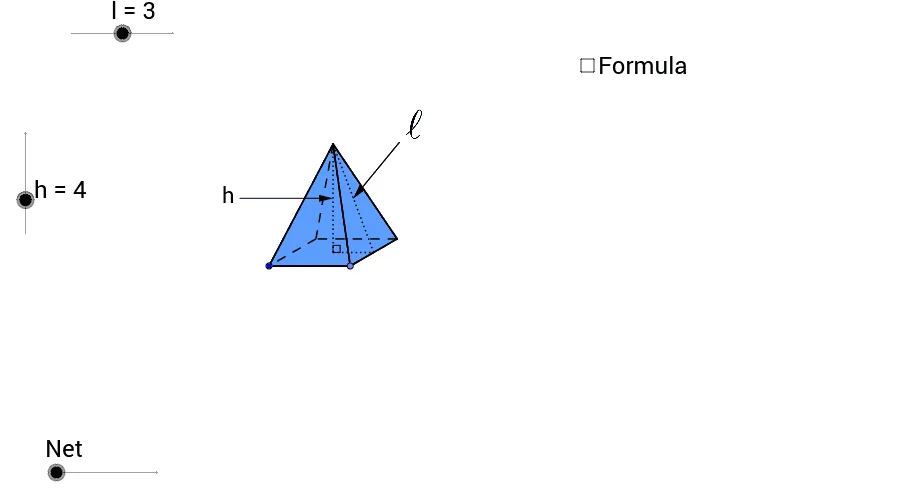
This GeoGebra example demonstrates the net of a square pyramid through an animated construction, showing how a square base and four triangular lateral faces unfold into a plane and fold back into a three-dimensional solid. Core mathematical concepts include solid geometry, polyhedra, nets, square bases, isosceles triangular faces, shared edges, and the relationship between 3D surfaces and their 2D developments. The construction utilizes GeoGebra commands such as Point, Segment, Line, Circle, Intersect, Rotate, Polygon, OrthogonalLine, Midpoint, Angle, Vector, Translate, LineBisector, CircleArc, Ray, and conditional If, together with objects including vertices A through J, segments a through f, circles c and c_1, polygon poly1, and angle α. Rotations and translations position the lateral faces around the base. Suitable for middle school and high school geometry instruction, this resource supports classroom demonstrations of pyramid nets and student exploration of surface area, spatial visualization, and geometric construction techniques.
GeoGebra Commands & Parameters
Point(Circle[A, l]) → BSegment(A, B) → aLine(A, B) → b_2Circle(B, 3.0 * l / 4.5) → cIntersect(c, b_2, 2.0) → CRotate(C, 30.0*°, B) → C'Line(C', b_2) → dSegment(B, C') → eLine(A, e) → fIntersect(d, f) → DPolygon(A, B, C', D) → poly1, a_1, b_1, c', d_1Segment(A, C') → gSegment(D, B) → h_1Intersect(g, h_1) → EOrthogonalLine(E, a_1) → iCircle(E, h) → kIntersect(k, i, 2.0) → FSegment(B, F) → jSegment(C', F) → l_5Segment(F, D) → mSegment(F, A) → nSegment(E, F) → pSegment(A, D) → qMidpoint(b_1) → GSegment(G, F) → rAngle(G, E, F) → αSegment(E, G) → tLine(E, G) → c_1Circle(G, F) → f_1Intersect(f_1, c_1, 2.0) → HIntersect(c_1, d_1) → ICircle(I, F) → g_1Intersect(g_1, c_1, 1.0) → JVector(F, J) → uPoint(c') → LCircle(L, F) → q_1Vector(F, H) → wMidpoint(A, B) → KLine(K, E) → e_1Circle(K, h) → p_1Intersect(e_1, c') → MCircle(M, h) → r_1Intersect(r_1, e_1, 2.0) → NIntersect(p_1, e_1, 1.0) → OVector(F, N) → vVector(F, O) → zTranslate(F, Vector[z * o]) → F'_1Translate(F, Vector[u * (o - 1.0)]) → F'_2Translate(F, Vector[v * (o - 2.0)]) → F'_3Translate(F, Vector[w * (o - 3.0)]) → F'Segment(F, N) → sLineBisector(s) → a_2Intersect(a_2, c') → PCircleArc(P, N, F) → c_2Ray(P, F'_3) → d_2Intersect(c_2, d_2, 1.0) → QSegment(F, O) → e_2LineBisector(e_2) → f_2Intersect(f_2, a_1) → RCircleArc(R, F, O) → g_2Ray(R, F'_1) → h_2Intersect(g_2, h_2, 1.0) → SCircleArc(I, F, J) → k_2CircleArc(G, H, F) → p_2Ray(I, F'_2) → i_2Intersect(k_2, i_2, 1.0) → TRay(G, F') → j_2Intersect(p_2, j_2, 1.0) → UCircle(I, E) → s_1OrthogonalLine(I, a_1) → i_1Intersect(s_1, i_1, 2.0) → VIntersect(s_1, i_1, 1.0) → WOrthogonalLine(V, i_1) → j_1OrthogonalLine(W, i_1) → k_1OrthogonalLine(G, k_1) → l_1Intersect(j_1, l_1) → ZIntersect(k_1, l_1) → A_1Midpoint(V, Z) → B_1Midpoint(A_1, W) → C_1Circle(B_1, r) → t_1Circle(C_1, r) → q_2OrthogonalLine(B_1, k_1) → m_1Intersect(t_1, m_1, 1.0) → D_1Intersect(q_2, m_1, 2.0) → E_1Vector(C', Z) → u_1Vector(B, A_1) → v_1Vector(N, D_1) → w_1Vector(O, E_1) → z_1Translate(N, Vector[w_1 * (o - 4.0)]) → N'Translate(O, Vector[z_1 * (o - 4.0)]) → O'Translate(B, Vector[v_1 * (o - 4.0)]) → B'Translate(A, Vector[v_1 * (o - 4.0)]) → A'Translate(C', Vector[u_1 * (o - 4.0)]) → C''Translate(D, Vector[u_1 * (o - 4.0)]) → D'If(o < 1.0, S, If[o < 4.0, O, If[o < 5.0, O', E_1]]) → F_1If(o < 1.0, F, If[o < 2.0, T, J]) → G_1If(o < 3.0, F, If[o < 4.0, U, H]) → H_1If(o < 2.0, F, If[o < 3.0, Q, If[o < 4.0, N, If[o < 5.0, N', D_1]]]) → I_1If(o < 4.0, A, If[o < 5.0, A', W]) → J_1If(o < 4.0, B, If[o < 5.0, B', A_1]) → K_1If(o < 4.0, C', If[o < 5.0, C'', Z]) → L_1If(o < 4.0, D, If[o < 5.0, D', V]) → M_1Polygon(F_1, J_1, K_1) → poly2, k_3, f_3, j_3Polygon(L_1, H_1, K_1) → poly3, k_4, l_2, h_3Polygon(L_1, I_1, M_1) → poly4, m_2, l_3, i_3Polygon(M_1, G_1, J_1) → poly5, j_4, m_3, g_3Intersect(m, j_3) → N_1Segment(I_1, N_1) → n_1Intersect(j_3, i_3) → O_1Intersect(c', i_3) → Q_1Intersect(c', i_3) → R_1Intersect(c', i_3) → S_1Intersect(c', i_3) → U_1Intersect(c', i_3) → A_2Intersect(l_2, i_3) → B_2Segment(B_2, O_1) → n_2Segment(B_2, M_1) → r_2Midpoint(M_1, L_1) → C_2Midpoint(L_1, K_1) → D_2Midpoint(K_1, J_1) → E_2Midpoint(J_1, M_1) → F_2Segment(G_1, F_2) → s_2Segment(C_2, I_1) → t_2Segment(D_2, H_1) → a_3Segment(E_2, F_1) → b_3Polygon(J_1, M_1, L_1, K_1) → poly6, j_5, m_4, l_4, k_5Intersect(j_3, d_1) → P_1Segment(P_1, M_1) → c_3Midpoint(p) → V_1OrthogonalLine(V_1, p) → d_3Point(d_3) → W_1Vector(W_1, V_1) → u_2Midpoint(r) → T_1Midpoint(a_3) → Z_1Point(a_2) → G_2Vector(G_2, T_1) → v_2Vector(G_2, Z_1) → w_2Point(Circle[H_2, l]) → I_2Segment(H_2, I_2) → e_3Line(H_2, I_2) → bCircle(I_2, 3.0 * l / 4.5) → p_3Intersect(p_3, b, 2.0) → J_2Rotate(J_2, 30.0*°, I_2) → K_2Segment(I_2, K_2) → n_3Line(K_2, b) → q_3Line(H_2, n_3) → r_3Intersect(q_3, r_3) → L_2Segment(H_2, K_2) → s_3Segment(I_2, L_2) → t_3Intersect(s_3, t_3) → M_2Circle(M_2, h) → c_4OrthogonalLine(M_2, b) → a_4Intersect(c_4, a_4, 2.0) → N_2Polygon(H_2, N_2, I_2) → poly7, i_4, h_4, n_4Polygon(I_2, N_2, K_2) → poly8, k_6, i_5, n_5Polygon(H_2, L_2, K_2, I_2) → poly9, h_5, l_6, k_7, i_6Polygon(H_2, N_2, L_2) → poly10, l_7, h_6, n_6Polygon(L_2, N_2, K_2) → poly11, k_8, l_8, n_7Midpoint(k_7) → O_2Segment(M_2, O_2) → b_4Segment(M_2, N_2) → d_4Segment(N_2, O_2) → e_4Angle(O_2, M_2, N_2) → βMidpoint(N_2, M_2) → P_2Midpoint(O_2, N_2) → Q_2Line(P_2, Q_2) → f_4Circle(P_2, l) → g_4Intersect(g_4, f_4, 1.0) → R_2Intersect(g_4, f_4, 2.0) → S_2Vector(R_2, P_2) → z_2Vector(S_2, Q_2) → u_3Midpoint(b_3) → V_2
AI Drawing Prompt Reference
Draw the net of a square pyramid, starting with a square base ABCD and four isosceles triangular faces. Then, rotate and translate these triangles to show how they fold into a 3D square pyramid. Ensure that each isosceles triangle's base aligns with the edges of the square base, and the apexes are near the center of the square.
The prompt above was compiled from the original drawing commands and is for reference only.