
Animated Net of a Square Pyramid by NW
Loading the math board and drawing, please wait…
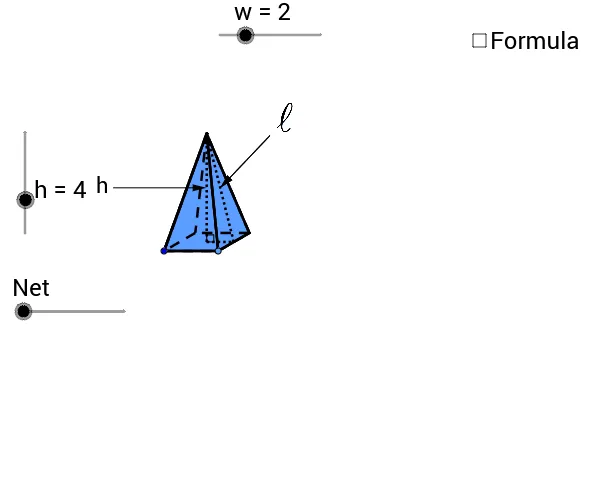
This example demonstrates the animated net of a square pyramid, illustrating geometric transformations and spatial relationships. It involves core math concepts like polygons, solid geometry, and transformations. Constructed using GeoGebra commands such as Point, Segment, Rotate, Polygon, etc. Ideal for high school students and math enthusiasts to visualize and understand the relationship between 3D solids and their 2D nets.
GeoGebra Commands & Parameters
Point(Circle[A, w]) → BSegment(A, B) → aLine(A, B) → b_2Circle(B, 3 * w / 4.5) → cIntersect(c, b_2, 2) → CRotate(C, 30*°, B) → C'Line(C', b_2) → dSegment(B, C') → eLine(A, e) → fIntersect(d, f) → DPolygon(A, B, C', D) → poly1, a_1, b_1, c', d_1Segment(A, C') → gSegment(D, B) → h_1Intersect(g, h_1) → EOrthogonalLine(E, a_1) → iCircle(E, h) → kIntersect(k, i, 2) → FSegment(B, F) → jSegment(C', F) → l_5Segment(F, D) → mSegment(F, A) → nSegment(E, F) → pSegment(A, D) → qMidpoint(b_1) → GSegment(G, F) → rAngle(G, E, F) → αSegment(E, G) → tLine(E, G) → c_1Circle(G, F) → f_1Intersect(f_1, c_1, 2) → HIntersect(c_1, d_1) → ICircle(I, F) → g_1Intersect(g_1, c_1, 1) → JVector(F, J) → uPoint(c') → LCircle(L, F) → q_1Vector(F, H) → w_3Midpoint(A, B) → KLine(K, E) → e_1Circle(K, h) → p_1Intersect(e_1, c') → MCircle(M, h) → r_1Intersect(r_1, e_1, 2) → NIntersect(p_1, e_1, 1) → OVector(F, N) → vVector(F, O) → zTranslate(F, Vector[z * o]) → F'_1Translate(F, Vector[u * (o - 1)]) → F'_2Translate(F, Vector[v * (o - 2)]) → F'_3Translate(F, Vector[w_3 * (o - 3)]) → F'Segment(F, N) → sLineBisector(s) → a_2Intersect(a_2, c') → PCircleArc(P, N, F) → c_2Ray(P, F'_3) → d_2Intersect(c_2, d_2, 1) → QSegment(F, O) → e_2LineBisector(e_2) → f_2Intersect(f_2, a_1) → RCircleArc(R, F, O) → g_2Ray(R, F'_1) → h_2Intersect(g_2, h_2, 1) → SCircleArc(I, F, J) → k_2CircleArc(G, H, F) → p_2Ray(I, F'_2) → i_2Intersect(k_2, i_2, 1) → TRay(G, F') → j_2Intersect(p_2, j_2, 1) → UCircle(I, E) → s_1OrthogonalLine(I, a_1) → i_1Intersect(s_1, i_1, 2) → VIntersect(s_1, i_1, 1) → WOrthogonalLine(V, i_1) → j_1OrthogonalLine(W, i_1) → k_1OrthogonalLine(G, k_1) → l_1Intersect(j_1, l_1) → ZIntersect(k_1, l_1) → A_1Midpoint(V, Z) → B_1Midpoint(A_1, W) → C_1Circle(B_1, r) → t_1Circle(C_1, r) → q_2OrthogonalLine(B_1, k_1) → m_1Intersect(t_1, m_1, 1) → D_1Intersect(q_2, m_1, 2) → E_1Vector(C', Z) → u_1Vector(B, A_1) → v_1Vector(N, D_1) → w_1Vector(O, E_1) → z_1Translate(N, Vector[w_1 * (o - 4)]) → N'Translate(O, Vector[z_1 * (o - 4)]) → O'Translate(B, Vector[v_1 * (o - 4)]) → B'Translate(A, Vector[v_1 * (o - 4)]) → A'Translate(C', Vector[u_1 * (o - 4)]) → C''Translate(D, Vector[u_1 * (o - 4)]) → D'If(o < 1, S, If[o < 4, O, If[o < 5, O', E_1]]) → F_1If(o < 1, F, If[o < 2, T, J]) → G_1If(o < 3, F, If[o < 4, U, H]) → H_1If(o < 2, F, If[o < 3, Q, If[o < 4, N, If[o < 5, N', D_1]]]) → I_1If(o < 4, A, If[o < 5, A', W]) → J_1If(o < 4, B, If[o < 5, B', A_1]) → K_1If(o < 4, C', If[o < 5, C'', Z]) → L_1If(o < 4, D, If[o < 5, D', V]) → M_1Polygon(F_1, J_1, K_1) → poly2, k_3, f_3, j_3Polygon(L_1, H_1, K_1) → poly3, k_4, l_2, h_3Polygon(L_1, I_1, M_1) → poly4, m_2, l_3, i_3Polygon(M_1, G_1, J_1) → poly5, j_4, m_3, g_3Intersect(m, j_3) → N_1Segment(I_1, N_1) → n_1Intersect(j_3, i_3) → O_1Intersect(c', i_3) → Q_1Intersect(c', i_3) → R_1Intersect(c', i_3) → S_1Intersect(c', i_3) → U_1Intersect(c', i_3) → A_2Intersect(l_2, i_3) → B_2Segment(B_2, O_1) → n_2Segment(B_2, M_1) → r_2Midpoint(M_1, L_1) → C_2Midpoint(L_1, K_1) → D_2Midpoint(K_1, J_1) → E_2Midpoint(J_1, M_1) → F_2Segment(G_1, F_2) → s_2Segment(C_2, I_1) → t_2Segment(D_2, H_1) → a_3Segment(E_2, F_1) → b_3Polygon(J_1, M_1, L_1, K_1) → poly6, j_5, m_4, l_4, k_5Intersect(j_3, d_1) → P_1Segment(P_1, M_1) → c_3Midpoint(p) → V_1OrthogonalLine(V_1, p) → d_3Point(d_3) → W_1Vector(W_1, V_1) → u_2Midpoint(r) → T_1Midpoint(a_3) → Z_1Point(a_2) → G_2Vector(G_2, T_1) → v_2Vector(G_2, Z_1) → w_2Point(Circle[H_2, w]) → I_2Segment(H_2, I_2) → e_3Line(H_2, I_2) → bCircle(I_2, 3 * w / 4.5) → p_3Intersect(p_3, b, 2) → J_2Rotate(J_2, 30*°, I_2) → K_2Segment(I_2, K_2) → n_3Line(K_2, b) → q_3Line(H_2, n_3) → r_3Intersect(q_3, r_3) → L_2Segment(H_2, K_2) → s_3Segment(I_2, L_2) → t_3Intersect(s_3, t_3) → M_2Circle(M_2, h) → c_4OrthogonalLine(M_2, b) → a_4Intersect(c_4, a_4, 2) → N_2Polygon(H_2, N_2, I_2) → poly7, i_4, h_4, n_4Polygon(I_2, N_2, K_2) → poly8, k_6, i_5, n_5Polygon(H_2, L_2, K_2, I_2) → poly9, h_5, l_6, k_7, i_6Polygon(H_2, N_2, L_2) → poly10, l_7, h_6, n_6Polygon(L_2, N_2, K_2) → poly11, k_8, l_8, n_7Midpoint(k_7) → O_2Segment(M_2, O_2) → b_4Segment(M_2, N_2) → d_4Segment(N_2, O_2) → e_4Angle(O_2, M_2, N_2) → βMidpoint(N_2, M_2) → P_2Midpoint(O_2, N_2) → Q_2Line(P_2, Q_2) → f_4Circle(P_2, w) → g_4Intersect(g_4, f_4, 1) → R_2Intersect(g_4, f_4, 2) → S_2Vector(R_2, P_2) → z_2Vector(S_2, Q_2) → u_3Midpoint(b_3) → V_2
AI Drawing Prompt Reference
Draw an animated net of a square pyramid, showing the dynamic transformation process. Start by creating a square base, then extend equal-length line segments from each vertex upwards to form four triangular sides. Connect these sides and the base to form a cube that can be unfolded. Animate the transformation to show the cube unfolding into a 2D net, labeling key points and lines to illustrate geometric transformations and spatial relationships.
The prompt above was compiled from the original drawing commands and is for reference only.