
Animated Demonstration of Geometry and Trigonometric Functions
Loading the math board and drawing, please wait…
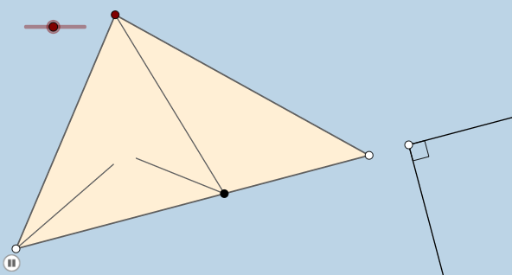
This example demonstrates geometric transformations and relationships involving the incircle of a triangle through animation. It covers core mathematical concepts such as the incircle, angles, trigonometric functions, hyperbolas, pie charts, squares, and fractal geometry. The construction utilizes commands like Segment, Rotate, Ray, Point, Circle, Line, Intersect, Angle, OrthogonalLine, Min, Dilate, CircleSector, CircleArc, Vector, Translate, and Polygon in GeoGebra. Suitable for high school students and geometry enthusiasts to explore complex geometric relationships and function graphs.
GeoGebra Commands & Parameters
Segment(B, A) → iRotate(A, (a * π / 180), B) → A'Ray(B, A') → gPoint(g) → CCircle(C, 2) → eLine(A, C) → lIntersect(e, l, 2) → ERay(C, E) → mSegment(B, C) → jAngle(C, A, B) → εRotate(C, ε / 2, A) → C'Ray(A, C') → n_1Segment(C, A) → hPoint(h) → DAngle(B, D, A) → ζRotate(B, ζ / 2, D) → B'_1Ray(D, B'_1) → a_1Intersect(n_1, a_1) → KOrthogonalLine(K, i) → cIntersect(c, i) → MCircle(K, M) → c_1Angle(C, D, B) → λRotate(C, λ / 2, D) → C'_1Ray(D, C'_1) → h_2Angle(B, C, A) → κRotate(B, κ / 2, C) → B'_2Ray(C, B'_2) → g_2Intersect(h_2, g_2) → LOrthogonalLine(L, j) → dIntersect(d, j) → NCircle(L, N) → k_2Min(Radius[c_1], Radius[k_2]) → o_1Circle(C, (0.6 * o_1)) → d_4Intersect(d_4, m, 1) → L_1Circle(L_1, 1) → e_4Intersect(e_4, m, 1) → M_1Ray(L_1, M_1) → j_3OrthogonalLine(L, h) → b_2Intersect(b_2, h) → POrthogonalLine(K, h) → a_2Intersect(h, a_2) → OAngle(A, B, A') → αRay(B, A) → fSegment(B, D) → kCircle(A, 2) → pPoint(j_3) → GOrthogonalLine(G, m) → nPoint(n) → FCircle(G, 2) → qIntersect(q, m, 2) → HIntersect(q, n) → I, JAngle(I, G, H) → βSegment(A, K) → rSegment(B, K) → sSegment(B, L) → tSegment(L, C) → bDilate(B, If[0 < u ≤ 1, 1 - u, 0], D) → B'Segment(B, B') → g_1Angle(D, A, K) → γSegment(D, K) → h_1Angle(B, D, K) → δMin(r, h_1) → vCircle(A, (0.3 * v)) → k_1Circle(D, (0.3 * v)) → p_1Intersect(k_1, h, 1) → QIntersect(k_1, r, 1) → RIntersect(p_1, h_1) → T,Intersect(p_1, k) → S,CircleSector(A, Q, R) → q_1CircleSector(D, S, T) → r_1Dilate(D, If[1 < u ≤ 2, 2 - u, 0], K) → D'Dilate(A, If[1 < u ≤ 2, 2 - u, 0], K) → A'_1Segment(A, A'_1) → i_1Segment(D, D') → j_1Segment(D, L) → l_1Segment(C, L) → m_1Min(m_1, l_1) → wCircle(C, (0.5 * w)) → s_1Intersect(s_1, j, 1) → UIntersect(s_1, m_1, 1) → VCircle(D, (0.5 * w)) → t_1Intersect(t_1, h) → W, ZIntersect(t_1, l_1) → A_1,CircleSector(D, W, A_1) → c_2CircleSector(C, U, V) → d_2Angle(C, A, C') → ηAngle(B, D, B'_1) → θSegment(A, K) → f_1Segment(D, K) → b_1Dilate(K, If[2 < u ≤ 3, 3 - u, 0], O) → K'Segment(K, K') → d_1Rotate(q_1, If[3 < u ≤ 4, ((u - 3) * γ), γ], A) → e_1Rotate(r_1, If[4 < u ≤ 5, ((u - 4) * δ), δ], D) → e_2Rotate(M, If[5 < u ≤ 7, ((u - 5) * π), (2 * π)], K) → M'CircleArc(K, M, M') → f_2Angle(B, C, B'_2) → μAngle(C, D, C'_1) → νDilate(D, If[7 < u ≤ 8, 8 - u, 0], L) → D'_1Dilate(C, If[7 < u ≤ 8, 8 - u, 0], L) → C'_2Segment(D, D'_1) → i_2Segment(C, C'_2) → j_2Dilate(L, If[8 < u ≤ 9, 9 - u, 0], P) → L'Segment(L, L') → l_2Rotate(c_2, If[9 < u ≤ 10, ((u - 9) * λ / 2), λ / 2], D) → p_2Rotate(d_2, If[10 < u ≤ 11, ((u - 10) * κ / 2), κ / 2], C) → q_2Rotate(N, If[11 < u ≤ 13, ((u - 11) * π), (2 * π)], L) → N'CircleArc(L, N, N') → r_2Dilate(B, If[13 < u ≤ 14, 14 - u, 0], K) → B'_3Segment(B, K) → m_2Segment(B, L) → n_2Min(m_2, n_2) → oCircle(K, (0.6 * o_1)) → s_2Circle(L, (0.6 * o_1)) → t_2Angle(K, O, A) → οAngle(C, P, L) → ιIntersect(s_2, m_2, 1) → B_1Intersect(s_2, i_1, 1) → C_1CircleSector(K, B_1, C_1) → c_3Intersect(t_2, j_2, 1) → D_1Intersect(t_2, n_2, 1) → E_1CircleSector(L, D_1, E_1) → d_3Segment(B, B'_3) → f_3Dilate(B, If[13 < u ≤ 14, 14 - u, 0], L) → B'_4Segment(B, B'_4) → g_3Angle(B_1, K, C_1) → ξAngle(E_1, L, D_1) → ρRotate(B_1, If[14 < u ≤ 15, ((u - 14) * ξ), ξ], K) → F_1CircleSector(K, B_1, F_1) → e_3Rotate(E_1, If[14 < u ≤ 15, ((-(u - 14)) * ρ), (-ρ)], L) → G_1CircleSector(L, G_1, E_1) → h_3Point(n) → I_1Dilate(K, If[15.5 < u ≤ 16.5, 16.5 - u, 0], G) → K'_1Vector(K, K'_1) → u_1Translate(c_3, u_1) → k_3Line(G, i_1) → i_3Point(i_3) → H_1Angle(H_1, G, I_1) → σRotate(k_3, If[16.5 < u ≤ 17.5, ((u - 16.5) * σ), σ], G) → p_3CircleArc(K, B_1, C_1) → q_3Circle(G, (0.6 * o_1)) → r_3Intersect(r_3, n, 2) → K_1Circle(K_1, (0.6 * o_1)) → s_3Intersect(s_3, n, 2) → J_1Dilate(L, If[17.5 < u ≤ 18.5, 18.5 - u, 0], J_1) → L'_1Vector(L, L'_1) → v_1Translate(d_3, v_1) → t_3CircleArc(L, D_1, E_1) → c_4Ray(C, L_1) → l_3Line(J_1, j_2) → m_3Rotate(B, ρ, K) → B'_5Rotate(B'_3, ρ, K) → N_1Rotate(B, σ, K) → B'_6Rotate(B'_3, σ, K) → O_1Segment(B'_6, O_1) → n_3Line(J_1, n_3) → a_3Point(a_3) → P_1Line(J_1, g_3) → b_3Point(b_3) → Q_1Angle(Q_1, J_1, P_1) → τRotate(t_3, If[18.5 < u ≤ 19.5, ((u - 18.5) * τ), τ], J_1) → f_4Dilate(J_1, If[19.5 < u ≤ 20.5, 20.5 - u, 0], G) → R_1Vector(J_1, R_1) → w_1Translate(f_4, w_1) → g_4Point(n) → S_1Ray(G, S_1) → h_4Line(C, G) → i_4Point(i_4) → T_1Ray(G, T_1) → j_4Polygon(A, C, B) → poly1, b_4, a_4, c_5Point(j_4) → U_1Point(h_4) → V_1Angle(V_1, G, U_1) → υ
AI Drawing Prompt Reference
Draw a triangle with its incircle, showing geometric transformations and trigonometric relationships. Demonstrate the angle relationships between the incircle and the triangle's vertices through animation, including rotations and translations. Include elements like the incircle, angles, trigonometric curves, hyperbolas, pie charts, squares, and fractal geometry. Start with the triangle and incircle, then perform rotations and translations to create new points and lines, forming a complex geometric pattern.
The prompt above was compiled from the original drawing commands and is for reference only.