
Angles Related to Parallel Lines (Summary)
Loading the math board and drawing, please wait…
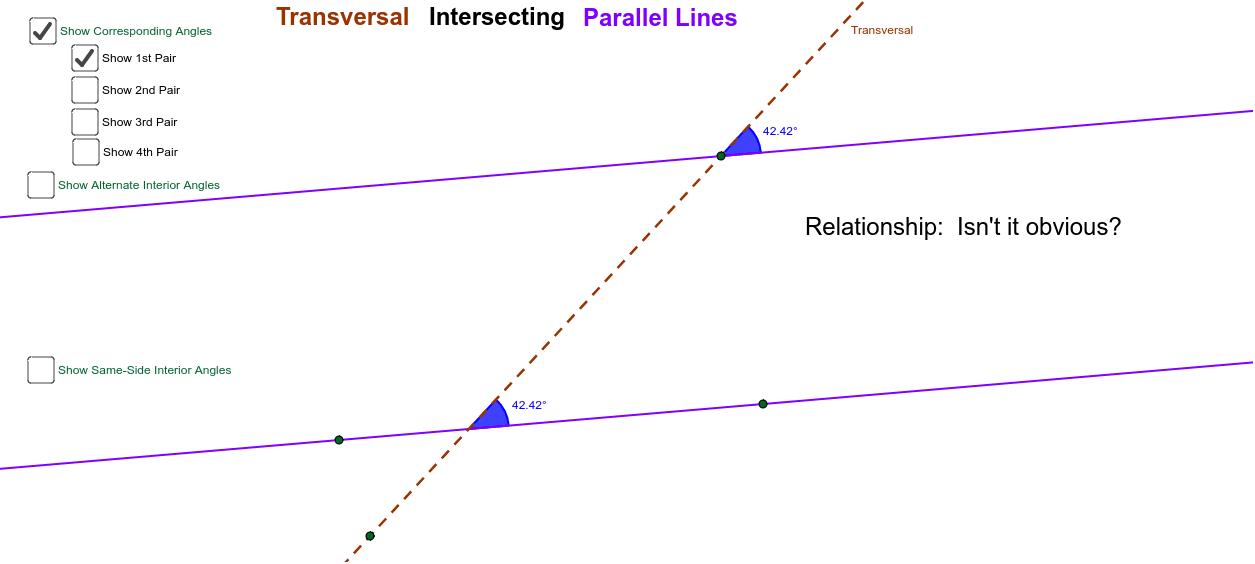
This example demonstrates the relationships between angles formed by parallel lines, dynamically illustrating concepts like alternate interior angles, corresponding angles, and consecutive interior angles. Key math concepts include properties of parallel lines, angle relationships (congruence and supplementary), and triangle angle sum theorem. GeoGebra commands used in construction are Line, Intersect, Angle, Point, Rotate, Circle, and Vector. Suitable for middle school and above students to understand parallel line geometry and angle applications.
GeoGebra Commands & Parameters
Line(A, B) → aLine(E, F) → cIntersect(a, c) → KAngle(A, K, F) → ηAngle(F, K, B) → θLine(E, a) → bAngle(B, K, E) → αAngle(E, K, A) → βPoint(c) → CPoint(b) → GPoint(b) → HAngle(H, E, C) → γAngle(C, E, G) → δAngle(G, E, K) → εAngle(K, E, H) → ζAngle(K, E, H) → ιAngle(G, E, K) → κAngle(B, K, E) → λAngle(E, K, A) → μAngle(H, E, C) → νAngle(C, E, G) → ξAngle(A, K, F) → οAngle(F, K, B) → ρAngle(H, E, C) → σAngle(C, E, G) → τAngle(G, E, K) → υAngle(K, E, H) → ϕAngle(B, K, E) → χAngle(E, K, A) → ψAngle(A, K, F) → ωAngle(F, K, B) → α_1Line(D, I) → a_1Point(a_1) → JRotate(I, ϕ, J) → I'Angle(I, J, I') → β_1Rotate(I', χ, J) → I''Angle(I', J, I'') → γ_1Circle(J, 2) → c_1Intersect(c_1, a_1, 1) → MIntersect(c_1, a_1, 2) → NVector(J, N) → uVector(J, M) → vLine(O, P) → b_1Point(b_1) → QRotate(P, ϕ, Q) → P'Angle(P, Q, P') → δ_1Rotate(P', χ, Q) → P''Angle(P', Q, P'') → ε_1Circle(Q, 2) → d_1Intersect(d_1, b_1, 1) → RIntersect(d_1, b_1, 2) → SVector(Q, S) → wVector(Q, R) → u_1