
Angles in the Coordinate Plane: Dynamic Terminal Side
Loading the math board and drawing, please wait…
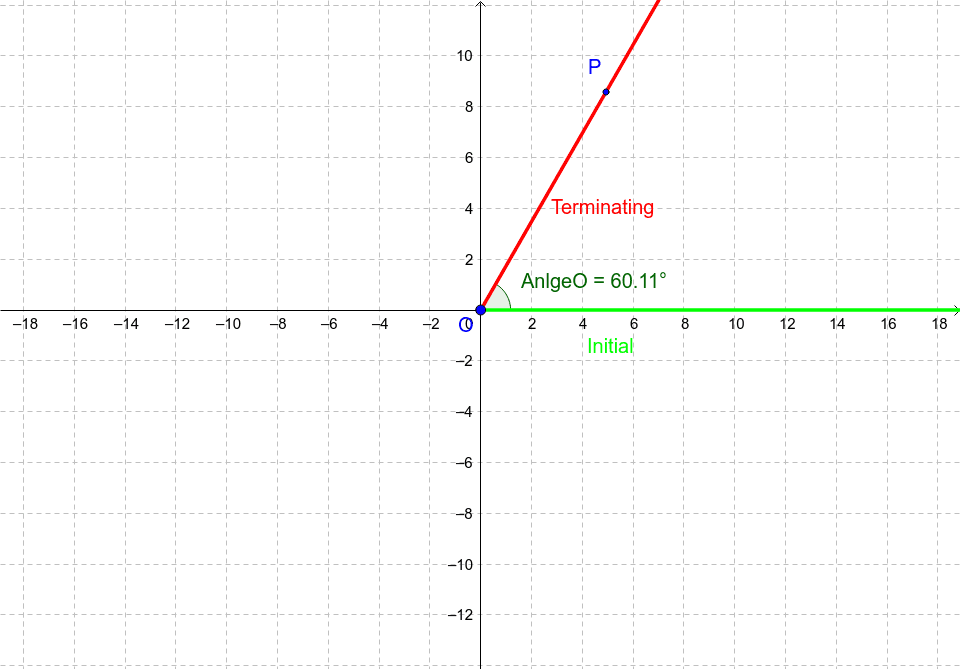
This example demonstrates how an angle is formed and measured in the Cartesian coordinate plane by dragging a movable point P. The core mathematical concepts include the standard position of an angle, its initial side, terminal side, and how the angle magnitude changes as P moves. Construction details: using GeoGebra commands Ray and Angle, with objects O (origin), A (fixed point), Initial (ray), P (movable point), Terminating (ray), and AnlgeO (the angle object). Suitable for middle or high school students learning trigonometry, general angle definitions, and coordinate geometry. It provides an interactive visual for understanding positive/negative angles and quadrant relationships.
GeoGebra Commands & Parameters
Ray(O, A) → InitialRay(O, P) → TerminatingAngle(Initial, Terminating) → AnlgeO
AI Drawing Prompt Reference
In the Cartesian coordinate plane, show an angle formed by a fixed ray as the initial side and a moving ray determined by a draggable point P as the terminal side, with the origin as the vertex. Demonstrate how the angle's magnitude changes as P moves, and illustrate the relationships among the initial side, terminal side, and angle in different quadrants to understand positive/negative angles and quadrant relationships.
The prompt above was compiled from the original drawing commands and is for reference only.