
Angles in Parallel Lines by Jonathan Robinson
Loading the math board and drawing, please wait…
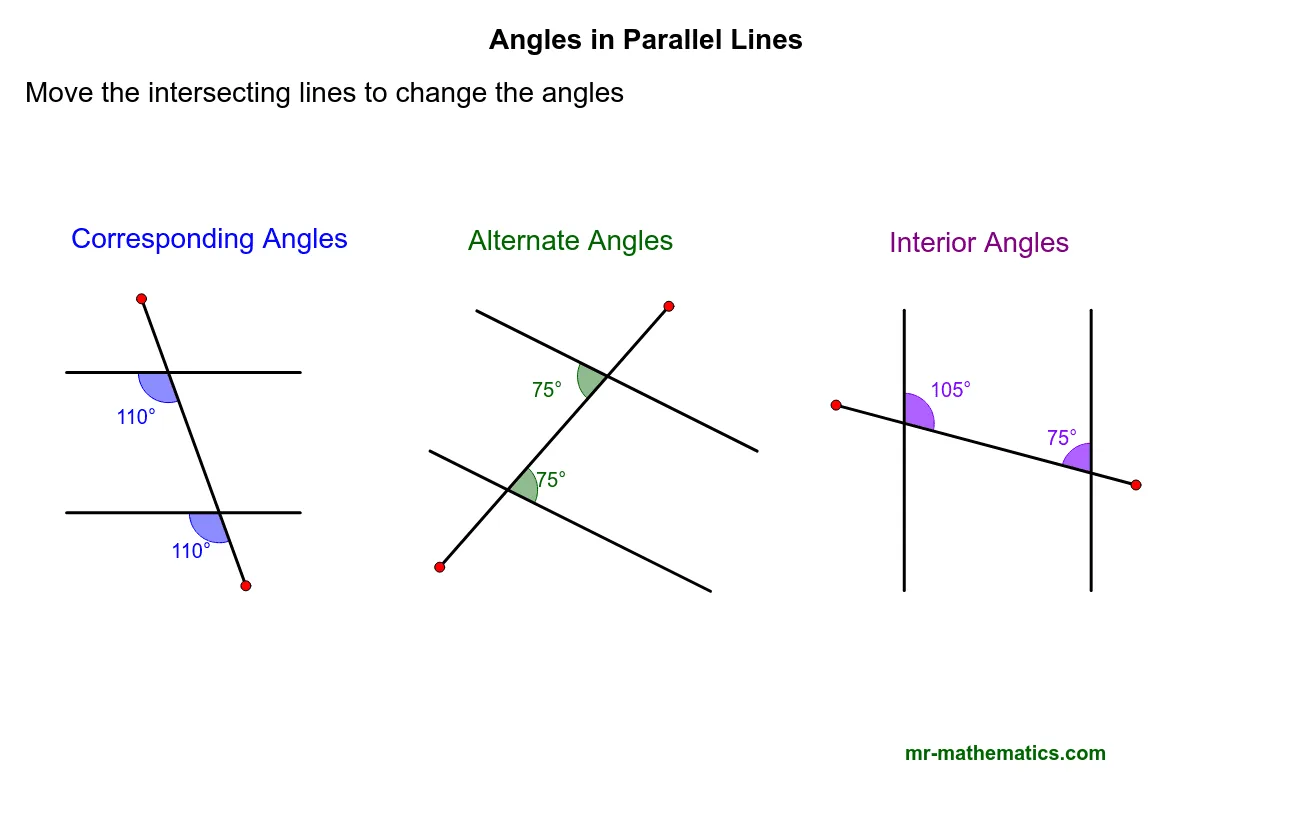
This example provides an interactive demonstration of angle relationships in parallel lines. It covers core math concepts such as corresponding angles, alternate interior angles, and consecutive interior angles. The construction uses commands like Segment, Intersect, Angle, and Point in GeoGebra. Suitable for middle school and above students to learn and understand geometric properties of parallel lines, or for classroom presentations.
GeoGebra Commands & Parameters
Segment(A, B) → aSegment(C, D) → bSegment(E, F) → cIntersect(b, c) → GIntersect(a, c) → HAngle(b, c) → αSegment(I_1, J_1) → d_1Segment(K_1, L_1) → e_1Segment(M_1, N_1) → f_1Intersect(d_1, f_1) → O_1Intersect(e_1, f_1) → P_1Point(b) → UIntersect(b, c) → VPoint(a) → WPoint(a) → A_1Point(b) → B_1Point(d_1) → C_1Point(d_1) → D_1Point(d_1) → E_1Point(e_1) → F_1Intersect(e_1, f_1) → G_1Point(e_1) → H_1Intersect(a, c) → ZAngle(A_1, Z, F) → βIntersect(d_1, f_1) → W_1Point(d_1) → Z_1Point(d_1) → A_2Point(e_1) → B_2Intersect(e_1, f_1) → C_2Point(e_1) → D_2Intersect(b, c) → E_2Intersect(a, c) → F_2Intersect(e_1, f_1) → G_2Point(b) → K_2Point(a) → L_2Point(b) → M_2Point(a) → N_2Point(d_1) → O_2Point(e_1) → P_2Point(e_1) → Q_2Point(d_1) → R_2Intersect(d_1, f_1) → H_2Angle(O_2, H_2, G_2) → γAngle(Q_2, G_2, H_2) → δSegment(M_3, N_3) → d_2Segment(O_3, P_3) → e_2Segment(Q_1, R_1) → f_2Intersect(d_2, f_2) → S_2Intersect(e_2, f_2) → T_1Intersect(d_2, f_2) → Q_3Point(d_2) → R_3Intersect(e_2, f_2) → S_3Point(e_2) → T_2Point(e_2) → U_1Point(d_2) → V_2Intersect(d_2, f_2) → I_2Intersect(e_2, f_2) → J_2Point(d_2) → S_1Point(d_2) → T_3Point(e_2) → U_2Point(e_2) → V_1Angle(J_2, I_2, S_1) → η_1Angle(V_1, J_2, I_2) → ε_1
AI Drawing Prompt Reference
Draw two parallel lines and mark three points on each line. Connect these points to form three angles, labeling one of them. Then, draw two lines intersecting the parallel lines, creating three new angles, and label them. Finally, connect the points on the parallel lines to the intersection points, forming several triangles and labeling their vertices.
The prompt above was compiled from the original drawing commands and is for reference only.