
Interior and Exterior Angles in Regular Polygons by Jonathan Robinson
Loading the math board and drawing, please wait…
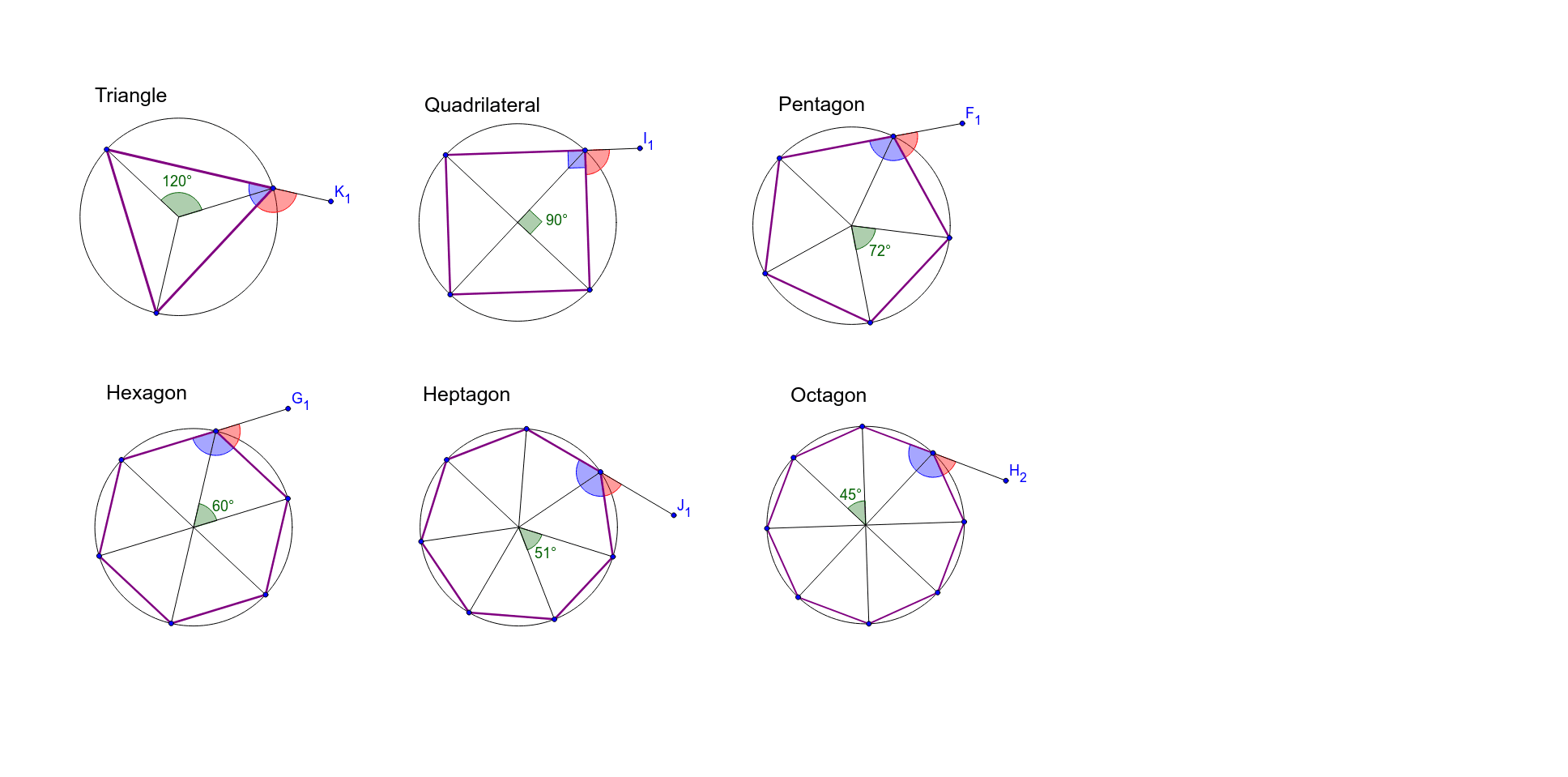
This example demonstrates the relationship between interior and exterior angles in regular polygons. A regular polygon is a polygon with equal sides and angles, and the sum of an interior angle and its corresponding exterior angle is 180 degrees. The construction involves using GeoGebra commands like Circle, Segment, Point, Rotate, and Angle to create the polygon. It is suitable for middle school students learning geometry or for educational demonstrations.
GeoGebra Commands & Parameters
Circle(M_7, N_7) → r_7Segment(M_7, N_7) → s_6Segment(M_7, N_7) → a_6Point(a_6) → C_3Rotate(N_7, 240*°, C_3) → E_1Angle(E_1, C_3, N_7) → α_1Rotate(E_1, 240*°, C_3) → E'_1Segment(E_1, C_3) → f_4Segment(C_3, E'_1) → g_4Segment(E_1, N_7) → h_4Segment(E'_1, E_1) → i_4Segment(E'_1, N_7) → j_4Angle(N_7, E_1, E'_1) → θ_2Angle(E'_1, E_1, K_1) → ο_1Segment(E_1, K_1) → n_4Circle(M_{10}, N_8) → r_8Segment(M_{10}, N_8) → s_2Rotate(N_8, 300*°, M_{10}) → N'_3Segment(M_{10}, N'_3) → a_7Rotate(N'_3, 300*°, M_{10}) → O_2Angle(O_2, M_{10}, N'_3) → γ_2Segment(M_{10}, O_2) → b_5Segment(O_2, N'_3) → g_5Segment(N'_3, N_8) → h_5Angle(N_8, N'_3, O_2) → ε_1Circle(M_{15}, N_3) → r_3Segment(M_{15}, N_3) → s_3Segment(M_{15}, N_3) → a_1Rotate(N_3, 288*°, M_{15}) → A_2Segment(M_{15}, A_2) → b_1Rotate(A_2, 288*°, M_{15}) → A'_2Segment(M_{15}, A'_2) → c_1Rotate(A'_2, 288*°, M_{15}) → A''_2Angle(A''_2, M_{15}, A'_2) → θ_3Segment(M_{15}, A''_2) → d_1Rotate(A''_2, 288*°, M_{15}) → A'''_2Segment(M_{15}, A'''_2) → e_1Segment(A'''_2, N_3) → f_1Segment(N_3, A_2) → g_1Segment(A_2, A'_2) → h_1Segment(A'_2, A''_2) → i_1Segment(A''_2, A'''_2) → j_1Angle(N_3, A_2, A'_2) → γ_1Angle(A'_2, A_2, F_1) → κ_1Segment(A_2, F_1) → k_1Circle(M_{16}, N_1) → r_1Segment(M_{16}, N_1) → s_9Segment(M_{16}, N_1) → a_3Point(a_3) → C_1Rotate(N_1, 270*°, C_1) → D_1Rotate(D_1, 270*°, C_1) → D'_1Angle(D'_1, C_1, D_1) → β_1Rotate(D'_1, 270*°, C_1) → D''_1Segment(D_1, C_1) → p_1Segment(D'_1, C_1) → q_1Segment(D''_1, C_1) → r_9Segment(D'_1, D_1) → s_1Segment(D_1, N_1) → t_2Segment(N_1, D''_1) → d_2Segment(D''_1, D'_1) → e_2Angle(N_1, D_1, D'_1) → ι_1Angle(D'_1, D_1, I_1) → ν_1Segment(D_1, I_1) → q_2Circle(M_{17}, N_2) → r_2Segment(M_{17}, N_2) → s_5Rotate(N_2, 60*°, M_{17}) → N'_1Segment(N'_1, M_{17}) → t_1Rotate(N_2, 300*°, M_{17}) → N'_2Segment(M_{17}, N'_2) → a_2Rotate(N'_2, 300*°, M_{17}) → O_1Angle(O_1, M_{17}, N'_2) → γ_3Segment(M_{17}, O_1) → b_2Rotate(O_1, 300*°, M_{17}) → O'_1Segment(M_{17}, O'_1) → c_2Rotate(O'_1, 300*°, M_{17}) → O''_1Segment(O''_1, M_{17}) → d_3Segment(O''_1, O'_1) → e_3Segment(O'_1, O_1) → f_2Segment(O_1, N'_2) → g_2Segment(N'_2, N_2) → h_2Segment(N_2, N'_1) → i_2Segment(N'_1, O''_1) → j_2Angle(N_2, N'_2, O_1) → ε_2Angle(O_1, N'_2, G_1) → λ_1Segment(N'_2, G_1) → l_1Circle(M_{18}, N_4) → r_4Segment(M_{18}, N_4) → s_4Segment(M_{18}, N_4) → a_4Rotate(N_4, 308.57*°, M_{18}) → A_1Rotate(A_1, 308.57*°, M_{18}) → A'_1Rotate(A'_1, 308.57*°, M_{18}) → A''_1Rotate(A''_1, 308.57*°, M_{18}) → A'''_1Angle(A'''_1, M_{18}, A''_1) → δ_1Rotate(A'''_1, 308.57*°, M_{18}) → B_1Rotate(B_1, 308.57*°, M_{18}) → B'_1Segment(M_{18}, A_1) → b_3Segment(M_{18}, A'_1) → c_3Segment(M_{18}, A''_1) → d_4Segment(M_{18}, A'''_1) → e_4Segment(M_{18}, B_1) → f_3Segment(M_{18}, B'_1) → g_3Segment(A_1, A'_1) → h_3Segment(A'_1, A''_1) → i_3Segment(A''_1, A'''_1) → j_3Segment(A'''_1, B_1) → k_2Segment(B_1, B'_1) → l_2Segment(B'_1, N_4) → m_1Segment(N_4, A_1) → n_1Angle(A_1, A'_1, A''_1) → η_1Angle(A''_1, A'_1, J_1) → ξ_1Segment(A'_1, J_1) → p_2Circle(M_{19}, N_5) → r_5Segment(M_{19}, N_5) → s_8Segment(M_{19}, N_5) → k_3Rotate(N_5, 315*°, M_{19}) → B_3Angle(B_3, M_{19}, N_5) → κ_3Segment(M_{19}, B_3) → l_3Rotate(B_3, 315*°, M_{19}) → B'_3Segment(B'_3, M_{19}) → m_2Rotate(B'_3, 315*°, M_{19}) → B''_1Rotate(B''_1, 315*°, M_{19}) → B'''_1Rotate(B'''_1, 315*°, M_{19}) → C_4Rotate(C_4, 315*°, M_{19}) → C'_1Rotate(C'_1, 315*°, M_{19}) → C''_1Segment(B''_1, M_{19}) → n_2Segment(M_{19}, C''_1) → p_3Segment(C'_1, M_{19}) → q_3Segment(C_4, M_{19}) → k_6Segment(B'''_1, M_{19}) → l_6Segment(B''_1, B'''_1) → m_3Segment(B'''_1, C_4) → n_6Segment(C_4, C'_1) → p_6Segment(C'_1, C''_1) → q_6Segment(C''_1, N_5) → t_4Segment(N_5, B_3) → a_8Segment(B_3, B'_3) → b_6Segment(B'_3, B''_1) → c_5Angle(B_3, B'_3, B''_1) → ζ_2Angle(B''_1, B'_3, H_2) → μ_2Segment(B'_3, H_2) → m_7
AI Drawing Prompt Reference
Draw a regular polygon to demonstrate the relationship between its interior and exterior angles. Start by drawing a circle, then select a point on the circle as the starting point. Use rotation and line segments to construct the sides and vertices of the polygon. Next, draw the interior and exterior angles at each vertex and label their degrees. Finally, connect these points and segments to form the complete structure of the regular polygon.
The prompt above was compiled from the original drawing commands and is for reference only.