
Angles in a Parallelogram
Loading the math board and drawing, please wait…
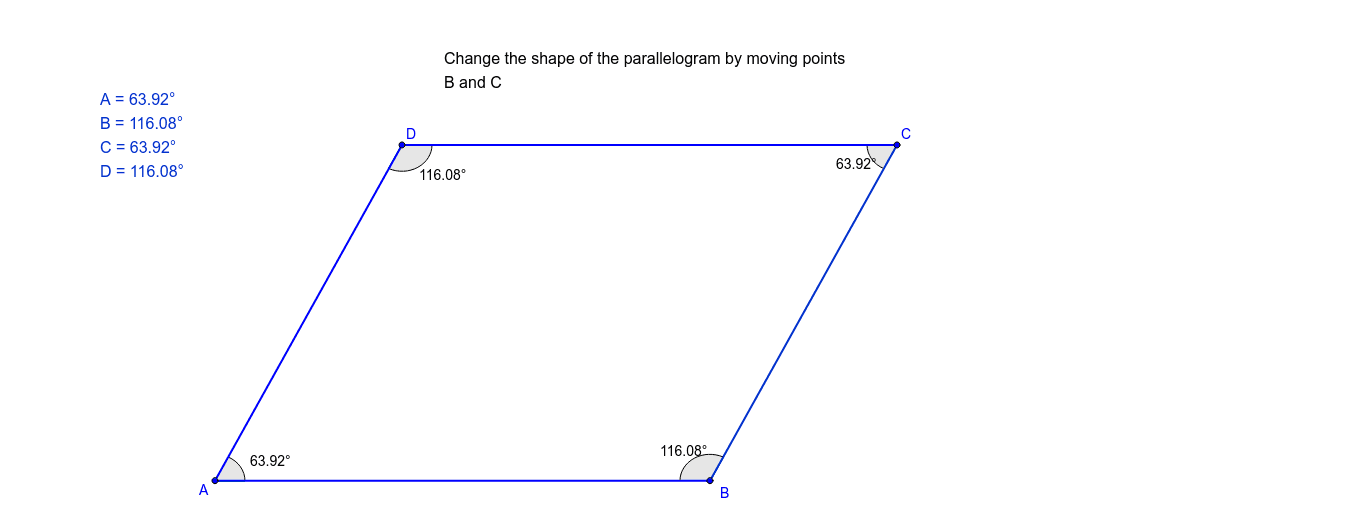
This example demonstrates the relationships and properties of angles within a parallelogram. Key math concepts include the definition of a parallelogram, the sum of interior angles theorem, properties of diagonals, and applications of trigonometric functions. Construction highlights GeoGebra commands like Point, Segment, Intersect, Line, and Angle measurement. Suitable for middle school and above students to visually understand geometric properties and angle calculations.
GeoGebra Commands & Parameters
Point(xAxis) → BSegment(B, C) → cIntersect(xAxis, yAxis) → ASegment(A, B) → dLine(C, d) → eLine(A, c) → fIntersect(e, f) → DSegment(D, C) → gSegment(A, D) → hAngle(B, A, D) → εAngle(C, B, A) → ζAngle(D, C, B) → ηAngle(A, D, C) → θ
AI Drawing Prompt Reference
Draw a parallelogram by first creating two parallel lines and finding their intersection point. Connect this point to the endpoints of the parallel lines to form the parallelogram. Then measure and label the angles at each vertex to demonstrate the properties of the interior angles and the intersection of diagonals.
The prompt above was compiled from the original drawing commands and is for reference only.