
Angles Created by Parallel Lines and a Transversal
Loading the math board and drawing, please wait…
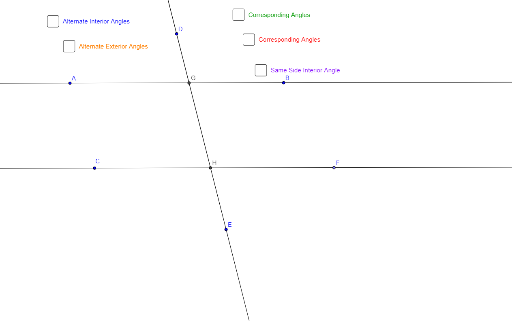
This example demonstrates the various types of angles formed when two parallel lines are intersected by a transversal, covering concepts like alternate interior angles, corresponding angles, and consecutive interior angles. It is constructed using GeoGebra commands such as Line, Point, Intersect, and Angle, making it suitable for middle school and high school students learning geometry.
GeoGebra Commands & Parameters
Line(A, B) → aLine(C, a) → bLine(D, E) → cPoint(b) → FIntersect(a, c) → GIntersect(b, c) → HAngle(B, G, D) → αAngle(F, H, G) → βAngle(E, H, F) → γAngle(H, G, B) → δAngle(A, G, H) → εAngle(G, H, C) → ζAngle(H, G, B) → ηAngle(G, H, C) → θAngle(B, G, D) → ιAngle(C, H, E) → κ
AI Drawing Prompt Reference
Draw two parallel lines and a transversal line intersecting them. Label all the angles formed, including corresponding, alternate interior, and consecutive interior angles. Use different colors or symbols to distinguish these angles and label them as α, β, γ, etc. Start by drawing the parallel and transversal lines, then find their intersection points, measure and draw all the angles, and finally label the angles with their names and types.
The prompt above was compiled from the original drawing commands and is for reference only.