
Angle Properties of Polygons by user3597
Loading the math board and drawing, please wait…
In collections
S2 Angles in Triangles and Polygons
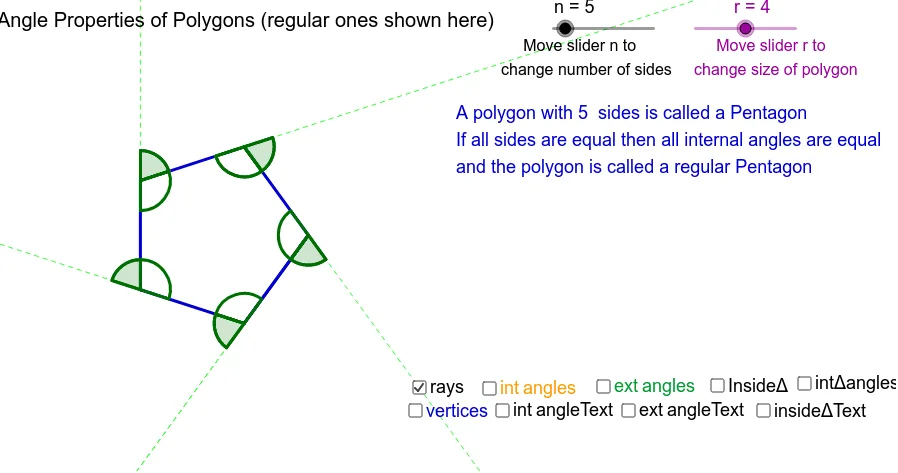
This example demonstrates the angle properties of polygons, including the sum of interior and exterior angles. Key math concepts involved are the polygon angle sum formula, exterior angle theorem, and angle calculations. Construction highlights the use of GeoGebra commands like Intersect, Segment, Ray, Sequence, and Angle, along with objects such as α, n, A, P, a, c, B, C, D, d, b, e, r, EdgesofPolygon, RaysofEdges, ExternalAnglesPolygon, ExternalAngles, γ, δ, η, ε, ζ, θ, ι, κ, λ, μ, ν, ξ, ο, ρ, σ, τ, υ, φ, χ, PolygonNamelist3to20, β, VerticesPolygon, and InternalAnglesPolygon. Suitable for high school students to learn and understand polygonal geometric properties, ideal for classroom instruction or self-directed exploration.
GeoGebra Commands & Parameters
Intersect(xAxis, yAxis) → ASegment(A, P) → aSegment((3.9999999999999933; 15.0*°), (4.0; 30.0*°)) → cSegment(C, D) → dRay(C, B) → bRay(B, C) → eSequence(Segment[(r; i°), (r; (i - 360.0 / n)°)], i, 0.0, 360.0, 360.0 / n) → EdgesofPolygonSequence(Ray[(r; i°), (r; (i - 360.0 / n)°)], i, 0.0, 360.0, 360.0 / n) → RaysofEdgesSequence(Angle[Element[RaysofEdges, i], Element[RaysofEdges, i + 1.0]], i, 1.0, n, 1.0) → ExternalAnglesPolygonSequence(Angle[Element[RaysofEdges, i], Element[RaysofEdges, i + 1.0]], i, 1.0, n, 1.0) → ExternalAnglesAngle(Element[RaysofEdges, 1.0], Element[RaysofEdges, 2.0]) → γAngle(Element[RaysofEdges, 2.0], Element[RaysofEdges, 3.0]) → δAngle(Element[RaysofEdges, 5.0], Element[RaysofEdges, 6.0]) → ηAngle(Element[RaysofEdges, 3.0], Element[RaysofEdges, 4.0]) → εAngle(Element[RaysofEdges, 4.0], Element[RaysofEdges, 5.0]) → ζAngle(Element[RaysofEdges, 6.0], Element[RaysofEdges, 7.0]) → θAngle(Element[RaysofEdges, 7.0], Element[RaysofEdges, 8.0]) → ιAngle(Element[RaysofEdges, 8.0], Element[RaysofEdges, 9.0]) → κAngle(Element[RaysofEdges, 9.0], Element[RaysofEdges, 10.0]) → λAngle(Element[RaysofEdges, 10.0], Element[RaysofEdges, 11.0]) → μAngle(Element[RaysofEdges, 11.0], Element[RaysofEdges, 12.0]) → νAngle(Element[RaysofEdges, 12.0], Element[RaysofEdges, 13.0]) → ξAngle(Element[RaysofEdges, 13.0], Element[RaysofEdges, 14.0]) → οAngle(Element[RaysofEdges, 14.0], Element[RaysofEdges, 15.0]) → ρAngle(Element[RaysofEdges, 15.0], Element[RaysofEdges, 16.0]) → σAngle(Element[RaysofEdges, 16.0], Element[RaysofEdges, 17.0]) → τAngle(Element[RaysofEdges, 17.0], Element[RaysofEdges, 18.0]) → υAngle(Element[RaysofEdges, 18.0], Element[RaysofEdges, 19.0]) → φAngle(Element[RaysofEdges, 19.0], Element[RaysofEdges, 20.0]) → χAngle(Element[RaysofEdges, 20.0], Element[RaysofEdges, 1.0]) → βSequence((r; i°), i, 0.0, 360.0, 360.0 / n) → VerticesPolygonSequence(Angle[(r; (i + 360.0 * 2.0 / n)°), (r; (i + 360.0 / n)°), (r; i°)], i, 0.0, 360.0, 360.0 / n) → InternalAnglesPolygonAngle(Element[VerticesPolygon, 3.0], Element[VerticesPolygon, 2.0], Element[VerticesPolygon, 1.0]) → α_1Angle(Element[VerticesPolygon, 4.0], Element[VerticesPolygon, 3.0], Element[VerticesPolygon, 2.0]) → β_2Angle(Element[VerticesPolygon, 5.0], Element[VerticesPolygon, 4.0], Element[VerticesPolygon, 3.0]) → ψAngle(Element[VerticesPolygon, 6.0], Element[VerticesPolygon, 5.0], Element[VerticesPolygon, 4.0]) → ωAngle(Element[VerticesPolygon, 7.0], Element[VerticesPolygon, 6.0], Element[VerticesPolygon, 5.0]) → β_1Angle(Element[VerticesPolygon, 8.0], Element[VerticesPolygon, 7.0], Element[VerticesPolygon, 6.0]) → γ_1Angle(Element[VerticesPolygon, 9.0], Element[VerticesPolygon, 8.0], Element[VerticesPolygon, 7.0]) → δ_1Angle(Element[VerticesPolygon, 10.0], Element[VerticesPolygon, 9.0], Element[VerticesPolygon, 8.0]) → ε_1Angle(Element[VerticesPolygon, 11.0], Element[VerticesPolygon, 10.0], Element[VerticesPolygon, 9.0]) → ζ_4Angle(Element[VerticesPolygon, 13.0], Element[VerticesPolygon, 12.0], Element[VerticesPolygon, 11.0]) → η_1Angle(Element[VerticesPolygon, 12.0], Element[VerticesPolygon, 11.0], Element[VerticesPolygon, 10.0]) → θ_1Angle(Element[VerticesPolygon, 2.0], Element[VerticesPolygon, 1.0], Element[VerticesPolygon, n]) → ι_1Angle(Element[VerticesPolygon, 14.0], Element[VerticesPolygon, 13.0], Element[VerticesPolygon, 12.0]) → κ_1Angle(Element[VerticesPolygon, 15.0], Element[VerticesPolygon, 14.0], Element[VerticesPolygon, 13.0]) → λ_1Angle(Element[VerticesPolygon, 16.0], Element[VerticesPolygon, 15.0], Element[VerticesPolygon, 14.0]) → μ_1Angle(Element[VerticesPolygon, 17.0], Element[VerticesPolygon, 16.0], Element[VerticesPolygon, 15.0]) → ν_1Angle(Element[VerticesPolygon, 18.0], Element[VerticesPolygon, 17.0], Element[VerticesPolygon, 16.0]) → ξ_1Angle(Element[VerticesPolygon, 19.0], Element[VerticesPolygon, 18.0], Element[VerticesPolygon, 17.0]) → ο_1Angle(Element[VerticesPolygon, 20.0], Element[VerticesPolygon, 19.0], Element[VerticesPolygon, 18.0]) → ρ_1Angle(Element[VerticesPolygon, 1.0], Element[VerticesPolygon, 20.0], Element[VerticesPolygon, 19.0]) → σ_1Sequence(Segment[(r; 0.0°), (r; (i + 360.0 / n)°)], i, 360.0 / n, 360.0, 360.0 / n) → InsideTrianglesAngle(Element[VerticesPolygon, 2.0], Element[VerticesPolygon, 1.0], Element[VerticesPolygon, 3.0]) → Δu_2Angle(Element[VerticesPolygon, 3.0], Element[VerticesPolygon, 2.0], Element[VerticesPolygon, 1.0]) → ΔuAngle(Element[VerticesPolygon, 1.0], Element[VerticesPolygon, n], Element[VerticesPolygon, n - 1.0]) → Δφ_1Angle(Element[VerticesPolygon, 3.0], Element[VerticesPolygon, 1.0], Element[VerticesPolygon, 4.0]) → Δχ_1Angle(Element[VerticesPolygon, 4.0], Element[VerticesPolygon, 1.0], Element[VerticesPolygon, 5.0]) → Δψ_1Angle(Element[VerticesPolygon, 5.0], Element[VerticesPolygon, 1.0], Element[VerticesPolygon, 6.0]) → Δω_1Angle(Element[VerticesPolygon, 6.0], Element[VerticesPolygon, 1.0], Element[VerticesPolygon, 7.0]) → Δα_2Angle(Element[VerticesPolygon, 7.0], Element[VerticesPolygon, 1.0], Element[VerticesPolygon, 8.0]) → Δγ_2Angle(Element[VerticesPolygon, 8.0], Element[VerticesPolygon, 1.0], Element[VerticesPolygon, 9.0]) → Δδ_2Angle(Element[VerticesPolygon, 9.0], Element[VerticesPolygon, 1.0], Element[VerticesPolygon, 10.0]) → Δε_2Angle(Element[VerticesPolygon, 10.0], Element[VerticesPolygon, 1.0], Element[VerticesPolygon, 11.0]) → Δζ_2Angle(Element[VerticesPolygon, 11.0], Element[VerticesPolygon, 1.0], Element[VerticesPolygon, 12.0]) → Δη_2Angle(Element[VerticesPolygon, 12.0], Element[VerticesPolygon, 1.0], Element[VerticesPolygon, 13.0]) → Δθ_2Angle(Element[VerticesPolygon, 13.0], Element[VerticesPolygon, 1.0], Element[VerticesPolygon, 14.0]) → Δι_2Angle(Element[VerticesPolygon, 14.0], Element[VerticesPolygon, 1.0], Element[VerticesPolygon, 15.0]) → Δκ_2Angle(Element[VerticesPolygon, 15.0], Element[VerticesPolygon, 1.0], Element[VerticesPolygon, 16.0]) → Δλ_2Angle(Element[VerticesPolygon, 16.0], Element[VerticesPolygon, 1.0], Element[VerticesPolygon, 17.0]) → Δμ_2Angle(Element[VerticesPolygon, 17.0], Element[VerticesPolygon, 1.0], Element[VerticesPolygon, 18.0]) → Δν_2Angle(Element[VerticesPolygon, 18.0], Element[VerticesPolygon, 1.0], Element[VerticesPolygon, 19.0]) → Δξ_2Angle(Element[VerticesPolygon, 19.0], Element[VerticesPolygon, 1.0], Element[VerticesPolygon, 20.0]) → Δο_2Angle(Element[VerticesPolygon, 1.0], Element[VerticesPolygon, 3.0], Element[VerticesPolygon, 2.0]) → Δu_3Angle(Element[VerticesPolygon, 4.0], Element[VerticesPolygon, 3.0], Element[VerticesPolygon, 1.0]) → Δσ_2Angle(Element[VerticesPolygon, 1.0], Element[VerticesPolygon, 4.0], Element[VerticesPolygon, 3.0]) → Δτ_2Angle(Element[VerticesPolygon, 1.0], Element[VerticesPolygon, 5.0], Element[VerticesPolygon, 4.0]) → Δυ_2Angle(Element[VerticesPolygon, 1.0], Element[VerticesPolygon, 6.0], Element[VerticesPolygon, 5.0]) → Δφ_2Angle(Element[VerticesPolygon, 1.0], Element[VerticesPolygon, 7.0], Element[VerticesPolygon, 6.0]) → Δχ_2Angle(Element[VerticesPolygon, 1.0], Element[VerticesPolygon, 8.0], Element[VerticesPolygon, 7.0]) → Δψ_2Angle(Element[VerticesPolygon, 1.0], Element[VerticesPolygon, 9.0], Element[VerticesPolygon, 8.0]) → Δω_2Angle(Element[VerticesPolygon, 1.0], Element[VerticesPolygon, 10.0], Element[VerticesPolygon, 9.0]) → Δα_3Angle(Element[VerticesPolygon, 1.0], Element[VerticesPolygon, 11.0], Element[VerticesPolygon, 10.0]) → Δβ_3Angle(Element[VerticesPolygon, 1.0], Element[VerticesPolygon, 12.0], Element[VerticesPolygon, 11.0]) → Δγ_3Angle(Element[VerticesPolygon, 1.0], Element[VerticesPolygon, 13.0], Element[VerticesPolygon, 12.0]) → Δδ_3Angle(Element[VerticesPolygon, 1.0], Element[VerticesPolygon, 14.0], Element[VerticesPolygon, 13.0]) → Δε_3Angle(Element[VerticesPolygon, 1.0], Element[VerticesPolygon, 16.0], Element[VerticesPolygon, 15.0]) → Δη_3Angle(Element[VerticesPolygon, 1.0], Element[VerticesPolygon, 17.0], Element[VerticesPolygon, 16.0]) → Δθ_3Angle(Element[VerticesPolygon, 1.0], Element[VerticesPolygon, 18.0], Element[VerticesPolygon, 17.0]) → Δι_3Angle(Element[VerticesPolygon, 1.0], Element[VerticesPolygon, 19.0], Element[VerticesPolygon, 18.0]) → Δκ_3Angle(Element[VerticesPolygon, 1.0], Element[VerticesPolygon, 20.0], Element[VerticesPolygon, 19.0]) → Δλ_3Angle(Element[VerticesPolygon, 5.0], Element[VerticesPolygon, 4.0], Element[VerticesPolygon, 1.0]) → Δμ_3Angle(Element[VerticesPolygon, 7.0], Element[VerticesPolygon, 6.0], Element[VerticesPolygon, 1.0]) → Δξ_3Angle(Element[VerticesPolygon, 8.0], Element[VerticesPolygon, 7.0], Element[VerticesPolygon, 1.0]) → Δο_3Angle(Element[VerticesPolygon, 9.0], Element[VerticesPolygon, 8.0], Element[VerticesPolygon, 1.0]) → Δρ_3Angle(Element[VerticesPolygon, 10.0], Element[VerticesPolygon, 9.0], Element[VerticesPolygon, 1.0]) → Δσ_3Angle(Element[VerticesPolygon, 11.0], Element[VerticesPolygon, 10.0], Element[VerticesPolygon, 1.0]) → Δτ_3Angle(Element[VerticesPolygon, 12.0], Element[VerticesPolygon, 11.0], Element[VerticesPolygon, 1.0]) → Δυ_3Angle(Element[VerticesPolygon, 13.0], Element[VerticesPolygon, 12.0], Element[VerticesPolygon, 1.0]) → Δφ_3Angle(Element[VerticesPolygon, 14.0], Element[VerticesPolygon, 13.0], Element[VerticesPolygon, 1.0]) → Δχ_3Angle(Element[VerticesPolygon, 15.0], Element[VerticesPolygon, 14.0], Element[VerticesPolygon, 1.0]) → Δψ_3Angle(Element[VerticesPolygon, 16.0], Element[VerticesPolygon, 15.0], Element[VerticesPolygon, 1.0]) → Δω_3Angle(Element[VerticesPolygon, 17.0], Element[VerticesPolygon, 16.0], Element[VerticesPolygon, 1.0]) → Δα_4Angle(Element[VerticesPolygon, 18.0], Element[VerticesPolygon, 17.0], Element[VerticesPolygon, 1.0]) → Δβ_4Angle(Element[VerticesPolygon, 19.0], Element[VerticesPolygon, 18.0], Element[VerticesPolygon, 1.0]) → Δγ_4Angle(Element[VerticesPolygon, 20.0], Element[VerticesPolygon, 19.0], Element[VerticesPolygon, 1.0]) → Δδ_4Angle(Element[VerticesPolygon, 7.0], Element[VerticesPolygon, 6.0], Element[VerticesPolygon, 1.0]) → Δζ_5Angle(Element[VerticesPolygon, 6.0], Element[VerticesPolygon, 5.0], Element[VerticesPolygon, 1.0]) → Δτ_1Angle(Element[VerticesPolygon, 1.0], Element[VerticesPolygon, 15.0], Element[VerticesPolygon, 14.0]) → Δζ_1
AI Drawing Prompt Reference
Draw a polygon to demonstrate the relationship between its interior and exterior angles. Start by plotting the x and y axes and finding their intersection to determine a vertex. Connect the vertices to form the polygon's sides. Then, draw rays from each vertex to create the exterior and interior angles. Use a slider to adjust the number of sides of the polygon, showing how the sum of interior angles and the properties of exterior angles change. Label key angles, such as the first exterior angle, the second exterior angle, etc., and display the formula for the sum of interior angles.
The prompt above was compiled from the original drawing commands and is for reference only.