
Angle Formed by 2 Chords
Loading the math board and drawing, please wait…
In collections
Circles (Theorems)
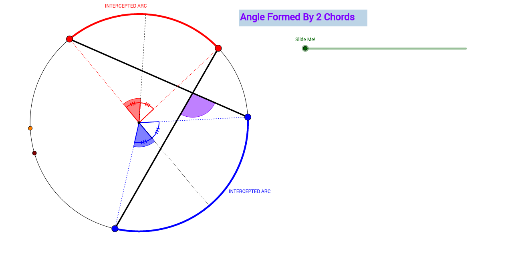
This example demonstrates the relationship between the angle formed by two intersecting chords in a circle, highlighting key concepts like the inscribed angle theorem and chord-angle relationships. It utilizes GeoGebra commands such as Vector, Circle, Point, Line, Intersect, CircleArc, AngularBisector, Segment, Translate, Angle, CircleSector, Length, Dilate, and Rotate to construct the geometric scenario. Ideal for high school students to grasp circle properties and prepare for coordinate geometry.
GeoGebra Commands & Parameters
Vector(A, S) → wCircle(A, 1.5) → tCircle(A, B) → cPoint(c) → CLine(C, A) → aIntersect(c, a, 2) → DCircleArc(A, D, C) → ePoint(e) → GPoint(e) → FAngularBisector(F, A, G) → lIntersect(e, l, 1) → JSegment(A, J) → mIntersect(t, m, 1) → NTranslate(N, w) → N'CircleArc(A, C, D) → dPoint(d) → HPoint(d) → EAngularBisector(H, A, E) → kIntersect(d, k) → K, ZSegment(A, K) → nIntersect(t, n, 1) → PTranslate(P, w) → P'Segment(G, E) → bSegment(F, H) → fIntersect(f, b) → IAngle(E, I, H) → αSegment(A, H) → gSegment(A, E) → hSegment(A, F) → iSegment(A, G) → jCircleArc(A, F, J) → pCircleArc(A, J, G) → qCircleArc(A, H, K) → rCircleArc(A, K, E) → sAngle(H, A, K) → βAngle(F, A, J) → γAngle(J, A, G) → δAngle(K, A, E) → εPoint(t) → LIntersect(t, i, 1) → MIntersect(t, g, 1) → OCircleSector(A, O, P) → d_1Intersect(t, j, 1) → QCircleSector(A, N, Q) → e_1Circle(I, 1.5) → g_1Intersect(g_1, f) → T, UIntersect(g_1, b) → V, WCircleSector(I, U, W) → h_1Length(w) → a_1Translate(M, w) → M'Angle(N', S, P') → κVector(A, I) → u_1CircleSector(A, M, N) → p_1Line(A, b) → c_1Line(A, f) → f_1Intersect(t, c_1) → R, A_1Angle(P, A, A_1) → θIntersect(t, f_1) → B_1, C_1Angle(N, A, C_1) → θ_1Dilate(A, If[0 ≤ v ≤ 1, 1 - v, 0], I) → A'Dilate(A, If[1 < v ≤ 2, 2 - v, 0], I) → A'_1Vector(A, A') → uVector(A, A'_1) → v_1Translate(e_1, u) → k_1Translate(d_1, v_1) → q_1Rotate(k_1, If[0 < v ≤ 1, (v * θ_1), θ_1], A') → r_1CircleSector(I, U, W) → s_1Rotate(q_1, If[1 < v ≤ 2, ((v - 1) * θ), θ], A'_1) → t_1
AI Drawing Prompt Reference
Draw a circle and two intersecting chords inside it, marking the angle formed by their intersection. Show the angle bisector and its intersection with the circle, connecting relevant points to form new segments and arcs. Measure and label the central and inscribed angles corresponding to the arcs, using different colors. Add a slider to dynamically demonstrate the relationship between the chords and angles, highlighting the chord angle theorem and properties of inscribed quadrilaterals.
The prompt above was compiled from the original drawing commands and is for reference only.