
Angle Bisector Theorem (Part 2): Dynamic Exploration of Equal Distances
Loading the math board and drawing, please wait…
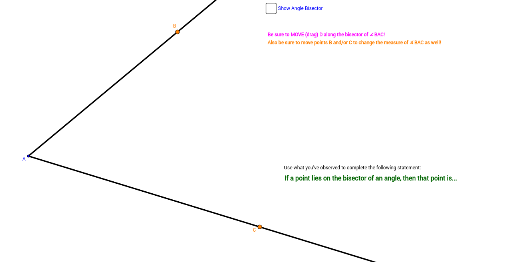
This GeoGebra applet dynamically demonstrates the converse of the angle bisector theorem: if a point lies on the bisector of an angle, then it is equidistant from the two sides of the angle. The core mathematical concepts include angle bisectors, perpendicular distance from a point to a line, and the informal verification of a geometric theorem. The construction uses commands such as Ray, AngularBisector, Point, OrthogonalLine, Intersect, and Segment to create the angle, its bisector, a movable point on the bisector, perpendiculars to the sides, and the resulting distance segments. Angle and text objects label the relevant measures. This applet is suitable for middle school or high school geometry classes, allowing students to drag the point and observe that the two distances remain equal, thereby gaining an intuitive understanding of the theorem before formal proof.
GeoGebra Commands & Parameters
Ray(A, B) → aRay(A, C) → bAngularBisector(C, A, B) → cPoint(c) → DRay(A, D) → dAngle(C, A, D) → αAngle(D, A, B) → βOrthogonalLine(D, b) → eOrthogonalLine(D, a) → fIntersect(f, a) → EIntersect(e, b) → FSegment(D, E) → gSegment(D, F) → hAngle(D, F, A) → γAngle(A, E, D) → δ