
Angle Bisector Theorem Demonstration
Loading the math board and drawing, please wait…
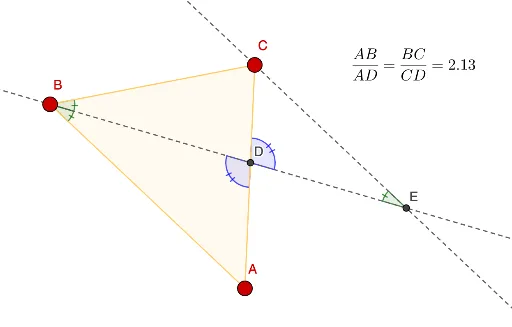
This example demonstrates the Angle Bisector Theorem in a triangle, showing that the angle bisector divides the opposite side into segments proportional to the adjacent sides. Key math concepts include angle bisectors, similar triangles, and ratios. GeoGebra commands used in construction are Polygon, AngularBisector, Intersect, Line, Angle, and Segment. Suitable for high school geometry education and understanding the geometric meaning and proof of the theorem.
GeoGebra Commands & Parameters
Polygon(B, A, C) → t1, b, c, aAngularBisector(C, B, A) → fIntersect(f, c) → DLine(C, b) → gIntersect(f, g) → EAngle(E, D, C) → αAngle(B, D, A) → βAngle(D, B, C) → γAngle(A, B, D) → δAngle(C, E, D) → εSegment(A, D) → h
AI Drawing Prompt Reference
Draw a triangle ABC with sides AB and AC. Draw the angle bisector from vertex B to side AC, intersecting at point D. Draw the angle bisector from vertex C to side AB, intersecting at point E. Connect points A and D, and points C and E. Label these angles and line segments to illustrate the geometric meaning of the angle bisector theorem.
The prompt above was compiled from the original drawing commands and is for reference only.