
Angle Between Two Planes: Dynamic 3D Construction and Measurement
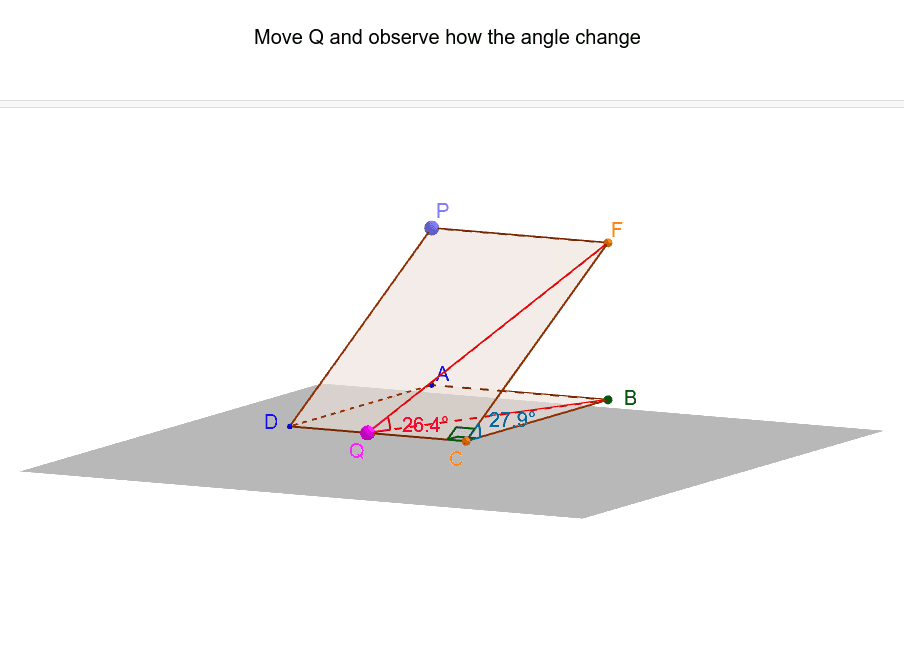
Loading the math board and drawing, please wait…
This GeoGebra example demonstrates the dynamic geometric construction and precise measurement of the dihedral angle (angle between two intersecting planes) in three-dimensional space. The core mathematical concepts covered include spatial planes, normal vectors, the definition of plane angles, trigonometric functions, and analytic geometry concerning the positional relationships among points, lines, and planes in 3D. Based on the construction summary, the example uses the Polygon command to create two planar polygons poly1 and poly2, Point to establish spatial reference points such as A, B, C, and D, OrthogonalLine and OrthogonalPlane to construct perpendicular lines and planes, Intersect to compute the intersection line of the planes, Angle to measure angles α, β, γ, and δ, and Segment to draw auxiliary line segments. It is suitable for high school solid geometry instruction, college engineering drawing, and introductory computer graphics courses, helping learners intuitively understand and calculate the angle between two planes.
GeoGebra Commands & Parameters
Polygon(D, A, B, C) → poly1, d, a, b, cOrthogonalLine(A, xOyPlane) → ePoint(e) → POrthogonalLine(B, xOyPlane) → fOrthogonalLine(P, e, space) → gOrthogonalPlane(P, e) → hIntersect(f, h) → FPolygon(P, F, C, D) → poly2, e_1, f_1, c_1, d_1Angle(B, C, F) → αPoint(c) → QSegment(F, Q) → iSegment(Q, B) → jAngle(B, Q, F) → βAngle(F, C, D) → γAngle(B, C, D) → δ
AI Drawing Prompt Reference
Construct two intersecting planar polygons in 3D space, with one polygon lying on a horizontal reference plane and the other tilted to intersect it. Start by defining four vertices on the horizontal plane to form a quadrilateral. From one vertex, draw a vertical line upward and place a point on it to serve as a vertex of the tilted polygon. From another vertex on the horizontal plane, draw another vertical line and intersect it with a plane perpendicular to the first vertical line, obtaining another vertex of the tilted polygon. Connect these points to form the second quadrilateral. Then measure the dihedral angle between the two planes, as well as angles formed by relevant segments and planes, and draw auxiliary segments connecting key points to clearly illustrate the angular relationships.
The prompt above was compiled from the original drawing commands and is for reference only.