
Angle-Angle Similarity Theorem Quick Investigation
Loading the math board and drawing, please wait…
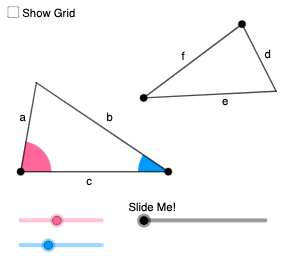
This example demonstrates the Angle-Angle (AA) Similarity Theorem by dynamically showing whether two triangles are similar when two angles are equal. Core math concepts include similar triangles, geometric transformations, and angle measurement. Construction highlights involve using commands like Rotate, Intersect, Segment, Line, Angle, Polygon, and Circle to build and analyze the triangles. Suitable for high school mathematics education to help students visually understand the criteria for triangle similarity.
GeoGebra Commands & Parameters
Rotate(D, (a_{2} * π / 180), E) → D'Ray(E, D') → nRotate(B, (a_{2} * π / 180), A) → B'_{1}Ray(A, B'_{1}) → f_{3}Rotate(A, ((-a_3) * π / 180), B) → A'Ray(B, A') → iIntersect(f_{3}, i) → CRotate(E, ((-a_3) * π / 180), D) → E'_{1}Ray(D, E'_{1}) → lIntersect(l, n) → FSegment(E, F) → dLine(A, d) → g_1Point(g_1) → OPoint(g_1) → NSegment(D, E) → fSegment(A, B) → cRotate(B, (a_{2} * π / 180), A) → B'Angle(B, A, B') → αRotate(E, α, D) → E'Ray(D, E') → hRay(A, B') → gRay(A, B) → f_{2}Ray(D, E) → mLine(A, f) → i_1Point(i_1) → MSegment(A, C) → aSegment(C, B) → bPolygon(A, B, C) → t1, c_{2}, a_{1}, b_1Polygon(D, F, E) → t2, e_1, d_{2}, f_1Segment(F, D) → eCircle(A, (0.4 * Min[l1])) → rCircle(C, (0.4 * Min[l1])) → sIntersect(r, c, 1) → GIntersect(r, a, 1) → HIntersect(s, a, 1) → IIntersect(s, b, 1) → JCircleSector(A, G, H) → tCircle(B, (0.4 * Min[l1])) → c_1Intersect(c_1, b, 1) → KIntersect(c_1, c, 1) → LCircleSector(B, K, L) → d_1Dilate(A, If[0 < v ≤ 1, 1 - v, 0], E) → A'_{2}Vector(A, A'_{2}) → u_1Translate(t, u_1) → t'CircleArc(A, G, H) → h_1Angle(C, A, O) → βRotate(t', If[0 < v ≤ 1, (v * β), β], A'_{2}) → t''Line(B, e) → j_1Point(j_1) → PDilate(B, If[1 < v ≤ 2, 2 - v, 0], D) → B'_{2}Vector(B, B'_{2}) → uTranslate(d_1, u) → k_1Angle(C, B, P) → γRotate(k_1, If[1 < v ≤ 2, ((v - 1) * γ), γ], B'_{2}) → p_1CircleArc(B, K, L) → k
AI Drawing Prompt Reference
Draw two triangles ABC and DEF, with angle A equal to angle D and angle B equal to angle E. Use rotation, intersection, and line segment commands to construct the triangles and find the intersection point F of corresponding sides. Draw triangle DEF and find the intersection point F of corresponding sides using rotation and intersection. Finally, use circle and arc commands to construct auxiliary lines and circles, demonstrating the similarity of the two triangles.
The prompt above was compiled from the original drawing commands and is for reference only.