
Angle-Angle-Side (SAA) Theorem
Loading the math board and drawing, please wait…
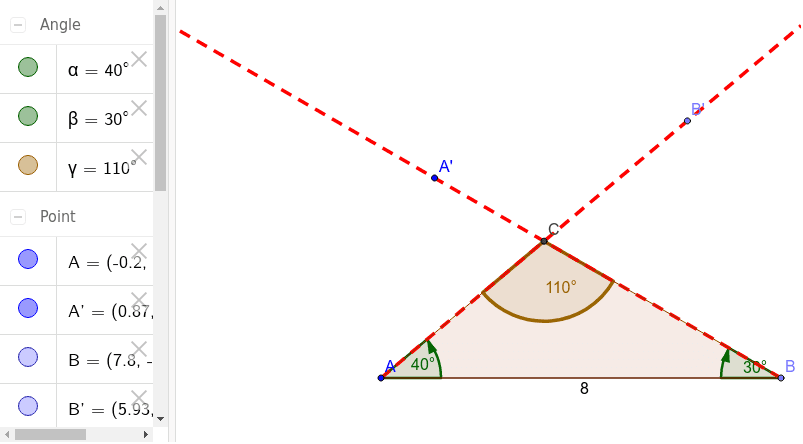
This example illustrates the Angle-Angle-Side (SAA) theorem, which states that if two angles and the included side of one triangle are equal to two angles and the included side of another triangle, then the triangles are congruent. Key mathematical concepts include triangle congruence, angle and side relationships. It uses GeoGebra commands such as point, segment, rotate, angle, ray, intersect, and polygon. Suitable for middle school and above students to learn triangle congruence through geometric construction.
GeoGebra Commands & Parameters
Point(Circle[A, 8]) → BSegment(A, B) → aRotate(B, 40*°, A) → B'Angle(B, A, B') → αRotate(A, -30*°, B) → A'Angle(A', B, A) → βRay(A, B') → bRay(B, A') → cIntersect(b, c) → CPolygon(A, C, B) → poly1, b_1, a_1, c_1Angle(A, C, B) → γ
AI Drawing Prompt Reference
Draw a triangle to illustrate the Angle-Angle-Side theorem. Start with a base segment. From its left endpoint, draw a ray rotated 40 degrees counterclockwise; from the right endpoint, draw a ray rotated 30 degrees clockwise. These rays intersect at a point, forming the triangle. Label the two base angles as 40 and 30 degrees, and label the third angle. Connect the three vertices with solid lines, and use arcs to indicate the angles.
The prompt above was compiled from the original drawing commands and is for reference only.