
Ambiguous Cosine Construction: Triangle Solutions and Hyperbolic Locus
Loading the math board and drawing, please wait…
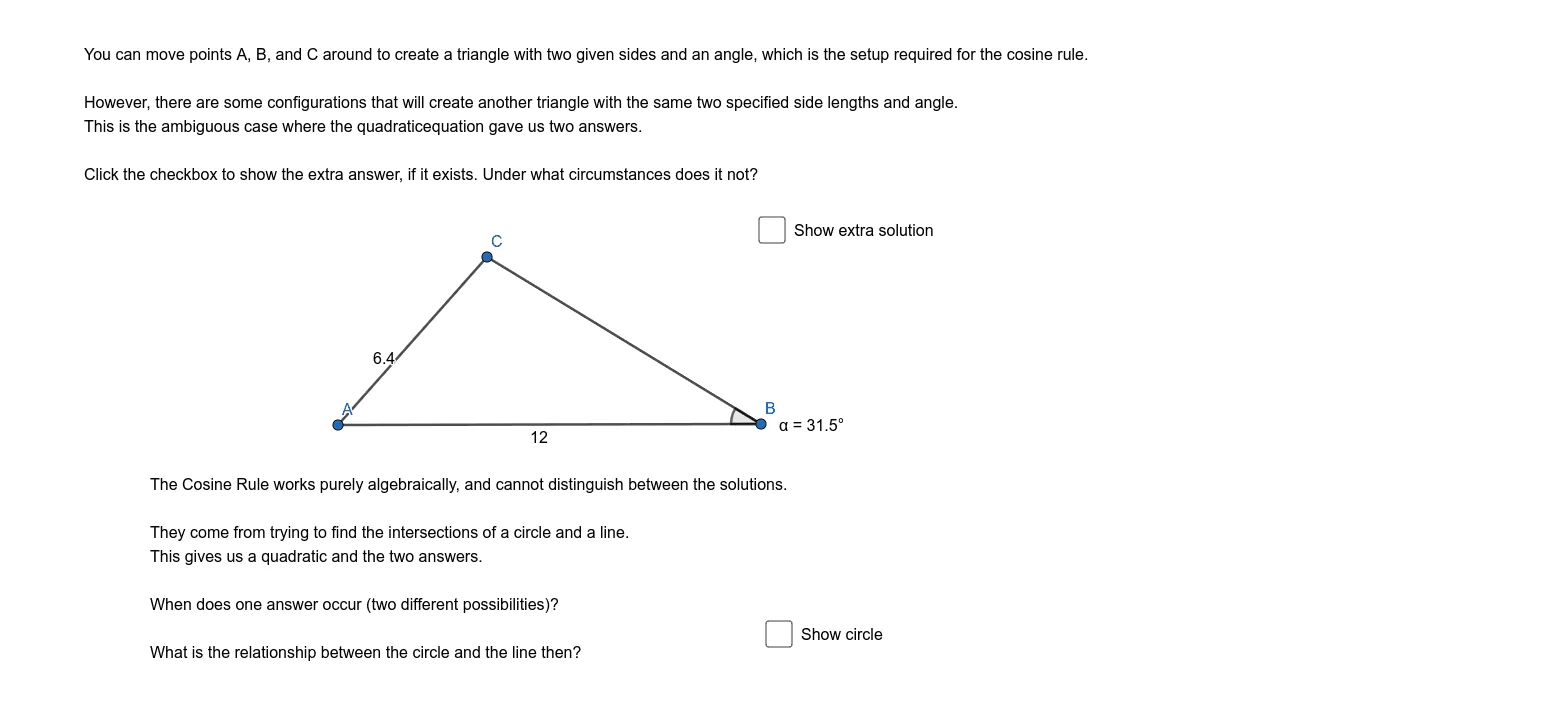
This GeoGebra example demonstrates the ambiguous case in triangle construction when two sides and a non-included angle (cosine form) are given, showing that the solution can yield two, one, or zero triangles. It explores core concepts of the cosine rule, the SSA ambiguity in triangle congruence, and the interplay between trigonometric functions and geometric construction. The construction uses segments and rays to set up the base, circles and intersection points to locate possible vertices, angle tools to mark the given angle, and a hyperbola combined with similarity transformations to visualize the locus of possible solutions. Suitable for high school or early college students studying triangle solvability, the cosine law, and geometric loci, this example provides an interactive way to investigate when ambiguous cases arise and how the solution set changes with parameters.
GeoGebra Commands & Parameters
Segment(A, B) → fSegment(A, C) → gRay(B, C) → hCircle(A, C) → cIntersect(c, h, 2) → DSegment(A, D) → iAngle(C, B, A) → αSegment(B, C) → kSegment(D, B) → j