
Algebraic Puzzle: Development
Loading the math board and drawing, please wait…
In collections
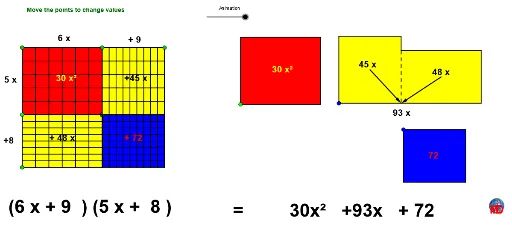
Algebraic puzzles for binomial formula
This example demonstrates the graphical solution of an algebraic puzzle, visualizing the solutions of equations through dynamic geometry. It involves core math concepts like Algebra, Expected Value, Conic Sections, Piecewise Functions, Special Points, and Logarithms. Construction highlights the use of commands such as Line, Point, Segment, Vector, Translate, Sequence, Polygon, and Midpoint in GeoGebra. Suitable for high school and above, it illustrates the integration of algebra and geometry.
GeoGebra Commands & Parameters
Line(A, xAxis) → aPoint(a) → FSegment(A, F) → cPoint(c) → CPoint(c) → BLine(A, yAxis) → bPoint(b) → GSegment(A, G) → dPoint(d) → EPoint(d) → DVector(H, V) → vTranslate(I, Vector[(Animation * v)]) → I'Segment(A, D) → fSegment(A, B) → eSequence(A + (i, 0), i, 0, e, e / e1) → liste1Sequence(D + (i, 0), i, 0, e, e / e1) → liste2Sequence(A - (0, i), i, 0, f, f / f1) → liste4Sequence(Segment[Element[liste1, i], Element[liste2, i]], i, 1, Length[liste1]) → liste3Sequence(B - (0, i), i, 0, f, f / f1) → liste5Sequence(Segment[Element[liste4, i], Element[liste5, i]], i, 1, Length[liste5]) → liste6Polygon(A, B, H, D) → poly1, a_1, b_1, h, d_1Segment(B, C) → gSequence(B + (i, (0 * i)), i, 0, g, g / g1) → liste7Sequence(H + (i, (0 * i)), i, 0, g, g / g1) → liste8Sequence(Segment[Element[liste7, i], Element[liste8, i]], i, 1, Length[liste7]) → liste9Sequence(C - (0, i), i, 0, f, f / f1) → liste10Sequence(Segment[Element[liste10, i], Element[liste5, i]], i, 1, Length[liste5]) → liste11Polygon(B, C, I, H) → poly2, i, j, k, lSegment(D, E) → mSequence(D - (0, i), i, 0, m, m / m1) → liste12Sequence(H - (0, i), i, 0, m, m / m1) → liste13Sequence(Segment[Element[liste12, i], Element[liste13, i]], i, 1, Length[liste12]) → liste14Sequence(E + (i, 0), i, 0, e, e / e1) → liste15Sequence(Segment[Element[liste15, i], Element[liste2, i]], i, 1, Length[liste1]) → liste16Polygon(D, H, J, E) → poly3, d_2, h_1, j_1, e_1Polygon(H, I, K, J) → poly4, h_2, i_1, k_1, j_2Sequence(J + (i, (0 * i)), i, 0, g, g / g1) → liste17Sequence(Segment[Element[liste17, i], Element[liste8, i]], i, 1, Length[liste7]) → liste18Sequence(I - (0, i), i, 0, m, m / m1) → liste19Sequence(Segment[Element[liste19, i], Element[liste13, i]], i, 1, Length[liste12]) → liste20Midpoint(A, B) → LMidpoint(B, C) → MMidpoint(A, D) → NMidpoint(D, E) → OMidpoint(B, D) → PMidpoint(I, J) → QMidpoint(I, B) → RMidpoint(J, D) → SVector(D, T) → uTranslate(A, Vector[(Animation * u)]) → A'Translate(B, Vector[(Animation * u)]) → B'Translate(H, Vector[(Animation * u)]) → H'Translate(D, Vector[(Animation * u)]) → D'Polygon(A', B', H', D') → poly1', a', b', h', d'Vector(E, I') → wTranslate(B, Vector[(Animation * v)]) → B'_1Translate(C, Vector[(Animation * v)]) → C'Translate(H, Vector[(Animation * v)]) → H'_1Polygon(B'_1, C', I', H'_1) → poly2', b'_1, c', i', h'_1Translate(D, Vector[(Animation * w)]) → D'_1Translate(H, Vector[(Animation * w)]) → H'_2Translate(J, Vector[(Animation * w)]) → J'Translate(E, Vector[(Animation * w)]) → E'Polygon(D'_1, H'_2, J', E') → poly3', d'_1, h'_2, j', e'Vector(H, W) → zTranslate(H, Vector[(Animation * z)]) → H'_3Translate(I, Vector[(Animation * z)]) → I'_1Translate(K, Vector[(Animation * z)]) → K'Translate(J, Vector[(Animation * z)]) → J'_1Polygon(H'_3, I'_1, K', J'_1) → poly4', h'_3, i'_1, k', j'_1Midpoint(B', T) → ZMidpoint(D'_1, I') → C_1Segment(C', D'_1) → pSegment(D'_1, I') → qMidpoint(I'_1, J'_1) → A_1Midpoint(C', V) → B_1Midpoint(H'_2, I') → D_1Vector(B_1, I') → rVector(D_1, I') → s