
AEF.NEC Numerical Estimation Comparison: Secant Method for Root Approximation
Loading the math board and drawing, please wait…
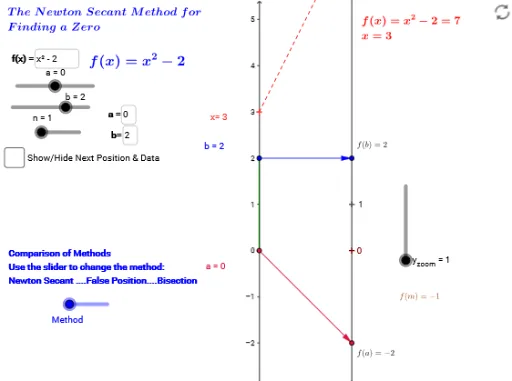
①This example demonstrates numerical estimation of function roots using the secant method, comparing the accuracy across different iteration counts. ②Core mathematical concepts include secant lines, root finding, iterative approximation, numerical error analysis, and the use of LCM/GCD in parameter settings. ③Construction highlights: using GeoGebra commands such as If, Line, Intersect, Point, Vector, Textfield, Segment, and Roots to build the function f, secant points, iteration sequence PAIR, and a slider n to control iterations, dynamically showing the estimated value Dif and error. ④Suitable for high school to university-level courses in numerical analysis or calculus, providing an intuitive visualization of convergence and error comparison in iterative methods.
GeoGebra Commands & Parameters
If(Method ≟ 1, Iteration[NEWT[f, x(z), y(z)], z, {(a, b)}, n - 1], If[Method ≟ 2, Iteration[FPNEXT[f, x(z), y(z)], z, {(a, b)}, n - 1], Iteration[NEXTB[f, x(z), y(z)], z, {(a, b)}, n - 1]]) → PAIRLine(b_n, fb_n) → hLine(a_n, fa_n) → iIntersect(h, i) → LinearFocusLine(zero, LinearFocus) → jLine((0, x(PAIR)), (0, y(PAIR))) → cIntersect(j, c) → SecpointPoint(yAxis) → x_0Vector(x_0, B) → uTextfield(f) → inputBox1Textfield(f) → inputBox2Textfield(a) → inputBox3Textfield(b) → inputBox4Segment((y(a_n), 0), (y(b_n), 0)) → dIf(Method ≠ 3, Secpoint, (0, (y(a_n) + y(b_n)) / 2)) → SecP_nVector(SecP_n, fm_n) → mArr_nVector(b_n, fb_n) → vVector(a_n, fa_n) → wRoots(f, a, b) → Root,Vector(REMD, fER) → gSegment((0, x(PAIR)), (0, y(PAIR))) → kIf(Method ≟ 1, text3, If[Method ≟ 2, text8, text9]) → Title