
Adding Complex Numbers on the Complex Plane
Loading the math board and drawing, please wait…
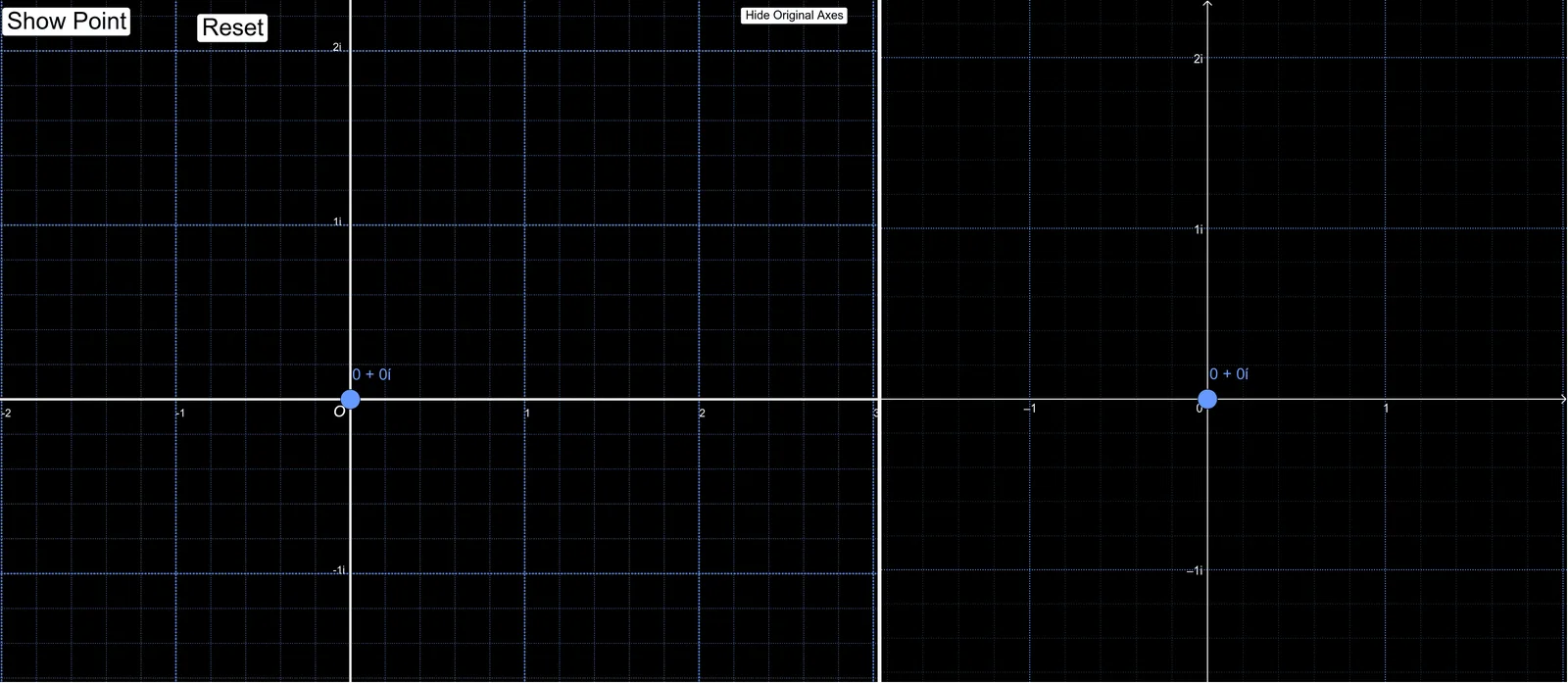
This example demonstrates how to add complex numbers using vector addition on the complex plane. It involves core mathematical concepts such as the geometric representation of complex numbers, vector addition, and the complex plane coordinate system. The construction utilizes GeoGebra commands like Vector, Circle, Point, If, Sequence, Join, Text, and Translate. It is suitable for high school and university-level mathematics courses teaching the geometric interpretation and operations of complex numbers.
GeoGebra Commands & Parameters
Vector(C) → vecVector(O, P'') → jCircle(O, A) → UnitCirclePoint(UnitCircle) → BIf(unit, abs(B), abs(C)) → rIf(r > 1, xMin, floor(xMin) / r) → xMinStretchSequence(Line[(-1, i), (1, i)], i, yMin', yMax', 1) → yMajorLinesSequence(Line[(i, -1), (i, 1)], i, xMin, xMax, 1) → xMajorLinesSequence(Line[(i, -1), (i, 1)], i, xMin, xMax, 1 / 5) → xMinorLinesJoin({{Sequence[Text[i, (i, -0.1)], i, xMin, -1]}, {Sequence[Text[i, (i, -0.1)], i, 1, xMax]}}) → xNumbersIf(unit, Angle[B], Angle[C]) → angText("O", (-0.1, -0.1)) → OriginNumberTranslate(xaxis, vec) → xaxis'If(r > 1, xMax, ceil(xMax / r)) → xMaxStretchSequence(Line[((r * i), -1), ((r * i), 1)], i, xMinStretch, xMaxStretch, 1) → xMajorStretchSequence(Line[((r * i), -1), ((r * i), 1)], i, xMinStretch, xMaxStretch, 1 / 5) → xMinorStretchSequence(Line[(-1, (r * i)), (1, (r * i))], i, xMinStretch, xMaxStretch, 1) → yMajorStretchSequence(Line[(-1, (r * i)), (1, (r * i))], i, xMinStretch, xMaxStretch, 1 / 5) → yMinorStretchJoin({{Sequence[Text[(i * "i"), (-0.15, i)], i, yMin, -1]}, {Sequence[Text[(i * "i"), (-0.1, i)], i, 1, yMax]}}) → yNumbersVector(O, C) → uVector(O, B) → vVector(O, P) → wVector(O, P') → hCircle(O, P') → secondcircleVector(O, R') → aVector(O, R'') → bTranslate(xMajorLines, vec) → xMajorLines'Translate(xMinorLines, vec) → xMinorLines'Translate(yMajorLines, vec) → yMajorLines'Sequence(Line[(-1, i), (1, i)], i, yMin', yMax', 1 / 5) → yMinorLinesTranslate(yMinorLines, vec) → yMinorLines'Translate(yaxis, vec) → yaxis'Text("O", C - (0.1, 0.1)) → OriginNumber'Join({{Sequence[Text[i, (i, -0.1) + vec], i, xMin', -1]}, {Sequence[Text[i, (i, -0.1) + vec], i, 1, xMax']}}) → xNumbers'Join({{Sequence[Text[(i * "i"), (-0.1, i) + vec], i, xMin', -1]}, {Sequence[Text[(i * "i"), (-0.1, i) + vec], i, 1, xMax']}}) → yNumbers'
AI Drawing Prompt Reference
Draw a complex‑plane illustration of adding two complex numbers by vector addition. Show a unit circle centered at the origin with a point on it representing a unit‑modulus complex number, and another point C for an arbitrary complex number. Draw vectors from the origin to both points, then the resultant sum vector, and a second circle centered at the origin through the tip of the sum vector. Include a full coordinate grid with major and minor lines and axis labels, and duplicate the entire grid, axes, and origin label translated by the vector to C, visualizing the translation that corresponds to complex addition.
The prompt above was compiled from the original drawing commands and is for reference only.