
Absolute Value of a Negative Balance: Hank's Bike Debt Problem
Loading the math board and drawing, please wait…
In collections
CCSS Support Math II Unit 2
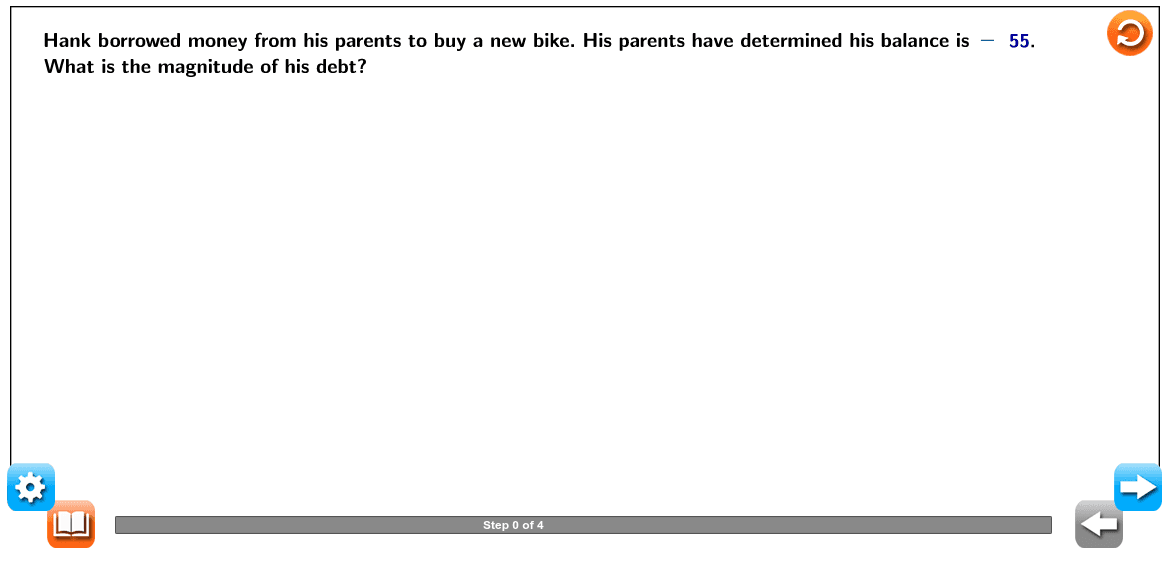
This example uses a real-life scenario—Hank borrows money from his parents to buy a bike, and his balance is –$55—to demonstrate how to find the absolute value of a negative number, i.e., the magnitude of his debt. The core mathematical concept is absolute value and distance on the number line, understanding that the negative sign indicates direction while the absolute value represents magnitude. Construction highlights: using GeoGebra commands such as Segment, Distance, OrthogonalLine, Vector, Sequence, and Point to build a number line and points, with sliders and sequences to dynamically show the transformation from a negative number to its absolute value, and text/buttons for interactive hints. Suitable for middle school students learning rational numbers and absolute value, also useful for introducing the concept of distance on a number line.
GeoGebra Commands & Parameters
Segment(C_0, (x(C_0), 0)) → D_1Distance(L2, D_1) → val1OrthogonalLine(L2, xAxis) → cOrthogonalLine(L2, xAxis) → kVector(B_0, C_0) → uLaTeX("\text{Hank borrowed money from his parents to buy a new bike. His parents have determined his balance is}") → Question1LaTeX("\text{Find the absolute value.}") → text1LaTeX("\text{Find the magnitude of Hank’s debt.}") → text4LaTeX("\text{The magnitude of his debt is represented by the absolute value of his debt; therefore the magnitude, }") → text5LaTeX((("\text{\textcolor{#000099}{" * val2) * "}.}")) → text7LaTeX("\text{What is the magnitude of his debt?}") → Question2Sequence(Sequence[Segment[A_0 + ((0.5 * i) + j, 0), A_0 + ((0.5 * i) + j, -1)], j, 1, 1], i, 0, 99) → list3Sequence(Segment[A_0 + (i, 0), A_0 + (i, (-2))], i, 0, 50) → list1Sequence(Segment[A_0 + (i - 0.5, 0), A_0 + (i - 0.5, -1)], i, 1, 50) → list2Segment((0.09275, 0), (0.09275, 4)) → iLaTeX((("\text{\textcolor{#000099}{" * val2) * "}.}")) → text7_1LaTeX((("\text{Absolute value=" * val2) * "}")) → text26Point(xAxis) → BPoint(i) → APoint(xAxis) → CPoint(i) → DPoint(xAxis) → ESegment(D, E) → dLaTeX((((((("\text{The absolute value of \textcolor{#000099}{-" * val2) * "} can be written as \textcolor{#000099}{|-") * val2) * "|}, which is equal to \textcolor{#000099}{") * val2) * "}.}")) → text2LaTeX("\text{or size, of Hank’s debt is}") → text6LaTeX("\text{absolute value}") → text8_1LaTeX("\text{a number’s distance from \textcolor{#000099}{0} on a number line; the positive value }") → text8_3LaTeX("\text{of a quantity}") → text8_4