
AB2009_4b_B: 2009 AP Test B, Problem 4
Loading the math board and drawing, please wait…
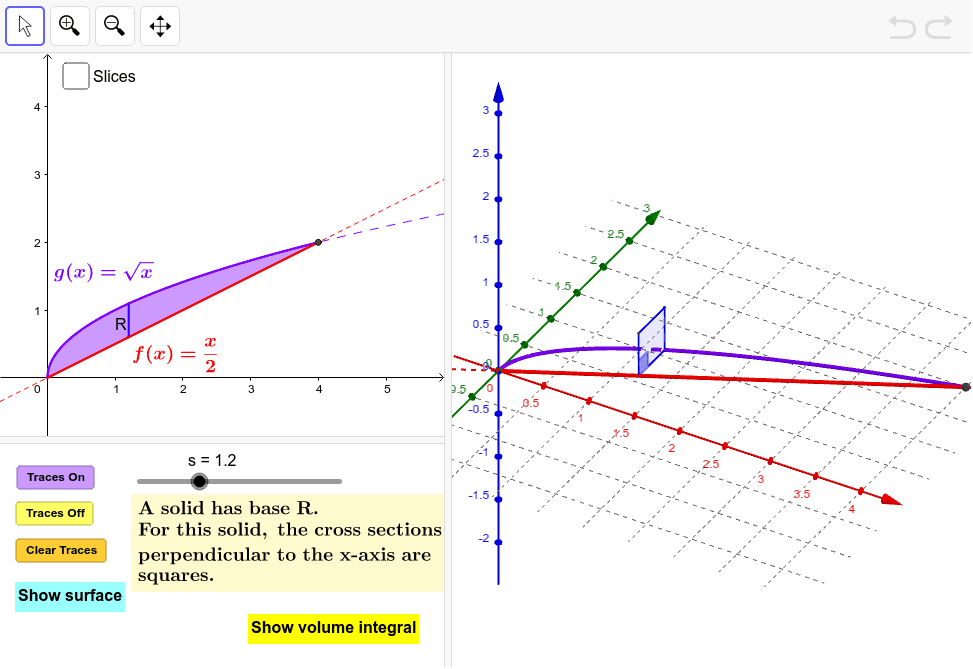
This example demonstrates the volume calculation of a solid with a square cross-section, as part of the 2009 AP Test B, Problem 4. Using GeoGebra commands such as Intersect, Segment, and Integral, the example dynamically shows the solid. Suitable for high school mathematics education, particularly for calculus and solid geometry.
GeoGebra Commands & Parameters
Intersect(f, g, 3, 5) → ESegment(A, B) → eIntegral((g(x) - f(x))^(2), 0, 4) → IntegLocus(C, s) → loc1If(togS ≟ 1, "Hide surface", "Show surface") → ShowSurfaceLocus(D, s) → loc2Polygon(A, B, C, D) → Rect, a, b, c, dAngle(B, A, D) → αSegment((0, 6, 27), (9, 6, 27)) → iSurface(u, (v * f(u)) + ((1 - v) * g(u)), 0, u, 0, 4, v, 0, 1) → BaseSurface(u, (v * f(u)) + ((1 - v) * g(u)), g(u) - f(u), u, 0, 4, v, 0, 1) → TopSurface(u, f(u), (v * (g(u) - f(u))), u, 0, 4, v, 0, 1) → SurfaceRightSurface(u, g(u), (v * (g(u) - f(u))), u, 0, 4, v, 0, 1) → SurfaceLeftIf(togDF ≟ 1, "Show Directions", "Show volume integral") → ToggleDirectionVolumeIntegralSequence(Polygon[((k * h), f(((k + p) * h)), 0), ((k * h), g(((k + p) * h)), 0), ((k * h), g(((k + p) * h)), ht(((k + p) * h))), ((k * h), f(((k + p) * h)), ht(((k + p) * h)))], k, 0, m - 1) → SlicesLeftSequence(Polygon[(((k + 1) * h), f(((k + p) * h)), 0), (((k + 1) * h), g(((k + p) * h)), 0), (((k + 1) * h), g(((k + p) * h)), ht(((k + p) * h))), (((k + 1) * h), f(((k + p) * h)), ht(((k + p) * h)))], k, 0, m - 1) → SlicesRightSequence(Surface[((k + u) * h), (v * f(((k + p) * h))) + ((1 - v) * g(((k + p) * h))), ht(((k + p) * h)), u, 0, 1, v, 0, 1], k, 0, m - 1) → SlicesTopSequence(Surface[((k + u) * h), f(((k + p) * h)), (v * ht(((k + p) * h))), u, 0, 1, v, 0, 1], k, 0, m - 1) → SlicesFrontSequence(Surface[((k + u) * h), g(((k + p) * h)), (v * ht(((k + p) * h))), u, 0, 1, v, 0, 1], k, 0, m - 1) → SlicesBackSequence(Polygon[((k * h), f(((k + p) * h)), 0), ((k * h), g(((k + p) * h)), 0), (((k + 1) * h), g(((k + p) * h)), 0), (((k + 1) * h), f(((k + p) * h)), 0)], k, 0, m - 1) → SlicesBaseSequence(Area[Element[SlicesLeft, k]], k, 1, m) → Areas