
AA Similarity Theorem Demonstration
Loading the math board and drawing, please wait…
In collections
Geometry - Mini Similarity Book
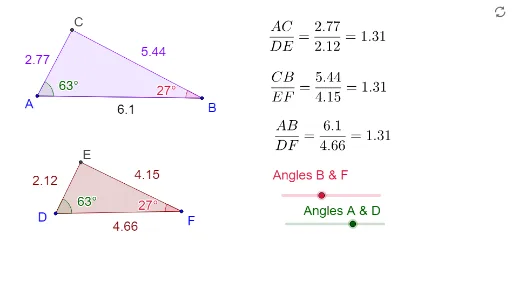
① This interactive GeoGebra applet visually demonstrates why the AA (Angle-Angle) similarity criterion is valid: if two triangles have two pairs of corresponding angles equal, then the triangles are similar. ② The core mathematical concept is triangle similarity, specifically the AA postulate, which implies that the third angles are also equal and corresponding sides are proportional. ③ Construction details: The applet uses GeoGebra commands such as Segment, Rotate, Angle, Line, Intersect, Polygon, and Distance to construct two triangles with labeled angles (α, β, γ, δ) and measure side lengths (distanceAC, distanceCB, distanceBA, etc.) to verify proportional relationships. Objects include points A, B, C and their rotated counterparts, along with auxiliary polygons and segments. ④ This resource is suitable for middle school geometry classes or high school review, helping students grasp the AA similarity condition through dynamic exploration, and can be used by teachers for demonstrations or by students for self-study.
GeoGebra Commands & Parameters
Segment(A, B) → aRotate(B, α, A) → B'Angle(B, A, B') → βRotate(A, (-γ), B) → A'Angle(A', B, A) → δLine(A', B) → bLine(A, B') → cIntersect(b, c) → CPolygon(C, A, B) → poly1, b_1, c_1, a_1Segment(D, F) → a_3Rotate(F, α, D) → B'_1Angle(F, D, B'_1) → β_1Rotate(D, (-γ), F) → A'_1Angle(A'_1, F, D) → δ_1Line(A'_1, F) → b_3Line(D, B'_1) → c_3Intersect(b_3, c_3) → EPolygon(E, D, F) → poly1_1, b_2, c_2, a_2Angle(E, F, D) → εAngle(F, D, E) → ζDistance(A, C) → distanceACDistance(C, B) → distanceCBDistance(B, A) → distanceBADistance(E, D) → distanceEDDistance(D, F) → distanceDFDistance(F, E) → distanceFE