
A Proof Without Words via Geometric Construction: Circles, Rotation, and Angle R
Loading the math board and drawing, please wait…
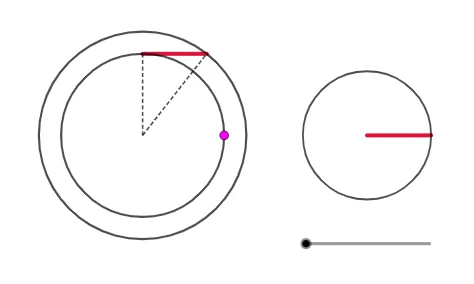
This example demonstrates a “proof without words” by using a constructed geometric diagram to make a mathematical claim visually inevitable. The main visual phenomenon comes from constraints created by circles and sector geometry, where rotation and angle measurement reveal a necessary correspondence (e.g., equal or corresponding angles under a transformation). It highlights key concepts such as geometric construction, circle geometry with intersection points, rotation as a transformation, and explicit angle labeling/measurement. Construction-wise, the GeoGebra setup is built from commands listed in the construct summary: Point, Circle, Intersect to create base points and circle intersection points; Rotate to generate rotated (transformed) configurations; Segment and Angle to define and display segment connections and the measured/marked angle relationships; Sector and Polygon to form sector regions and polygonal frameworks that support the layout of the argument; CurveCartesian to include a curve for additional structure or reading of the relation; and Sequence, Join to organize repeated or connected elements during the construction. Suitable for upper secondary through early university geometry courses and for teaching/learning transformation-based reasoning and proof visualization.
GeoGebra Commands & Parameters
Point(xAxis) → ACircle(A, 1) → cIntersect(c, xAxis, 2) → BRotate(B, a, A) → B'Segment(A, B') → fSector(c, B, B') → dIntersect(xAxis, yAxis) → CPoint(xAxis) → DCircle(C, D) → eIntersect(e, yAxis, 2) → ERotate(E, a) → E'Circle(C, F) → gSegment(E', F) → hCurveCartesian(((x(D) * cos(t + π / 2)), (x(D) * sin(t + π / 2))), t, 0, a) → bIntersect(xAxis, yAxis) → HSegment(H, G) → jAngle(D, C, G) → αCurveCartesian(((j * cos(t + α)), (j * sin(t + α))), t, 0, a) → iSequence(((j * cos(w)), (j * sin(w))), w, α, α + a, π / 180) → l1Sequence(((x(D) * cos(w)), (x(D) * sin(w))), w, a + π / 2, π / 2, ((-π)) / 180) → l2Join({l1, l2}) → l3Polygon(l3) → poly1Segment(C, E') → kSegment(C, F) → l
AI Drawing Prompt Reference
Draw a geometric figure composed of circles and rotations. The figure includes a circle c intersecting the x-axis at point B. Point B is rotated around point A to obtain point B'. Connect points A and B' with segment f. Circle c also defines a sector d. The intersection of the x-axis and y-axis is point C, used as a center. Draw a circle e centered at C, intersecting the y-axis at point E. Point E is rotated around C to obtain point E'. Connect E' and F with segment h. Draw a curve b parameterized by point D and angle a. Draw another curve i parameterized by line segment j and angle α. Create two sequences l1 and l2 using angles α and a+π/2. Connect these sequences to form polygon poly1. Connect point C and E' with segment k. Connect point C and F with segment l. The figure should illustrate circles, rotations, angle measurements, and sector regions to show angle correspondence in geometric construction.
The prompt above was compiled from the original drawing commands and is for reference only.