
A Geometric Construction Based on the Finsler–Hadwiger Theorem
Loading the math board and drawing, please wait…
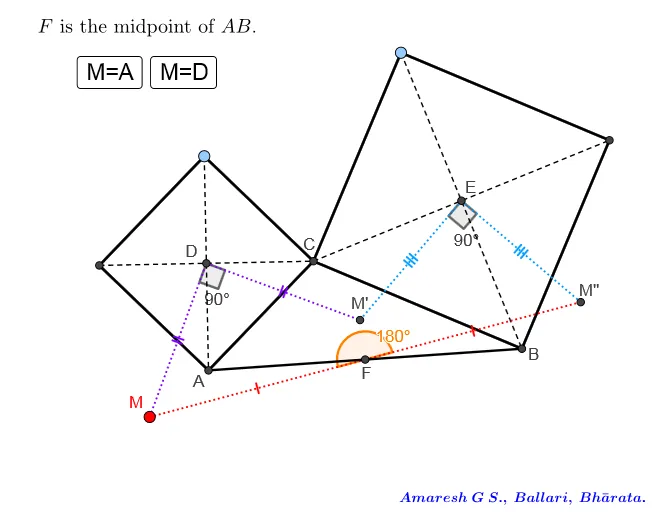
This example demonstrates a geometry-solving workflow that uses construction and rotation to translate a problem inspired by the Finsler–Hadwiger theorem into angle- and segment-based relationships. It focuses on building structured triangles and related polygons, then enforcing correspondences created by rigid transformations. The key math ideas include the geometric nature behind the Finsler–Hadwiger theorem, angle measurement, the role of midpoints in generating useful lines, and how Rotate preserves distances/angles to make the configuration analyzable. Construction in GeoGebra uses Intersect to generate critical intersection points, Polygon to form the main shapes, Segment to define the geometric framework, Midpoint to obtain midpoint-based constraints, Rotate to create rotated copies and alignment relations, and Angle to compute/mark the relevant angles. Suitable for high school enrichment, olympiad-style Euclidean geometry practice, and classroom demonstrations of theorem-driven construction and transformation methods.
GeoGebra Commands & Parameters
Intersect(xAxis, yAxis) → CPolygon(C, B_1, 4) → poly1, f, g, h, i, C_1, APolygon(E_1, C, 4) → poly2, j, k, l, m, B, GSegment(B_1, A) → pSegment(C_1, C) → qSegment(C, G) → rSegment(E_1, B) → sIntersect(p, q) → DIntersect(r, s) → EMidpoint(A, B) → FRotate(M, 90°, D) → M'Rotate(M', 90°, E) → M''Segment(M, D) → tSegment(D, M') → aSegment(M', E) → bSegment(E, M'') → cSegment(M, F) → dSegment(F, M'') → eAngle(M, D, M') → αAngle(M', E, M'') → βAngle(M'', F, M) → γSegment(F, E) → f_1Angle(E, F, D) → δSegment(A, F) → nSegment(F, B) → g_1
AI Drawing Prompt Reference
Construct a geometric figure based on the Finsler-Hadwiger theorem. Start by creating a quadrilateral at the intersection of the axes, then construct and rotate line segments to form multiple triangles and quadrilaterals. Use intersections, midpoints, and rotations to generate key segments and angles, ultimately forming a series of related geometric shapes, including angles α, β, γ, and δ.
The prompt above was compiled from the original drawing commands and is for reference only.