
3D Visualization of the Sum of the First n Odd Integers
Loading the math board and drawing, please wait…
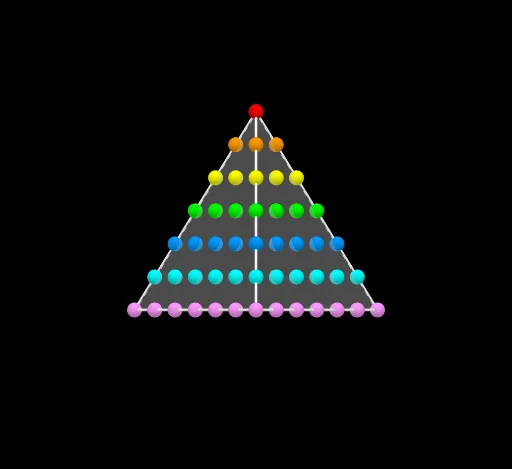
This example demonstrates the 3D visualization of the sum of the first n odd integers. 1+3+5+...+(2n-1)=n². Using commands like Rotate, Polygon, and Tetrahedron, it dynamically illustrates this mathematical concept. Suitable for middle school and above students to learn sequences and solid geometry.
GeoGebra Commands & Parameters
Rotate(A, 120°) → A'Rotate(A, (-(120°))) → A'_1Polygon(A, A', A'_1) → t1, a'_1, a, a'Tetrahedron(t1, true) → b, B, face1, faceAA'B, face2, arêteAB, arête1, arêteA'BPoint(a'_1) → CIntersect(a'_1, yAxis) → DPoint(a'_1) → EPoint(a'_1) → FPoint(a'_1) → GLine(G, arêteAB) → fLine(F, arêteAB) → gLine(E, arêteAB) → hLine(D, arêteAB) → iLine(C, arêteAB) → jLine(C, arêteA'B) → kLine(D, arêteA'B) → lLine(E, arêteA'B) → mLine(F, arêteA'B) → nLine(G, arêteA'B) → pIntersect(k, arêteAB) → HIntersect(f, arêteA'B) → IIntersect(arêteAB, l) → JIntersect(f, k) → KIntersect(arêteA'B, g) → LIntersect(m, arêteAB) → MIntersect(f, l) → NIntersect(k, g) → OIntersect(arêteA'B, h) → PIntersect(n, arêteAB) → QIntersect(f, m) → RIntersect(l, g) → SIntersect(k, h) → TIntersect(arêteA'B, i) → UIntersect(p, arêteAB) → VIntersect(n, f) → WIntersect(m, g) → ZIntersect(i, k) → B_1Intersect(l, h) → C_1Intersect(arêteA'B, j) → D_1Mirror(I, q) → I'Mirror(K, q) → K'Mirror(L, q) → L'Mirror(N, q) → N'Mirror(O, q) → O'Mirror(P, q) → P'Mirror(R, q) → R'Mirror(S, q) → S'Mirror(T, q) → T'Mirror(U, q) → U'Mirror(W, q) → W'Mirror(Z, q) → Z'Mirror(C_1, q) → A_1Mirror(B_1, q) → E_1Mirror(D_1, q) → F_1Mirror(G, q) → G'Mirror(F, q) → F'Mirror(E, q) → E'Mirror(D, q) → D'Mirror(C, q) → C'Mirror(A', q) → A''
AI Drawing Prompt Reference
Create a 3D geometric visualization showing the sum of the first n odd integers equals n squared. Start with an equilateral triangle as the base, then build a regular tetrahedron on it. Place several points along one edge of the triangle, and from each point draw lines parallel to the two opposite edges of the tetrahedron, creating intersections and segments. These lines form a lattice-like structure that visually demonstrates the cumulative sum of odd numbers. Ensure the figure has clear edges, vertices, and symmetry.
The prompt above was compiled from the original drawing commands and is for reference only.