
3.4.3 Museo de Onda: Tile 3 - Parallelogram and Cylinder via Vectors
Loading the math board and drawing, please wait…
In collections
geometriadinamica.es
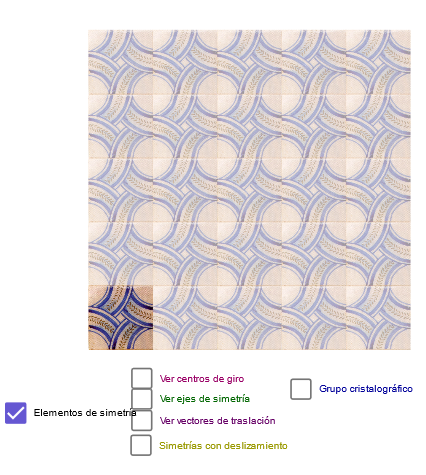
This GeoGebra example demonstrates the construction of a composite figure involving a parallelogram, a cylinder, and vector addition/subtraction, set in the context of the Museo de Onda tile pattern. The core mathematical concepts include properties of parallelograms, vector addition and subtraction, translation transformations, and the geometric representation of a cylinder. The construction uses commands such as Line, Point, OrthogonalLine, Intersect, Midpoint, Mirror, Min, Vector, and Translate, with numerous objects (A, B, b, G, e, J, h, f, H, g, E, I, B_1, a, vp, vg, dif, c, vs, vr, vt, v, vd, gr, D, F, K, L, M, N, O, P, Q, R, S, T, U, V, W, Z) to build complex relationships via vector differences (dif) and multiple translation vectors (vs, vr, vt, etc.). It is suitable for high school or early college students learning coordinate geometry, vector operations, and geometric construction, and can be used in lessons integrating mathematics with cultural heritage.
GeoGebra Commands & Parameters
Line(A, B) → bLine(G, b) → ePoint(e) → JOrthogonalLine(J, e) → hOrthogonalLine(G, e) → fPoint(f) → HOrthogonalLine(H, f) → gIntersect(g, h) → EMidpoint(E, H) → IMidpoint(I, E) → B_1Midpoint(G, J) → DMidpoint(J, E) → FMidpoint(H, G) → KMidpoint(D, I) → LMidpoint(K, L) → MMidpoint(L, F) → NMidpoint(F, J) → OMidpoint(J, D) → PMidpoint(G, D) → QMidpoint(K, G) → RMidpoint(Q, M) → SMidpoint(L, D) → TMidpoint(P, N) → UMidpoint(F, E) → VMidpoint(K, H) → WMidpoint(W, V) → ZMidpoint(H, I) → A_1Midpoint(N, B_1) → C_1Midpoint(Z, W) → D_1Midpoint(D, U) → E_1Midpoint(U, J) → F_1Midpoint(T, Q) → G_1Midpoint(S, G) → H_1Midpoint(S, K) → I_1Midpoint(M, T) → J_1Midpoint(T, N) → K_1Midpoint(N, O) → L_1Midpoint(F, C_1) → M_1Midpoint(C_1, L) → N_1Midpoint(L, D_1) → O_1Midpoint(D_1, K) → P_1Midpoint(H, D_1) → Q_1Midpoint(D_1, I) → R_1Midpoint(I, C_1) → S_1Midpoint(C_1, E) → T_1Mirror(F_1, h) → U_1Mirror(L_1, h) → V_1Mirror(M_1, h) → W_1Mirror(T_1, h) → Z_1Mirror(B_1, h) → A_2Line(Q, A_2) → dLine(F, d) → iLine(C_1, d) → kLine(S_1, k) → lLine(R_1, L_1) → jLine(D_1, j) → mLine(M, j) → nLine(I, j) → pLine(S, A_1) → tLine(I, T) → a_1Line(U, B_1) → b_1Line(E_1, N_1) → c_1Line(F_1, M_1) → d_1Line(G_1, R_1) → e_1Line(W_1, P_1) → g_1Line(Q_1, Z_1) → h_1Point(a_1) → F_2Mirror(F_2, m) → L_2Mirror(F_2, m) → M_2Point(b) → A1Min(90, ((a - 1) * 90)) → r1Line(G_1, O_1) → l_1OrthogonalLine(G_1, l_1) → m_1OrthogonalLine(J_1, l_1) → q_1OrthogonalLine(O_1, l_1) → r_1OrthogonalLine(R_1, l_1) → s_1OrthogonalLine(E_1, m_1) → t_1OrthogonalLine(F_1, m_1) → a_2Point(a_1) → COrthogonalLine(F_2, d) → i_1OrthogonalLine(C, d) → j_1Min(180, ((a - 1) * 180)) → r2Min(270, ((a - 1) * 270)) → r3Min(180, ((a - 5.5) * 180)) → r4Vector(R, S) → z_1Vector(R, G) → u_2Vector(L_1, F_1) → uVector(L_1, V_1) → wTranslate(pic1, u) → pic1'Translate(pic1', u) → pic1''Translate(pic1'', u) → pic1'''Translate(pic1''', u) → pic2Translate(pic2, w) → pic2'Translate(pic1''', w) → pic3Translate(pic1'', w) → pic1'''_1Translate(pic1', w) → pic1''_1Translate(pic1, w) → pic1'_1Translate(pic1'_1, w) → pic4Translate(pic1''_1, w) → pic5Translate(pic2', w) → pic2''Translate(pic3, w) → pic3'Translate(pic4, w) → pic4'Translate(pic4', w) → pic4''Translate(pic4', u) → pic4''_1Translate(pic5, u) → pic5'Translate(pic4'', u) → pic4'''Translate(pic2'', w) → pic2'''Translate(pic2''', w) → pic6Translate(pic3', w) → pic3''Translate(pic3'', w) → pic3'''Translate(pic5', w) → pic5''Translate(pic5'', w) → pic5'''Midpoint(H_1, G_1) → B_2Midpoint(G_1, E_1) → C_2Midpoint(E_1, F_1) → D_2Midpoint(F_1, U_1) → E_2Midpoint(V_1, L_1) → G_2Midpoint(L_1, K_1) → H_2Midpoint(K_1, J_1) → I_2Midpoint(J_1, I_1) → J_2Midpoint(S, T) → K_2Midpoint(T, U) → N_2Midpoint(U, O) → O_2Midpoint(F, N) → P_2Midpoint(N, L) → Q_2Midpoint(L, M) → R_2Midpoint(P_1, O_1) → S_2Midpoint(O_1, N_1) → T_2Midpoint(N_1, M_1) → U_2Midpoint(M_1, W_1) → V_2Midpoint(V, C_1) → W_2Midpoint(C_1, Z) → Z_2Midpoint(Z, D_1) → A_3Midpoint(Q_1, R_1) → B_3Midpoint(R_1, S_1) → C_3Midpoint(S_1, T_1) → E_3Midpoint(T_1, Z_1) → F_3Mirror(A_3, D_1) → D_3
AI Drawing Prompt Reference
Draw a composite figure consisting of a parallelogram and a cylinder. The figure includes multiple points, line segments, and intersection points. The construction order is: first draw the parallelogram, then add the cylinder, then determine key positions using perpendicular lines and intersections, and finally connect these points with midpoints to form a grid. The figure should reflect the geometric representation of vector addition and subtraction, as well as translation transformations.
The prompt above was compiled from the original drawing commands and is for reference only.