
2D Cavalieri's Principle - Rectangle Demo
Loading the math board and drawing, please wait…
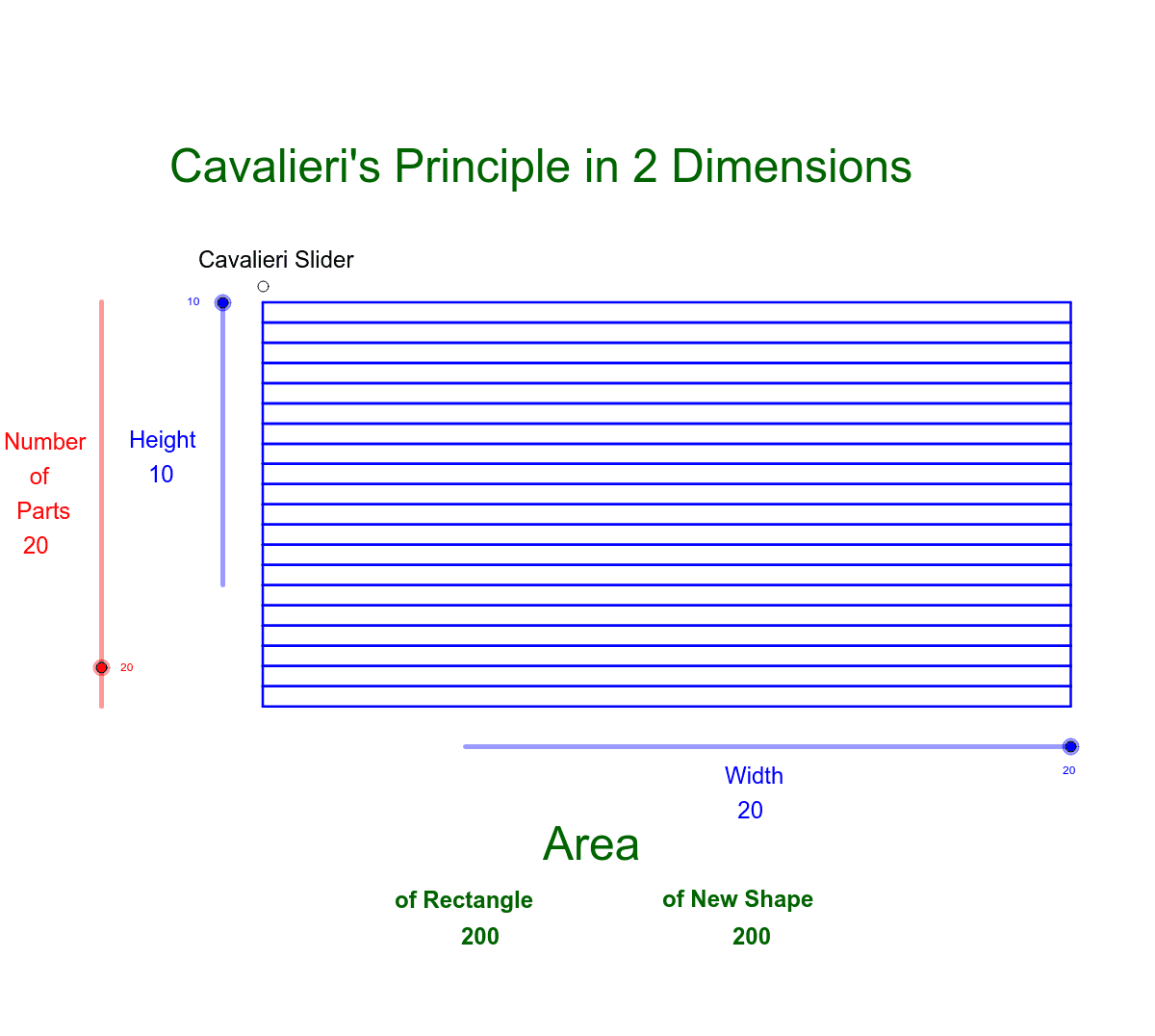
This example uses sliders to demonstrate how Cavalieri's principle works in 2D, specifically with rectangles. It covers core concepts like geometric similarity, area calculation, and properties of parallel lines. Constructed using GeoGebra commands like Point, Sequence, Segment, Zip, and objects such as Slide, Height, Width, Parts for dynamic visualization. Ideal for high school mathematics education to intuitively understand the universality of Cavalieri's principle.
GeoGebra Commands & Parameters
Point({0, Height / Parts}) → CSequence(C + ((Slide * i / (Parts - 1)), (Height * i / Parts)), i, 1, Parts - 1) → HorizontalPoint({0, 0}) → ASegment(A, B) → ABSegment(C, D) → CDZip(Segment[B, B + (Width, 0)], B, Horizontal) → HSegsZip(Segment[B + (0, ((-Height)) / Parts), B + (Width, ((-Height)) / Parts)], B, Horizontal) → HSegslZip(Segment[B, B - (0, Height / Parts)], B, Horizontal) → VSegsSegment(A, C) → ACSegment(B, D) → BDZip(Segment[B + (Width, 0), B + (Width, ((-Height)) / Parts)], B, Horizontal) → VSegsr