
11 Patterns of a Cube? (Net of a Cube) by Mátisné Lócskai Judit
Loading the math board and drawing, please wait…
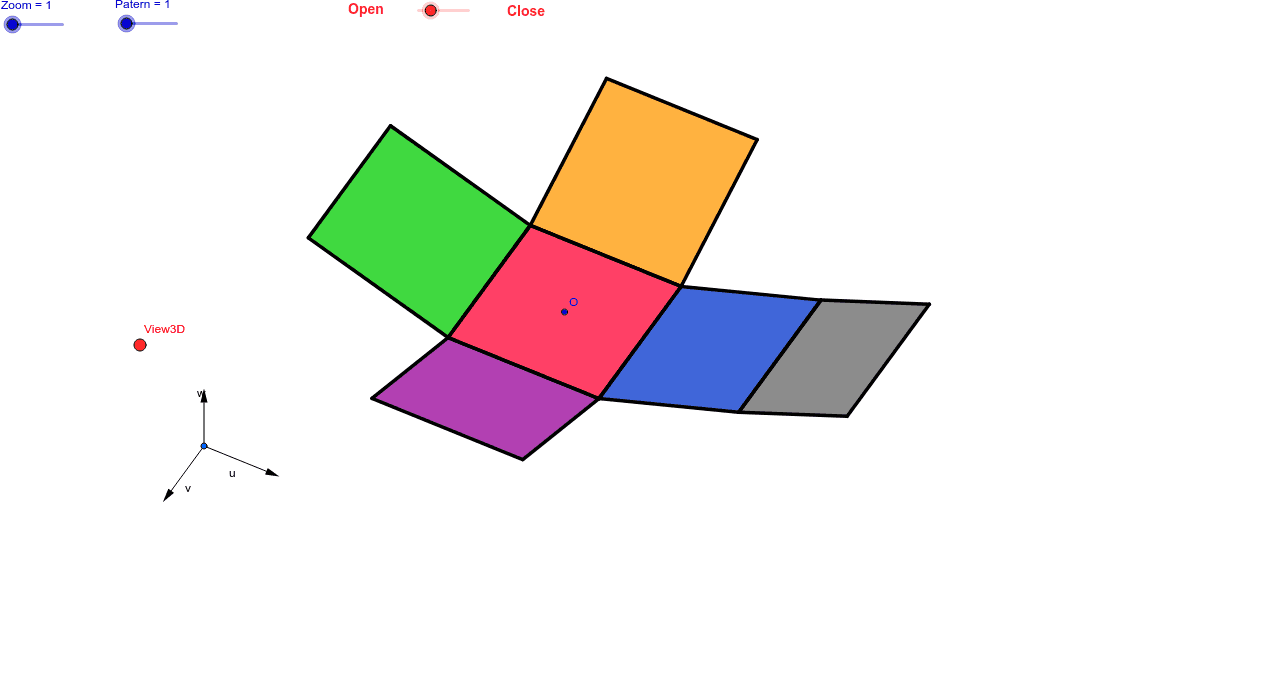
This example demonstrates 11 different patterns of a cube's net, allowing observation through sliders and 3D viewpoint. It involves core math concepts like solid geometry and spatial visualization. Construction uses commands such as Vector, OrthogonalLine, Polygon, Midpoint, Translate, Segment, Mirror in GeoGebra. Suitable for high school students or math enthusiasts exploring spatial geometry.
GeoGebra Commands & Parameters
Vector(B_1, X) → uVector(B_1, Z) → wOrthogonalLine(View3D, yAxis) → a_1OrthogonalLine(View3D, xAxis) → b_1Vector(B_1, Y) → vPolygon(L, K, N, M) → poly1, l, k_1, n, mPolygon(K, P, Q, N) → poly2, k_2, p, q, n_1Polygon(L, M, S, R) → poly3, l_1, m_1, s, rPolygon(N, V, W, M) → poly4, n_2, v_1, w_1, m_2Polygon(K, T, U, L) → poly5, k_3, t, u_1, l_2Polygon(B, Q, P, A) → poly6, b_2, q_1, p_1, a_2Midpoint(R, M) → DTranslate(S, Vector[-(2.0 * v)]) → S'Segment(S, C) → eTranslate(M, Vector[-(2.0) * v]) → M'Segment(M, E) → fSegment(E, C) → hTranslate(N, Vector[-(2.0) * v]) → N'Translate(Q, Vector[-(2.0) * v]) → Q'_1Segment(Q, F) → iSegment(N, G) → jSegment(G, F) → d_1Translate(Q, Vector[-(2.0) * v]) → Q'_2Translate(B, Vector[-(2.0) * v]) → B'_1Segment(B, I) → e_1Segment(I, H) → f_1Segment(H, Q) → g_1Translate(K, Vector[2.0 * v]) → K'Translate(P, Vector[2.0 * v]) → P'_1Segment(P, J) → h_1Segment(J, A_1) → i_1Segment(A_1, K) → j_1Segment(B, H_1) → s_1Segment(H_1, C_1) → cSegment(C_1, A) → r_1Midpoint(N, P) → D_1Midpoint(k_1) → F_1Translate(A, Vector[2.0 * v]) → A'Translate(P, Vector[2.0 * v]) → P'Segment(A, G_1) → t_1Segment(G_1, I_1) → c_2Segment(I_1, P) → d_2Segment(J, K_1) → f_2Segment(P, L_1) → e_2Segment(L_1, K_1) → g_2Segment(M, W) → h_2Mirror(L_1, F_1) → O_1Mirror(K_1, F_1) → P_1Segment(M, M_1) → i_2Segment(N_1, J_1) → j_2Segment(J_1, M_1) → p_2Polygon(M, E, C, S) → poly7, q_2, r_2, s_2, t_2Polygon(Q, N, G, F) → poly8, q_3, n_3, g_3, f_3Polygon(B, Q, H, I) → poly9, b_3, q_4, h_3, i_3Polygon(J, A_1, K, P) → poly10, j_3, a_3, k_4, p_3Polygon(C_1, A, B, H_1) → poly11, c_3, a_4, b_4, h_4Polygon(G_1, I_1, P, A) → poly12, g_4, i_4, p_4, a_5Polygon(K_1, J, P, L_1) → poly13, k_5, j_4, p_5, l_3Polygon(M, M_1, J_1, N_1) → poly14, m_3, m_4, j_5, n_4
AI Drawing Prompt Reference
Draw an unfolded net of a cube with 11 different patterns. Start by creating the cube's vertices, then use vectors and midpoints to create the polygons for the net. Use translation and mirroring commands to move the polygons to the correct positions, forming the different parts of the net.
The prompt above was compiled from the original drawing commands and is for reference only.