
立方体与立方八面体的旋转变换
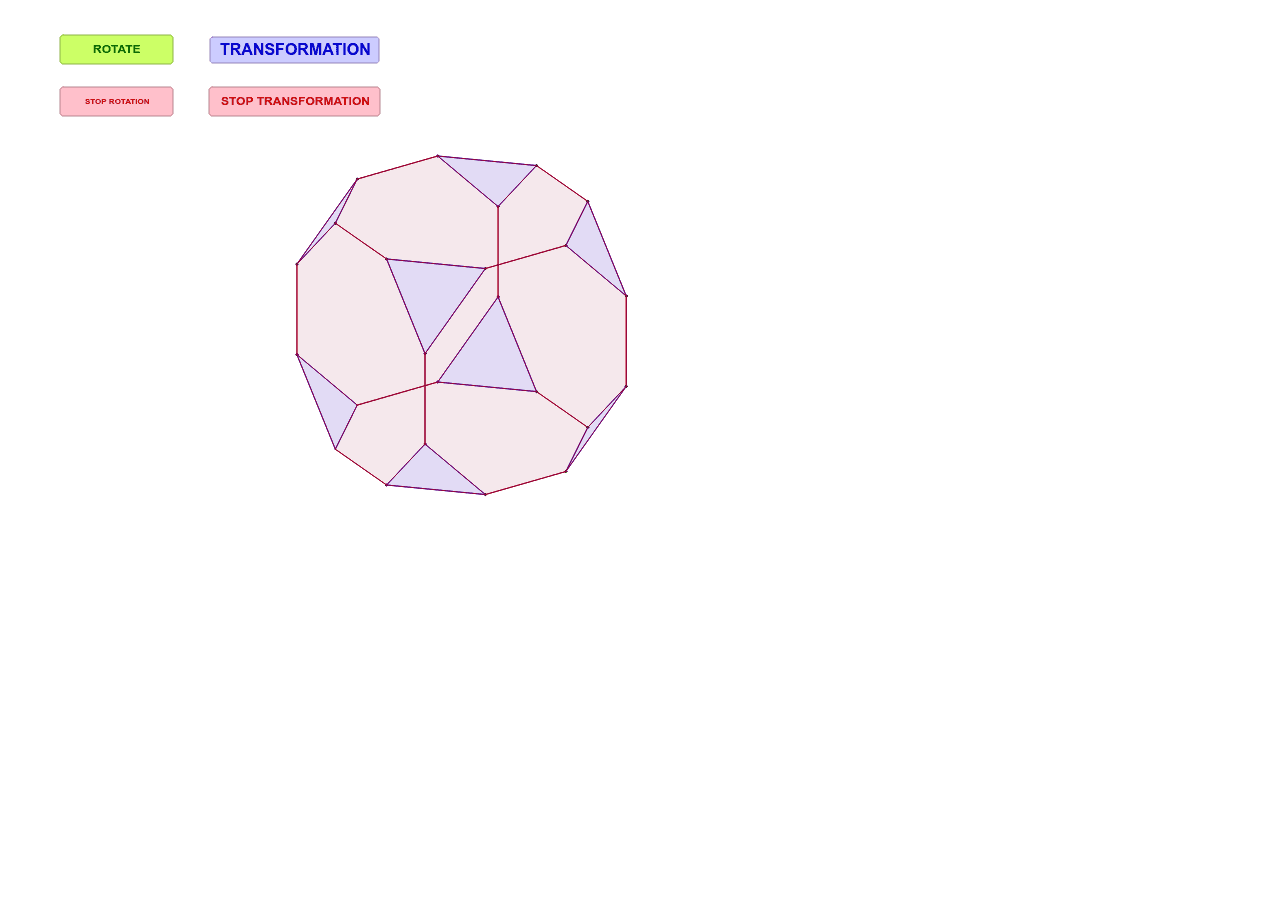
几何画板及绘图内容加载中,请稍等……
该范例演示了立方体(cube)在旋转过程中如何通过截角变换形成立方八面体(cuboctahedron),并展示了三维立体在二维平面上的投影与动态旋转效果。核心数学概念包括三维旋转变换、多面体的顶点与棱关系、以及投影几何。作图要点:利用GeoGebra的Point、Line、Segment、Polygon等命令构造立方体的顶点和棱,通过Translate、Rotate(隐含于旋转动画)和PathParameter控制动态过程,使用Ellipse、OrthogonalLine、Intersect、Ray、Midpoint、Vector等辅助构造投影与辅助线,最终生成多个多边形面(如三角形和正方形)以呈现立方八面体的结构。适合高中或大学阶段的立体几何、变换几何教学,也可用于数学可视化演示。
GeoGebra 命令及参数
Point(xAxis) → QPoint(xAxis) → WPoint(yAxis) → ZEllipse(Q, W, Z) → cPoint(c) → ALine(Q, W) → aOrthogonalLine(Z, a) → bIntersect(b, a) → ORay(A, O) → dIntersect(c, d) → Q_1, CLine(Z, d) → eIntersect(c, e) → Q_3, Q_2Midpoint(Q_2, Z) → Q_4Line(Q_4, O) → fPoint(b) → EVector(O, E) → uPoint(c) → BRay(B, O) → gIntersect(c, g, 2) → DSegment(A, B) → hSegment(A, D) → iSegment(D, C) → jSegment(C, B) → k_1Translate(A, u) → A'Translate(D, u) → D'Translate(C, u) → C'Translate(B, u) → B'Segment(D', C') → lSegment(C', B') → mSegment(B', A') → nSegment(A', D') → pSegment(D', D) → qSegment(C', C) → rSegment(B', B) → sSegment(A', A) → tVector(A, B) → vVector(A, D) → wTranslate({A, B, C, D}, Vector[(k * u)]) → upTranslate({A', B', C', D'}, Vector[((-k) * u)]) → downTranslate({A, A', B', B}, Vector[(k * w)]) → ostTranslate({A, A', D', D}, Vector[(k * v)]) → nordTranslate({B, B', C'}, Vector[((-k) * v)]) → sudTranslate(C, Vector[((-k) * v)]) → C_1Translate({D, D', C'}, Vector[((-k) * w)]) → westTranslate(C, Vector[((-k) * w)]) → C_2PathParameter(A) → oPolygon(Element[down, 1], Element[nord, 2], Element[ost, 2]) → poly1, a_1, b_1, c_1Polygon(Element[down, 4], Element[nord, 3], Element[west, 2]) → poly2, d_1, e_1, f_1Polygon(Element[up, 2], Element[sud, 1], Element[ost, 4]) → poly3, g_1, h_1, i_1Polygon(Element[down, 3], Element[sud, 3], Element[west, 3]) → poly4, j_1, l_1, m_1Polygon(Element[down, 2], Element[sud, 2], Element[ost, 3]) → poly5, n_1, p_1, q_1Polygon(Element[up, 1], Element[nord, 1], Element[ost, 1]) → poly6, r_1, s_1, t_1Polygon(C_1, C_2, Element[up, 4]) → poly7, a_2, b_2, c_2Polygon(Element[up, 5], Element[nord, 4], Element[west, 1]) → poly8, d_2, e_2, f_2Polygon(Element[up, 1], Element[nord, 1], Element[sud, 1], Element[up, 2], Element[down, 2], Element[sud, 2], Element[nord, 2], Element[down, 1]) → poly9, g_2, h_2, i_2, j_2, k_2, l_2, m_2, n_2Polygon(Element[ost, 2], Element[nord, 2], Element[sud, 2], Element[ost, 3], Element[west, 3], Element[sud, 3], Element[nord, 3], Element[west, 2]) → poly11, d_3, e_3, f_3, g_3, h_3, i_3, j_3, k_3Polygon(Element[up, 2], Element[down, 2], Element[ost, 3], Element[west, 3], Element[down, 3], Element[up, 4], C_2, Element[ost, 4]) → poly10, p_2, q_2, r_2, s_2, t_2, a_3, c_3, b_3Polygon(Element[up, 1], Element[down, 1], Element[ost, 2], Element[west, 2], Element[down, 4], Element[up, 5], Element[west, 1], Element[ost, 1]) → poly12, l_3, m_3, n_3, p_3, q_3, r_3, s_3, t_3Polygon(Element[ost, 1], Element[nord, 1], Element[sud, 1], Element[ost, 4], C_2, C_1, Element[nord, 4], Element[west, 1]) → poly13, a_4, b_4, c_4, d_4, c_5, c_6, e_4, f_4Polygon(Element[up, 5], Element[down, 4], Element[nord, 3], Element[sud, 3], Element[down, 3], Element[up, 4], C_1, Element[nord, 4]) → poly14, g_4, h_4, i_4, j_4, k_4, l_4, c_7, m_4