
三部件旋转器
几何画板及绘图内容加载中,请稍等……
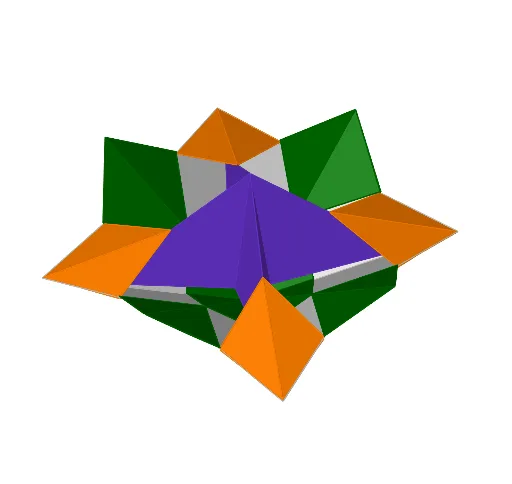
①本范例演示了一个由纸折叠而成的三维模型动画,该模型源自《Action Modular Origami》一书。②涉及的核心数学概念包括交点、面积、四边形、矩形及统计特征。③作图要点:运用了Vector(向量)、WaterbombPreliminaryFold(水bomb基础折痕)、Line(线)、Point(点)、Rotate(旋转)、Plane(平面)、Intersect(交点)、Midpoint(中点)、Translate(平移)、Circle(圆)、Polygon(多边形)、OrthogonalLine(垂线)、Sphere(球体)、LineBisector(角平分线)、Sequence(序列)、Mirror(镜像)、PointIn(点在对象内)等GeoGebra命令/对象。④适合高中及以上学生及数学爱好者学习空间几何与组合模型。
GeoGebra 命令及参数
Vector((0, 0, offset)) → vOffsetWaterbombPreliminaryFold(xOyPlane, H, I, α) → list2, J, K, L, OLine(O, J) → pLine(J, L) → nPoint(n) → PRotate(P, 90°, p) → P'_1Rotate(P, (-(90°)), p) → P'Plane(P'_1, P, P') → cWaterbombPreliminaryFold(c, P, P', β) → list3, R, S, T, UPlane(U, J, L) → oLine(J, H) → f_1Rotate(f_1, (90 / 4)°, J) → g_1Vector(L, K) → vLine(J, K) → j_1Line(I, H) → dIntersect(g_1, d) → B_1Midpoint(I, H) → C_1Translate(L, Vector[(frac * v)]) → L'Plane(J, K, L') → wCircle(K, L', w) → d_1Intersect(j_1, d_1) → H_1, I_1Polygon(I_1, L', H_1) → poly5, h_2, i_2, l'_1OrthogonalLine(I_1, n, w) → k_1Intersect(n, k_1) → J_1Polygon(J, J_1, I_1) → poly6, i_3, j_2, j_3Midpoint(J, I_1) → M_1Polygon(A, B, 4, xOyPlane) → poly1, f, g, h, i, C, DMidpoint(A, C) → ESphere(E, A) → bOrthogonalLine(E, xOyPlane) → jIntersect(j, b) → M, NLine(D, B) → mMidpoint(C, B) → GLineBisector(D, C, xOyPlane) → kLineBisector(D, B, xOyPlane) → lRotate(G, If[α < 0°, α, (2 * α)], k) → G'Rotate(C, If[α ≥ 0°, α, (2 * α)], m) → C'Polygon(E, G', C') → poly2, c', e, g'Plane(E, C, F) → aSequence(Rotate[{poly2, Mirror[poly2, a]}, (nn * 90°), j], nn, 0, 3, 1) → list1Rotate(m, (-(90°)), p) → m'Point(list2) → QPoint(p) → VPoint(p) → WVector(V, W) → uPolygon(H, I, 4, xOyPlane) → poly3, q, r, s, t, Z, A_1Rotate(poly3, (90 / 2)°, J) → poly3'Mirror(L', o) → L''Line(L', L'') → h_1Intersect(h_1, o) → D_1Circle(D_1, L, o) → c_1Line(D_1, L) → i_1Intersect(i_1, c_1) → E_1, F_1PointIn(o) → G_1Polygon(L, L', G_1) → poly4, g_2, l_1, l'Rotate(Translate[Sequence[Rotate[{poly5, poly6, Mirror[{poly5, poly6}, o]}, (nn * 90°), p], nn, 0, 3, 1], vOffset], γ, p) → list5Translate(list5, Vector[(-2 * vOffset)]) → list5'Plane(J, H_1, O) → a_1Circle(H_1, I_1, a_1) → e_1Point(e_1) → K_1Plane(J, W, I) → b_1Mirror(Q, b_1) → Q'Polygon(Q', H_1, K_1) → poly7, k_2, q', h_3OrthogonalLine(G_1, xOyPlane) → m_1Line(J, P) → n_1Intersect(n_1, m_1) → L_1Plane(O, K_1, J) → o_1Mirror(Q', o_1) → Q''Polygon(J_1, M_1, J) → poly9, s_1, t_1, f_2Polygon(Q'', Translate[P, vOffset], J_1) → poly8, p_1, q_1, r_1PointIn(o) → N_1Rotate(Translate[Sequence[Rotate[{poly8, poly9, Mirror[{poly8, poly9}, o]}, (nn * 90°), p], nn, 0, 3, 1], Vector[(-vOffset)]], γ, p) → list7Rotate(Translate[Sequence[Rotate[{poly7, Mirror[{poly7}, o]}, (nn * 90°), p], nn, 0, 3, 1], vOffset], γ, p) → list6Rotate(Sequence[Rotate[{poly4, Mirror[poly4, o]}, (nn * 90°), p], nn, 0, 3, 1], γ, p) → list4Rotate(Translate[list3, u], γ, p) → list3'Rotate(list2, γ, p) → list2'