
化圆为方:通过缩放构造等面积正方形
几何画板及绘图内容加载中,请稍等……
所属专题
Complex Math
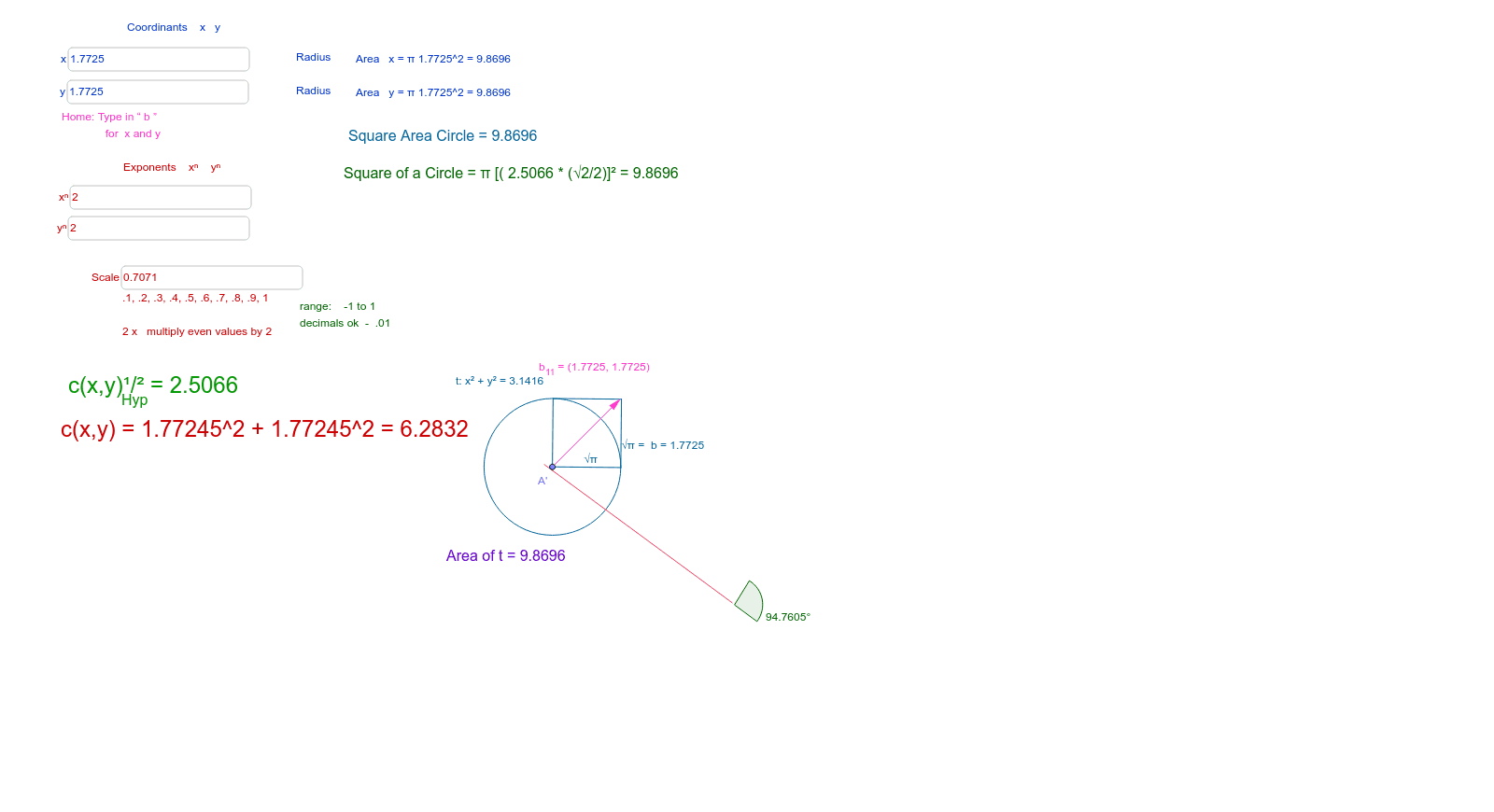
①本范例演示了如何通过几何缩放操作,构造一个与给定圆面积相等的正方形,即经典的“化圆为方”问题。②核心数学概念包括圆的面积公式、正方形面积、比例缩放、几何构造与面积守恒。③作图要点:从构造摘要可见,使用了GeoGebra的文本输入框(inputBox1-5)让用户输入参数,通过点(Point)、距离(Distance)、多边形(Polygon)、旋转(Rotate)、向量(Vector)、平移(Translate)、线段(Segment)、直线(Line)、正交线(OrthogonalLine)、交点(Intersect)、角度(Angle)、面积(Area)等命令构建动态几何图形,并利用缩放(Scale)调整尺寸,最终通过面积计算验证正方形与圆面积相等。④适合高中及以上学生或数学爱好者,用于探索几何作图、面积关系及动态数学实验,也可作为数学史中“化圆为方”问题的可视化教学工具。
GeoGebra 命令及参数
Textfield(a) → inputBox1Textfield(b_9) → inputBox2Textfield(m) → inputBox3Textfield(v) → inputBox4Point(Hyp_1) → APoint(Hyp_1) → BDistance(A, B) → distanceABTextfield(ε) → inputBox5Polygon(C_1, D_1, B_1, A_1) → poly1_1, c_1, d_1, b_1, a_1Rotate(C_1, 5*°, A_1) → C'_1Rotate(D_1, 5*°, A_1) → D'_1Rotate(B_1, 5*°, A_1) → B'_1Rotate(A_1, 5*°, A_1) → A'_1Polygon(C'_1, D'_1, B'_1, A'_1) → poly1'_1, c'_1, d'_1, b'_1, a'_1Vector(E_1, F_1) → u_1Translate(C'_1, u_1) → C''_1Translate(D'_1, u_1) → D''_1Translate(B'_1, u_1) → B''_1Translate(A'_1, u_1) → A''_1Polygon(C''_1, D''_1, B''_1, A''_1) → poly1''_1, Z_1, d''_1, b''_1, a''_1Distance(E_1, F_1) → distanceEF_1Distance(B'_1, B''_1) → distanceB'B''_1Segment(C'_1, C''_1) → e_1Segment(A'_1, A''_1) → f_1Segment(B'_1, B''_1) → g_8Segment(D'_1, D''_1) → h_7Segment(D''_1, G_1) → Y_1Segment(G_1, C''_1) → X_1Segment(H_1, I_1) → i_8Line(J_1, i_8) → j_1Point(j_1) → K_1Segment(I_1, K_1) → k_1Line(L_1, Y_1) → l_1Distance(G_1, I_1) → distanceGI_1Distance(D''_1, K_1) → distanceD''K_1Point(l_1) → M_1Segment(G_1, M_1) → m_1Line(N_1, m_1) → n_1Segment(M_1, N_1) → p_1Distance(N_1, C''_1) → distanceNC''_1Distance(G_1, M_1) → distanceGM_1Segment(G_1, I_1) → q_1Segment(D''_1, K_1) → r_1OrthogonalLine(P_1, q_1) → s_1OrthogonalLine(Q_1, q_1) → t_1OrthogonalLine(R_1, r_1) → a_2OrthogonalLine(S_1, r_1) → b_2Line(T_1, k_1) → c_2Line(P_1, q_1) → d_2OrthogonalLine(U_1, a_2) → e_2Segment(K_1, R_1) → f_2Segment(R_1, P_1) → g_2Segment(P_1, I_1) → h_2Segment(I_1, K_1) → i_2Intersect(t_1, d_2) → V_1Segment(P_1, V_1) → j_2Segment(G_1, V_1) → k_2Segment(G_1, I_1) → l_2Segment(I_1, K_1) → m_2Segment(K_1, D''_1) → n_2Segment(D''_1, G_1) → p_2Intersect(b_2, e_2) → W_1Segment(D''_1, W_1) → q_2Segment(W_1, V_1) → r_2Segment(W_1, R_1) → s_2Segment(V_1, P_1) → t_2Segment(R_1, P_1) → a_3Segment(G_1, V_1) → b_3Segment(I_1, P_1) → c_3Line(A_2, q_1) → d_3Point(d_3) → B_2Segment(G_1, B_2) → e_3Line(C_2, e_3) → f_3Line(D_2, f_3) → g_3Line(E_2, g_3) → h_3Line(F_2, p_1) → i_3Line(G_2, p_1) → j_3Point(f_3) → H_2Segment(B_2, H_2) → k_3Segment(M_1, H_2) → l_3Segment(H_2, B_2) → m_3Segment(B_2, G_1) → n_3Segment(G_1, M_1) → p_3Intersect(h_3, i_3) → I_2Segment(B_2, I_2) → r_3Segment(I_2, C''_1) → s_3Segment(C''_1, G_1) → t_3Segment(G_1, B_2) → a_4Segment(I_2, L_2) → b_4Segment(L_2, H_2) → c_4Segment(L_2, I_2) → d_4Segment(H_2, B_2) → e_4Segment(C''_1, N_1) → f_4Segment(L_2, N_1) → q_3Segment(J_2, K_2) → g_4Intersect(Z_1, a''_1) → M_2Intersect(Y_1, X_1) → N_2Intersect(e_3, k_3) → O_2Intersect(r_3, s_3) → P_2Polygon(M_2, N_2, O_2, P_2) → poly2_1, m_4, n_4, o_1, p_4Intersect(Y_1, X_1) → Q_2Intersect(k_1, q_1) → R_2Intersect(k_1, r_1) → S_2Intersect(Z_1, d''_1) → T_2Polygon(Q_2, R_2, S_2, T_2) → poly3_1, q_4, r_4, s_4, t_4Intersect(Y_1, X_1) → U_2Intersect(j_2, r_2) → V_2Intersect(h_2, j_2) → W_2Intersect(k_1, q_1) → Z_2Polygon(U_2, V_2, W_2, Z_2) → poly4_1, u_2, v_1, w_1, z_1Intersect(k_1, q_1) → A_3Intersect(h_2, j_2) → B_3Intersect(f_2, s_2) → C_3Intersect(k_1, r_1) → D_3Polygon(A_3, B_3, C_3, D_3) → poly5_1, a_5, b_5, c_5, d_5Rotate(M_2, 15*°, M_2) → E_3Rotate(N_2, 15*°, M_2) → F_3Rotate(O_2, 15*°, M_2) → G_3Rotate(P_2, 15*°, M_2) → H_3Polygon(E_3, F_3, G_3, H_3) → poly2'_1, e_5, f_5, g_5, h_4Rotate(G_1, 15*°, M_2) → G'_1Rotate(C''_1, 15*°, M_2) → C'''_1Segment(G'_1, C'''_1) → X'_1Rotate(C''_1, 15*°, M_2) → C'''_2Rotate(D''_1, 15*°, M_2) → D'''_1Segment(C'''_2, D'''_1) → Z'_1Rotate(D''_1, 15*°, M_2) → D'''_2Rotate(G_1, 15*°, M_2) → G'_2Segment(D'''_2, G'_2) → Y'_1Rotate(E_3, 15*°, M_2) → J_3Rotate(F_3, 15*°, M_2) → K_3Rotate(G_3, 15*°, M_2) → L_3Rotate(H_3, 15*°, M_2) → M_3Polygon(J_3, K_3, L_3, M_3) → poly2''_1, j_4, k_4, l_4, m_5Rotate(J_3, 15*°, M_2) → N_3Rotate(K_3, 15*°, M_2) → O_3Rotate(L_3, 15*°, M_2) → P_3Rotate(M_3, 15*°, M_2) → Q_3Polygon(N_3, O_3, P_3, Q_3) → poly2'''_1, n_5, o_2, p_5, q_5Rotate(N_3, 15*°, M_2) → R_3Rotate(O_3, 15*°, M_2) → S_3Rotate(P_3, 15*°, M_2) → T_3Rotate(Q_3, 15*°, M_2) → U_3Polygon(R_3, S_3, T_3, U_3) → poly6_1, r_5, s_5, t_5, u_3Rotate(R_3, 15*°, M_2) → V_3Rotate(S_3, 15*°, M_2) → W_3Rotate(T_3, 15*°, M_2) → Z_3Rotate(U_3, 15*°, M_2) → A_4Polygon(V_3, W_3, Z_3, A_4) → poly6'_1, v_2, w_2, z_2, a_6Rotate(V_3, 15*°, M_2) → B_4Rotate(W_3, 15*°, M_2) → C_4Rotate(Z_3, 15*°, M_2) → D_4Rotate(A_4, 15*°, M_2) → E_4Polygon(B_4, C_4, D_4, E_4) → poly6''_1, b_6, c_6, d_6, e_6Rotate(B_4, 15*°, M_2) → F_4Rotate(C_4, 15*°, M_2) → G_4Rotate(D_4, 15*°, M_2) → H_4Rotate(E_4, 15*°, M_2) → I_4Polygon(F_4, G_4, H_4, I_4) → poly6'''_1, f_6, g_6, h_5, i_4Rotate(F_4, 15*°, M_2) → J_4Rotate(G_4, 15*°, M_2) → K_4Rotate(H_4, 15*°, M_2) → L_4Rotate(I_4, 15*°, M_2) → M_4Polygon(J_4, K_4, L_4, M_4) → poly7_1, j_5, k_5, l_5, m_6Rotate(J_4, 15*°, M_2) → N_4Rotate(K_4, 15*°, M_2) → O_4Rotate(L_4, 15*°, M_2) → P_4Rotate(M_4, 15*°, M_2) → Q_4Polygon(N_4, O_4, P_4, Q_4) → poly7'_1, n_6, o_3, p_6, q_6Rotate(N_4, 15*°, M_2) → R_4Rotate(O_4, 15*°, M_2) → S_4Rotate(P_4, 15*°, M_2) → T_4Rotate(Q_4, 15*°, M_2) → U_4Polygon(R_4, S_4, T_4, U_4) → poly7''_1, r_6, s_6, t_6, u_4Rotate(R_4, 15*°, M_2) → V_4Rotate(S_4, 15*°, M_2) → W_4Rotate(T_4, 15*°, M_2) → Z_4Rotate(U_4, 15*°, M_2) → A_5Polygon(V_4, W_4, Z_4, A_5) → poly7'''_1, v_3, w_3, z_3, a_7Rotate(V_4, 15*°, M_2) → B_5Rotate(W_4, 15*°, M_2) → C_5Rotate(Z_4, 15*°, M_2) → D_5Rotate(A_5, 15*°, M_2) → E_5Polygon(B_5, C_5, D_5, E_5) → poly8_1, b_7, c_7, d_7, e_7Rotate(B_5, 15*°, M_2) → F_5Rotate(C_5, 15*°, M_2) → G_5Rotate(D_5, 15*°, M_2) → H_5Rotate(E_5, 15*°, M_2) → I_5Polygon(F_5, G_5, H_5, I_5) → poly8'_1, f_7, g_7, h_6, i_5Rotate(F_5, 15*°, M_2) → J_5Rotate(G_5, 15*°, M_2) → K_5Rotate(H_5, 15*°, M_2) → L_5Rotate(I_5, 15*°, M_2) → M_5Polygon(J_5, K_5, L_5, M_5) → poly8''_1, j_6, k_6, l_6, m_7Rotate(J_5, 15*°, M_2) → N_5Rotate(K_5, 15*°, M_2) → O_5Rotate(L_5, 15*°, M_2) → P_5Rotate(M_5, 15*°, M_2) → Q_5Polygon(N_5, O_5, P_5, Q_5) → poly8'''_1, n_7, o_4, p_7, q_7Rotate(N_5, 15*°, M_2) → R_5Rotate(O_5, 15*°, M_2) → S_5Rotate(P_5, 15*°, M_2) → T_5Rotate(Q_5, 15*°, M_2) → U_5Polygon(R_5, S_5, T_5, U_5) → poly9_1, r_7, s_7, t_7, u_5Rotate(R_5, 15*°, M_2) → V_5Rotate(S_5, 15*°, M_2) → W_5Rotate(T_5, 15*°, M_2) → Z_5Rotate(U_5, 15*°, M_2) → A_6Polygon(V_5, W_5, Z_5, A_6) → poly9'_1, v_4, w_4, z_4, a_8Rotate(V_5, 15*°, M_2) → B_6Rotate(W_5, 15*°, M_2) → C_6Rotate(Z_5, 15*°, M_2) → D_6Rotate(A_6, 15*°, M_2) → E_6Polygon(B_6, C_6, D_6, E_6) → poly9''_1, b_8, c_8, d_8, e_8Rotate(B_6, 15*°, M_2) → F_6Rotate(C_6, 15*°, M_2) → G_6Rotate(D_6, 15*°, M_2) → H_6Rotate(E_6, 15*°, M_2) → I_6Rotate(F_6, 15*°, M_2) → J_6Rotate(G_6, 15*°, M_2) → K_6Rotate(H_6, 15*°, M_2) → L_6Rotate(I_6, 15*°, M_2) → M_6Polygon(J_6, K_6, L_6, M_6) → poly10_1, j_7, k_7, l_7, m_8Rotate(B_6, 15*°, M_2) → N_6Rotate(C_6, 15*°, M_2) → O_6Rotate(D_6, 15*°, M_2) → P_6Rotate(E_6, 15*°, M_2) → Q_6Polygon(N_6, O_6, P_6, Q_6) → poly9'''_1, n_8, o_5, p_8, q_8Intersect(Z_1, h_7) → R_6Intersect(Z'_1, Y'_1) → S_6Segment(R_6, S_6) → i_1Intersect(e_5, f_5) → T_6Point(Z'_1) → U_6Segment(T_6, U_6) → ρ_1Intersect(Z_1, h_7) → V_6Segment(V_6, U_6) → i_7Intersect(Z'_1, ρ_1) → W_6Segment(M_2, W_6) → f_8Intersect(Z'_1, Y'_1) → Z_6Segment(M_2, Z_6) → z'_1Angle(Z_1, f_8) → α_1Angle(Y_1, i_7) → β_1Intersect(ρ_1, i_7) → A_7Segment(M_2, A_7) → g_1Intersect(Y'_1, i_1) → B_7Segment(A_7, B_7) → i_6Segment(M_2, B_7) → h_1Intersect(X'_1, Y'_1) → C_7Intersect(ρ_1, i_7) → D_7Point(Z_1) → E_7Intersect(Y'_1, i_1) → F_7Polygon(C_7, D_7, E_7, F_7) → poly11_1, c_9, d_9, e_9, f_9Angle(i_1, Y_1) → γ_1Angle(C''_1, G_1, D''_1) → δ_1Angle(X'_1, ρ_1) → ζ_1Point(Y_1) → CPoint(k_3) → DSegment(C, D) → jIntersect(Z_1, X_1) → EPoint(b_4) → FSegment(E, F) → kSegment(F, D) → lIntersect(Z_1, X_1) → GIntersect(p_1, q_3) → HSegment(G, H) → nIntersect(c'_1, a'_1) → IIntersect(Z_1, X_1) → JSegment(I, J) → pAngle(w_3, f_1) → αPoint(w_3) → KPoint(b_{11}) → LSegment(K, L) → qAngle(w_3, q) → βArea(t) → uPointIn(t) → Pointt_1Point(t) → PSegment(A, P) → bRotate(A, 90*°, A) → A'Rotate(P, 90*°, A) → P'Segment(A', P') → j_8Rotate(A', 90*°, P') → A''Rotate(P', 90*°, P') → P''Segment(A'', P'') → k_8Rotate(A, -90*°, P) → A'_2Rotate(P, -90*°, P) → P'_1Segment(A'_2, P'_1) → l_8Textfield(δ) → inputBox7Area(t) → v_6PointIn(t) → Pointt
AI 绘图提示语参考
绘制一个圆和一个正方形,使得正方形的面积等于圆的面积。首先,输入圆的半径,然后根据圆的面积公式计算出正方形的边长。接着,构造一个正方形,通过旋转和移动调整正方形的位置,使其与圆的面积相等。最后,通过调整和旋转,确保正方形的面积与圆的面积相等。
以上提示语为根据原始绘图命令整理而来,仅供参考。