
足球3v3 - 位置、角度与缩放
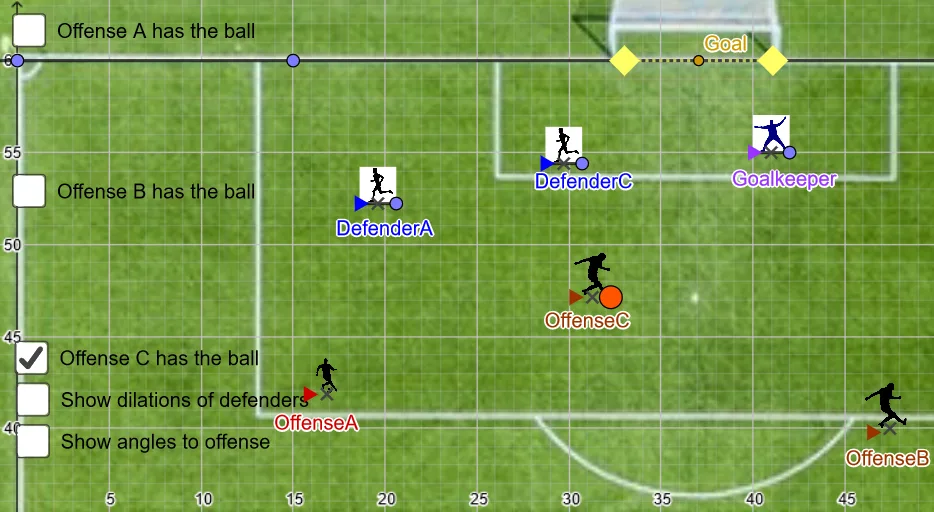
几何画板及绘图内容加载中,请稍等……
①本范例演示足球比赛中球员位置、角度和缩放关系的几何原理;②涉及核心数学概念包括角度、缩放变换、几何变换、相似性、解析几何;③作图要点运用了Point, Line, Midpoint, Circle, Segment, Distance, Intersect, Polygon等GeoGebra命令与对象;④适合高中阶段数学教学,用于理解体育中的几何应用。
GeoGebra 命令及参数
Point(yAxis) → ALine(A, B) → fPoint(f) → CPoint(f) → DPoint(f) → EPoint(f) → FMidpoint(E, F) → GoalCircle(Goal, OffenseA) → cPoint(Circle[OffenseA, 2]) → KSegment(OffenseA, K) → hMidpoint(OffenseA, K) → LPoint(Circle[Goalkeeper, 2]) → NSegment(Goalkeeper, N) → jMidpoint(Goalkeeper, N) → MDistance(L, M) → distanceLMDistance(L, M) → dDistance(M, Goal) → distanceMGoalPoint(Circle[OffenseB, 2]) → VSegment(OffenseB, V) → rMidpoint(OffenseB, V) → GPoint(Circle[DefenderA, 2]) → SSegment(DefenderA, S) → tMidpoint(DefenderA, S) → B_1Line(V, DefenderA) → p_2Line(V, S) → q_2Line(V, Goalkeeper) → a_2Line(V, N) → b_2Point(p_2) → O_1Point(a_2) → U_1Line(O_1, f) → c_2Line(U_1, f) → e_2Intersect(q_2, c_2) → V_1Intersect(e_2, b_2) → Z_1Polygon(U_1, Z_1, V) → t8, v_2, u_1, z_1Polygon(O_1, V_1, V) → t9, v_3, g_3, h_3Midpoint(O_1, V_1) → H_2Midpoint(U_1, Z_1) → J_2Polygon(V, OffenseA, K) → t11, k_3, v_5, offenseaPolygon(V, E, F) → t12, f_4, v_6, e_3Line(K, DefenderA) → i_3Line(K, S) → j_3Line(K, Goalkeeper) → n_3Line(K, N) → p_3Point(i_3) → QPoint(n_3) → RLine(Q, f) → nLine(R, f) → q_3Intersect(n, j_3) → B_2Intersect(q_3, p_3) → C_2Intersect(f, i_3) → E_2Intersect(f, j_3) → F_2Intersect(f, n_3) → G_2Intersect(f, p_3) → K_2Midpoint(Q, B_2) → A_1Midpoint(R, C_2) → N_2Polygon(Q, B_2, K) → t14, k_5, q_4, a_3Polygon(R, C_2, K) → t15, c_3, d_3, g_4Polygon(K, V, OffenseB) → t17, i_4, k_7, v_7Polygon(K, E, F) → t18, f_5, k_8, e_4Point(Circle[OffenseC, 2]) → TSegment(OffenseC, T) → gMidpoint(OffenseC, T) → PPolygon(K, OffenseC, T) → t1, t_1, k, offensecPolygon(V, OffenseC, T) → t2, t_2, v, iPoint(Circle[DefenderC, 2]) → ZSegment(DefenderC, Z) → lLine(K, DefenderC) → mLine(K, Z) → pPoint(m) → OLine(O, f) → sIntersect(s, p) → UMidpoint(O, U) → D_1Midpoint(DefenderC, Z) → E_1Polygon(O, U, K) → t3, k_1, o, uIntersect(f, m) → F_1Intersect(f, p) → G_1Line(V, DefenderC) → aLine(V, Z) → bIntersect(f, a) → H_1Intersect(f, b) → I_1Point(a) → J_1Line(J_1, f) → eIntersect(e, b) → M_1Midpoint(J_1, M_1) → N_1Polygon(J_1, M_1, V) → t4, v_1, j_1, m_1Line(T, DefenderA) → f_1Line(T, S) → g_1Line(T, DefenderC) → h_1Line(T, Z) → i_1Line(T, Goalkeeper) → l_1Line(T, N) → n_1Point(f_1) → WPoint(h_1) → C_1Point(l_1) → P_1Line(W, f) → p_1Line(C_1, f) → q_1Line(P_1, f) → r_1Intersect(p_1, g_1) → Q_1Intersect(q_1, i_1) → R_1Intersect(n_1, r_1) → S_1Midpoint(P_1, S_1) → T_1Midpoint(W, Q_1) → W_1Midpoint(C_1, R_1) → A_2Polygon(T, V, OffenseB) → t5, offenseb, t_3, v_4Polygon(T, OffenseA, K) → t6, k_2, t_4, s_1Polygon(T, E, F) → t7, f_2, t_5, e_1Polygon(P_1, S_1, T) → t10, t_6, c_1, d_1Polygon(C_1, R_1, T) → t13, t_7, g_2, h_2Polygon(W, Q_1, T) → t16, t_8, w_1, i_2
AI 绘图提示语参考
画一个足球场上的3v3阵型,包含三个进攻球员、一个守门员和三个防守球员。用圆圈表示球员的位置,用线段连接相关点,标出关键角度和距离。先画出一条基线,再确定球门位置和球员位置,然后画出球员之间的距离和角度关系,最后用多边形连接相关点形成区域。
以上提示语为根据原始绘图命令整理而来,仅供参考。