
八角星环旋转动画
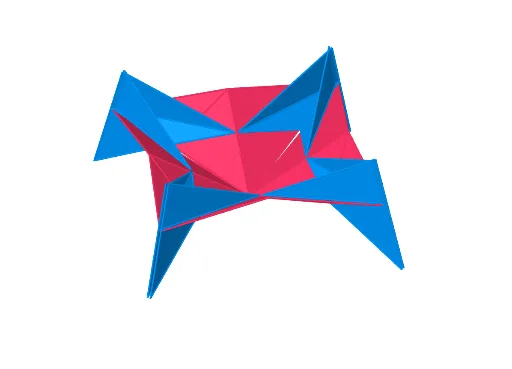
几何画板及绘图内容加载中,请稍等……
①本范例演示了一个由纸折叠而成的八角星环模型的旋转动画;②涉及的核心数学概念包括多边形构造、几何变换(旋转、平移等)、向量运算;③作图要点提炼自构造摘要,使用了Intersect, PolyLine, If, Plane, Line, Midpoint, Rotate, Vector, Dilate, Circle, OrthogonalLine, Polygon, AngularBisector, Point, Translate, LineBisector, Mirror, Distance等GeoGebra命令和对象;④适合高中及以上学生学习几何作图、变换以及参数化模型,也可用于数学教学演示。
GeoGebra 命令及参数
Intersect(yAxis, zAxis) → KPolyLine(C_2, E_3, O_3, F_3, H_3, I_3, J_3, K_3, L_3, M_3, N_3) → j_3Intersect(g_3, j_3) → offsetCurveIf(clock0 < 2.75, clock0, 2.75 - (clock0 - 2.75)) → clockuseIf(clock < 1 ∨ clock > 3, 0°, (-((((clock - 1) * 90))°))) → βIf(clock < 1 ∨ clock > 3, 0°, ((((clock - 1) * 90)) / 2)°) → γPlane(E, F, C) → aLine(E, C) → pMidpoint(C, D) → HIntersect(xAxis, yAxis) → ARotate(C, If[α ≥ 0°, (-α), (-2 * α)], A, a) → C'Vector((0, 0, (-z(C')))) → vShiftDilate(C, 0.5^(0.5), A) → C'_1Midpoint(C'_1, A) → OCircle(O, C'_1, a) → rOrthogonalLine(O, p, a) → qIntersect(q, r) → P, QPolygon(C'_1, Q, A) → poly5, a_2, c'_1, q_1AngularBisector(p, c'_1) → s, tIntersect(a_2, t) → ROrthogonalLine(A, xOyPlane) → lOrthogonalLine(R, l, a) → f_1Intersect(f_1, l) → SPolygon(R, S, 4, a) → poly6, g_1, h_1, i_1, j_1, T, URotate(K, (-β), T, a) → K'Polygon(R, S, T) → poly7, t_1, r_1, s_1AngularBisector(s_1, r_1) → l_1, m_1Intersect(f_1, m_1) → WRotate(W, (-β), T, a) → W'Line(W', K') → b_1Rotate(R, If[clock < 2, (-γ), 45° - (2 * γ)], T, a) → R'OrthogonalLine(R', b_1, a) → p_1Intersect(b_1, p_1) → A_1Line(R', T) → f_2Point(zAxis) → C_1Midpoint(E, B) → JPlane(H, C_1, J) → oRotate(S, If[clock < 2, (-β), 45° + ((-β)) / 2], T, o) → S'_1Polygon(S', T, R') → poly8, r', s', t_2Plane(R', T, S') → uLine(T, S'_1) → g_2AngularBisector(f_2, g_2) → h_2, i_2Intersect(i_2, t_2) → D_1Line(D_1, f_2) → j_2Intersect(g_2, j_2) → E_1OrthogonalLine(E_1, g_2, u) → k_2Intersect(k_2, f_2) → F_1OrthogonalLine(F_1, a) → k_3Point(k_3) → P_3Dilate(F_1, offsetCurveValue, P_3) → Q_3Polygon(R', Q_3, S') → poly16, q_3, r_3, s_3Polygon(T, Q_3, S') → poly15, a_3, b_3, c_3PolyLine(Q_2, R_2, C_3, D_3, S_2, T_2, U_2, V_2, W_2, Z_2, A_3, B_3) → i_3PolyLine(D_2, E_2, N_2, O_2, P_2, F_2, G_2, H_2, I_2, J_2, K_2, L_2, M_2) → h_3PolyLine(O_1, P_1, A_2, B_2, Q_1, R_1, S_1, T_1, U_1, V_1, W_1, Z_1) → f_3Intersect(g_3, i_3) → offsetZIntersect(g_3, h_3) → offsetYIntersect(g_3, f_3) → offsetXVector((offsetXX, offsetYY, offsetZZ)) → vOffsetPolygon(R', F_1, 4, a) → poly10, n_2, p_2, q_2, r_2, I_1, J_1Translate(Polygon[R', Q_3, E_1], vOffset) → poly12OrthogonalLine(R', s', a) → m_2LineBisector(J_1, T, a) → c_1Mirror(R', c_1) → R''OrthogonalLine(R'', m_2, a) → d_1Intersect(m_2, d_1) → N_1Translate(Polygon[J_1, Q_3, R'], vOffset) → poly11Polygon(J_1, F_1, N_1) → poly14, s_2, b_2, e_2Circle(R', J_1, a) → d_2Intersect(m_2, d_2) → K_1, L_1Translate(Polygon[R', N_1, E_1], vOffset) → poly9OrthogonalLine(R', j_2, u) → l_2Intersect(j_2, l_2) → H_1Intersect(k_2, l_2) → G_1Intersect(s_1, p) → ZRotate(Z, (-β), T, a) → Z'Line(Z', K') → n_1Intersect(p_1, n_1) → B_1Midpoint(C, B) → GPlane(A, G, F) → gRotate(G, If[α < 0°, α, (2 * α)], A, g) → G'Polygon(A, G', C') → poly2, c', a_1, g'Point(g') → LPolygon(L, C', G') → poly3, i, j, kMidpoint(D, E) → ICircle(A, C, a) → fCircle(A, G, g) → hTranslate(Sequence[Rotate[{poly3, Mirror[poly3, a]}, (n * 90°), zAxis], n, 0, 3, 1], vShift) → pos0rTranslate(pos0r, vOffset) → list1'Rotate(list1', 45°, l) → list1''Rotate(poly3, 45°, l) → poly3'Plane(G', xOyPlane) → mIntersect(l, m) → MMidpoint(A, M) → NPlane(N, xOyPlane) → nMirror(pos0r, n) → list1'_1Dilate(C', sqrt(2) - 1, L) → L'_1Dilate(G', sqrt(0.5), A) → L'Dilate(G', sqrt(2), A) → G''Polygon(L', L'_1, G'') → poly4, g'', l', l'_1Translate(poly4, vOffset) → poly4'Translate(Sequence[Rotate[{poly4', Mirror[poly4', a]}, (n * 90°), zAxis], n, 0, 3, 1], vShift) → pos0bRotate(Q, γ, K, a) → Q'Rotate(C'_1, γ, K, a) → VDistance(R', S') → distanceR'S'Distance(G'', L'_1) → distanceG''L'1Circle(T, R, a) → e_1Circle(T, S'_1, o) → c_2If(clock < 1 ∨ clock > 3, 0°, (-((((clock - 1) * 90))°))) → β_3If(clock < 1 ∨ clock > 4, 0°, ((((clock - 3) * 90)) / 2)°) → γ_3Point(zAxis) → M_1Translate(Sequence[Rotate[{poly9, poly12, poly11, Mirror[{poly9, poly11, poly12}, a]}, (n * 90°), zAxis], n, 0, 3, 1], Vector[(0 * vShift)]) → pos2rTranslate(Sequence[Rotate[{poly15, poly16, Mirror[{poly15, poly16}, a]}, (n * 90°), zAxis], n, 0, 3, 1], Vector[(0 * vShift)]) → pos2bPlane(M_1, xOyPlane) → vRotate(Mirror[pos2b, v], 45°, l) → pos3bRotate(Mirror[pos2r, v], 45°, l) → pos3rVector((0, 0, If[clock0 ≥ 2.75, fall - (((clock0 - 3.5) * z(T) / 2) * 3.5) + If[clock0 ≥ 2.75, ((clock0 - 2.75) * z(T) / 1.75), 0], (-fall) - z(T)] / 2)) → vFallTranslate(pos2r, vFall) → pos2r'Translate(pos2b, vFall) → pos2b'Translate(pos3b, vFall) → pos3b'Translate(pos3r, vFall) → pos3r'Dilate(S', 2, T) → S''Rotate(S'', (-(90°)), l) → S'''Polygon(S'', T, S''') → poly13, s''', s'', t_3Line(J_1, F_1) → k_1Intersect(k_2, f_2) → F_0Point(zAxis) → G_3
AI 绘图提示语参考
绘制一个八角星环动画,首先构造一个八边形,然后围绕中心点旋转和缩放该八边形,形成环状结构。接着,通过旋转、平移和镜像等操作,构建多个多边形,最终形成一个复杂的旋转动画效果。
以上提示语为根据原始绘图命令整理而来,仅供参考。