
四边形内角
几何画板及绘图内容加载中,请稍等……
所属专题
Mathematics Form 1
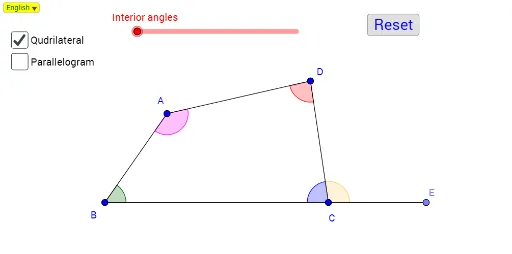
①本范例演示四边形的内角计算与性质;②涉及核心数学概念包括内角和定理、多边形几何;③作图要点:使用 GeoGebra 命令如 Circle(圆)、Segment(线段)、Intersect(交点)、Line(直线)、Angle(角度)等构建四边形并测量内角;④适合初中及以上学生学习多边形内角性质及几何作图。
GeoGebra 命令及参数
Circle(Q, Saiz) → h_1Segment(P, Q) → a_1Intersect(h_1, a_1, 1) → Q_2Segment(P, S) → c_1Line(Q, c_1) → d_1Intersect(h_1, d_1, 2) → Q_1Angle(Q_1, Q, Q_2) → θIf(θ < 180°, CircleSector[Q, Q_1, Q_2], CircleSector[Q, Q_2, Q_1]) → k_1If(o < 1, 1, o) → T_2If(o > 1, 1, o) → T_1Circle(P, Saiz) → e_1Intersect(e_1, c_1, 1) → P_2Intersect(e_1, a_1, 1) → P_1Angle(P_1, P, P_2) → εIf(ε < 180°, CircleSector[P, P_1, P_2], CircleSector[P, P_2, P_1]) → p_1Circle(C, Saiz) → hLine(B, C) → m_0Intersect(h, m_0, 1) → C_2Segment(C, D) → cIntersect(h, c, 1) → C_1Segment(D, A) → dCircle(D, Saiz) → kIntersect(k, d, 1) → D_1Intersect(k, c, 1) → D_2Circle(B, Saiz) → gIntersect(g, m_0, 2) → B_2Segment(A, B) → aIntersect(g, a, 1) → B_1If(m_2 < 1, 1, m_2) → S_3If(m_2 > 1, 1, m_2) → S_4Segment(B, C) → bPoint(m_0) → ECircle(A, Saiz) → fIntersect(f, a, 1) → A_1Intersect(f, d, 1) → A_2Line(D, yAxis) → lSegment(C, E) → iCircleSector(D, D_1, D_2) → qRotate(q, (((-S_4) * 180))°, D) → q'Vector(D, A) → u_1Vector(B, A) → u_2CircleSector(B, B_2, B_1) → sRotate(s, (((S_3 - 1) * 180))°, B) → s'Vector(C, A) → u_3If(m_2 < 0.5, 0.5, If[m_2 > 1.5, 1.5, m_2]) → S_5Translate(q', Vector[(S_4 * u_1)]) → q''CircleSector(C, C_1, C_2) → pTranslate(p, Vector[((S_5 - 0.5) * u_3)]) → p'Translate(s', Vector[((S_3 - 1) * u_2)]) → s''Intersect(h, i, 1) → C_3CircleSector(C, C_3, C_1) → tLine(S, a_1) → b_1Intersect(b_1, d_1) → RCircle(S, Saiz) → f_1Circle(R, Saiz) → g_1Intersect(f_1, c_1, 1) → S_1Intersect(f_1, b_1, 2) → S_2Intersect(g_1, b_1, 1) → R_1Intersect(g_1, d_1, 1) → R_2Angle(S_1, S, S_2) → ζAngle(R_1, R, R_2) → ηIf(ζ < 180°, CircleSector[S, S_1, S_2], CircleSector[S, S_2, S_1]) → q_1If(η < 180°, CircleSector[R, R_1, R_2], CircleSector[R, R_2, R_1]) → r_1Vector(Q, S) → v_1Vector(P, R) → v_2Rotate(p_1, ((T_1 * 180))°, P) → t_1Translate(t_1, Vector[(T_1 * v_2)]) → d_2Rotate(k_1, (((T_2 - 1) * 180))°, Q) → s_1Translate(s_1, Vector[((T_2 - 1) * v_1)]) → c_2Segment(S, R) → i_1Segment(Q, R) → j_1Line(A, D) → m_1Line(A, B) → n_0Line(C, D) → n_1If(x(A) > x(B), y > (Slope[n_0] * (x - x(A))) + y(A), y < (Slope[n_0] * (x - x(A))) + y(A)) → vIf(x(C) > x(D), y > (Slope[n_1] * (x - x(D))) + y(D), y < (Slope[n_1] * (x - x(D))) + y(D)) → wLine(B, D) → l_1Line(A, C) → a_2If(x(C) > x(A), y > (Slope[a_2] * (x - x(A))) + y(A), y < (Slope[a_2] * (x - x(A))) + y(A)) → o_1ClosestPoint(a_2, B) → FLine(B, F) → b_2Circle(F, Ds) → e_2Intersect(e_2, b_2, 1) → GClosestPoint(a_2, D) → HLine(H, D) → f_2Circle(H, Ds) → g_2Intersect(g_2, f_2, 2) → IClosestPoint(l_1, C) → JLine(J, C) → h_2Circle(J, Ds) → k_2Intersect(k_2, h_2, 2) → KClosestPoint(l_1, A) → LLine(L, A) → i_2Circle(L, Ds) → p_2Intersect(p_2, i_2, 2) → MClosestPoint(m_0, D) → NLine(N, D) → j_2Circle(N, Ds) → q_2Intersect(q_2, j_2, 2) → OClosestPoint(m_0, A) → TCircle(T, Ds) → r_2Line(A, T) → l_2Intersect(r_2, l_2, 1) → UClosestPoint(m_1, B) → VLine(B, V) → n_2Circle(V, Ds) → s_2Intersect(s_2, n_2, 1) → WClosestPoint(m_1, C) → ZLine(Z, C) → t_2Circle(Z, Ds) → c_3Intersect(c_3, t_2, 2) → E_1ClosestPoint(n_0, D) → F_1Line(F_1, D) → a_3Circle(F_1, Ds) → d_3Intersect(d_3, a_3, 2) → G_1ClosestPoint(n_0, C) → H_1Line(H_1, C) → b_3Circle(H_1, Ds) → e_3Intersect(e_3, b_3, 2) → I_1ClosestPoint(n_1, B) → J_1Line(B, J_1) → f_3Circle(J_1, Ds) → g_3Intersect(g_3, f_3, 1) → K_1ClosestPoint(n_1, A) → L_1Line(A, L_1) → h_3Circle(L_1, Ds) → k_3Intersect(k_3, h_3, 1) → M_1CircleSector(A, A_1, A_2) → rSelectedIndex(Bahasa) → nn