
QR4-03-P4a-CYU2 二次函数图像绘制练习
几何画板及绘图内容加载中,请稍等……
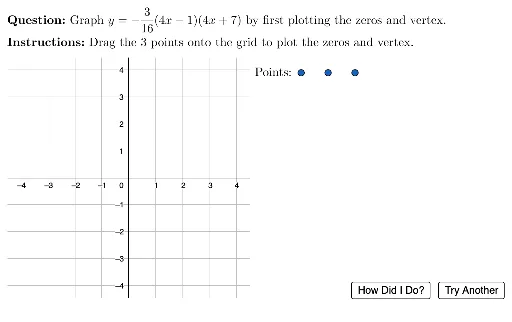
① 本范例是一个交互式二次函数作图练习,学生需要在坐标平面上点击或输入点来绘制给定的二次函数图像,系统会实时判断所绘点是否正确。② 核心数学概念是二次函数的图像特征,包括顶点、对称轴、开口方向以及关键点的坐标确定,同时涉及概率与条件概率的反馈机制(如随机出题、尝试次数统计)。③ 作图要点:从构造摘要可见,使用了GeoGebra的Element、Flatten、Sequence、Point、UnicodeToLetter、LaTeX、FitPoly等命令,创建了用户点集userPts、正确点集correctPts、反馈点fbPoint、网格空间GridSpace、点空间PointSpace等对象,并通过条件判断isCorrect、showFeedback、TryAnother等实现交互反馈,背景中还有xmark、cmark等标记符号。④ 适合中学阶段(初中高年级或高中)学习二次函数图像的学生,也可用于教师课堂演示或学生自主练习,帮助巩固二次函数图像与坐标的关系。
GeoGebra 命令及参数
Element(SolutionPtsLst, caseIndx) → correctPtsFlatten(Sequence[Sequence[(i, j), i, -4, 4, 0.25], j, -4, 4, 0.25]) → GridSpaceSequence((i, y(fbPoint + 1.7)), i, x(fbPoint) + 2, x(fbPoint) + 4, 1) → PointSpacePoint(Union[GridSpace, {Element[PointSpace, 1]}]) → P1Point(Union[GridSpace, {Element[PointSpace, 2]}]) → P2Point(Union[GridSpace, {Element[PointSpace, 3]}]) → P3UnicodeToLetter(10007) → xmarkUnicodeToLetter(10003) → cmarkLaTeX("\text{Points:}") → txtPointLblLaTeX(chkUserInput) → fbCorrectLaTeX("\text{Plot all three points before \\checking your work.}") → fbNotDoneLaTeX("\text{The three points you should plot are the \\two zeros and the vertex. Please try again.}") → fbTryAgainPoint(GridSpace) → B2Point(GridSpace) → B3Point(GridSpace) → C2Point(GridSpace) → C3Point(GridSpace) → D2FitPoly(B2:B4, 2) → B5FitPoly(C2:C4, 2) → C5Point(GridSpace) → D3FitPoly(D2:D4, 2) → D5Point(GridSpace) → E2Point(GridSpace) → E3FitPoly(E2:E4, 2) → E5LaTeX("\Big(1,\dfrac{7}{4}\Big)") → B9Element(FunctionLst, caseIndx) → correctFuncElement(FunctionLst, caseIndx) → hintFuncElement(LatexValsLst, caseIndx) → CaseLatexValsLaTeX((("{\text{The vertex is } " * Element[CaseLatexVals, 2]) * ".")) → fbVertexLaTeX("x=1") → B12LaTeX("x=-1") → C12LaTeX("x=\dfrac{1}{4}") → E12LaTeX((("\text{The equation of the axis of symmetry is }" * Element[CaseLatexVals, 5]) * ".")) → fbAxisSymLaTeX("\Big(-1,-\dfrac{ 5}{4}\Big)") → C9LaTeX("\Big(-\dfrac{3}{4},3\Big)") → D9LaTeX("\Big(\dfrac{1}{4},-\dfrac{15}{4}\Big)") → E9LaTeX(If[A15 < 0, "-", ""]) → A21LaTeX(If[A15 ≟ 0, "0", If[A16 ≟ 0, "", ("" * A16)]]) → A22LaTeX(If[A17 ≟ 0, "", (((("\dfrac{" * A19) * "}{") * A20) * "}")]) → A23LaTeX(((("" * A21) * A22) * A23)) → A24LaTeX(If[B15 < 0, "-", ""]) → B21LaTeX(If[B15 ≟ 0, "0", If[B16 ≟ 0, "", ("" * B16)]]) → B22LaTeX(If[B17 ≟ 0, "", (((("\dfrac{" * B19) * "}{") * B20) * "}")]) → B23LaTeX(((("" * B21) * B22) * B23)) → B24LaTeX((((("\big(" * A24) * ",") * B24) * "\big)")) → lblActivePtLaTeX("x=-\dfrac{3}{4}") → D12LaTeX("x=-\dfrac{ 1}{2}") → B10LaTeX("x=-\dfrac{5}{2}") → C10LaTeX("x=-\dfrac{7}{4}") → D10LaTeX("x=-\dfrac{7}{2}") → E10LaTeX("x=\dfrac{5}{2}") → B11LaTeX("x-\dfrac{1}{2}") → C11LaTeX("x=\dfrac{1}{4}") → D11LaTeX("x=4") → E11LaTeX(((((" \text{The zeros occur at \(" * Element[CaseLatexVals, 3]) * "\) and \( ") * Element[CaseLatexVals, 4]) * "\).")) → fbZerosLaTeX((((("\text{\textbf{Question: }" * MainInstruc) * "\\\textbf{Instructions: }") * SpecInstruc) * "}")) → allInstruc