
花瓶中的玫瑰概率
几何画板及绘图内容加载中,请稍等……
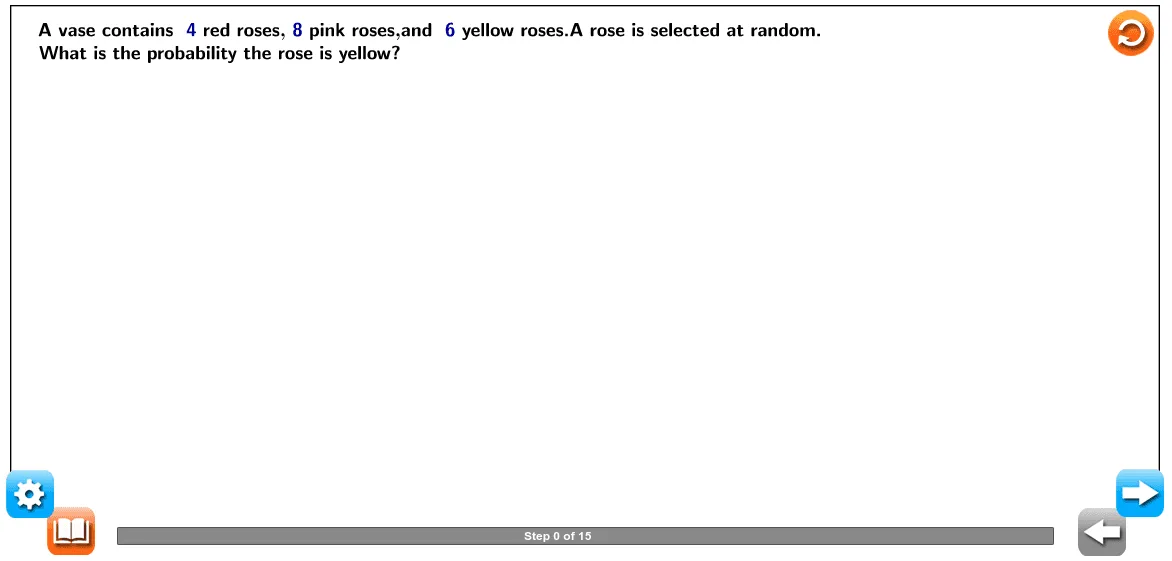
本范例演示了一个花瓶中随机抽取玫瑰的概率问题。涉及的核心数学概念是概率统计。通过构造摘要中的命令,可以了解到使用了Border, Gear, Book等对象。适合初中或高中学生学习概率统计。
GeoGebra 命令及参数
LaTeX("\text{What is the probability the rose is yellow?}") → Question2LaTeX("\text{Describe the sample space and identify the number of outcomes in it.}") → Pg1ALaTeX((("\text{\left\{\textcolor{#000099}{ " * Total) * "}\right\}}")) → Pg1DLaTeX("\text{Define the event and identify the number of outcomes in it.}") → Pg2ALaTeX((((((((("\text{There are \textcolor{#000099}{" * Red) * "+") * Pink) * "+") * Yellow) * "=") * RPY) * "} possible outcomes when selecting a rose from the vase.}")) → Pg1ELaTeX("\text{The sample space is the set of all possible outcomes.If \textcolor{#000099}{R} represents a red rose,\textcolor{#000099}{P} represents a pink rose,and }") → Pg1BLaTeX("\text{\textcolor{#000099}{Y} represents a yellow rose,the sample space is:}") → Pg1CLaTeX("\text{The event is “selecting a yellow rose”.}") → Pg2BLaTeX((((("\text{There are \textcolor{#000099}{ " * Yellow) * "} yellow roses in the vase,so there are \textcolor{#000099}{ ") * Yellow) * "} outcomes in this event.}")) → Pg2CLaTeX("\text{Determine the probability of the event.}") → Pg3ALaTeX("\text{Use the formula for the probability of an event:}") → Pg3BLaTeX("\text{Probability formula}") → Pg3GFractionText(Yellow / RPY) → Pg3IBLaTeX("\text{Substitute “selecting a yellow rose” for \textcolor{#000099}{E},\textcolor{#000099}{6} for the number of outcomes}") → Pg3HBLaTeX("\text{in \textcolor{#000099}{E},and \textcolor{#000099}{18} for the number of outcomes in the sample space.}") → Pg3HCLaTeX("\text{The probability of selecting a yellow rose is}") → Pg3JAFractionText(Yellow / RPY) → Pg3JBLaTeX("\text{.}") → Pg3JCLaTeX((((("\text{\textcolor{#000099}{P}(selecting a yellow rose)=\textcolor{#000099}{\frac{(" * Yellow) * ")}{(") * RPY) * ")}}}")) → Pg3HLaTeX("\text{\textcolor{#000099}{P}(selecting a yellow rose)=}") → Pg3ILaTeX("\text{Simplify.}") → Pg3ICLaTeX((((((("\text{A vase contains \textcolor{#000099}{ " * Red) * "} red roses,\textcolor{#000099}{ ") * Pink) * "} pink roses,and \textcolor{#000099}{ ") * Yellow) * "} yellow roses.A rose is selected at random.}")) → QuestionLaTeX("\text{\textcolor{#000099}{P(E)}=\frac{number \;of \;outcomes\; in\textcolor{#000099}{\;E}}{number\; of\; outcomes \;in \;the \;sample \;space}}") → Pg3CLaTeX("\text{\textcolor{#000099}{P(E)}=\frac{number \;of \;outcomes\; in\textcolor{#000099}{\;E}}{number\; of\; outcomes \;in \;the \;sample \;space}}") → Pg3FLaTeX("\text{In this formula,the event (\textcolor{#000099}{E}) is “selecting a yellow rose”,the number of outcomes in the event is \textcolor{#000099}{6},and the number}") → Pg3DLaTeX((("\text{of outcomes in the sample space is \textcolor{#000099}{" * RPY) * "}.Substitute these values into the formula.}")) → Pg3ELaTeX("\text{\textcolor{#000099}{P(E)}=\frac{number \;of \;outcomes\; in\textcolor{#000099}{\;E}}{number\; of\; outcomes \;in \;the \;sample \;space} in a uniform probability model.}") → WTK2LaTeX("\text{\mathbf{Probability\; of \;an \;event\; \textcolor{#000099}{E}} denoted \textcolor{#000099}{ P(E)},and is given by}") → WTK1LaTeX((("\text{Red rose=" * Red) * "}")) → DKTRLaTeX((("\text{Pink rose=" * Pink) * "}")) → DKTPLaTeX((("\text{Yellow rose=" * Yellow) * "}")) → DKTY