
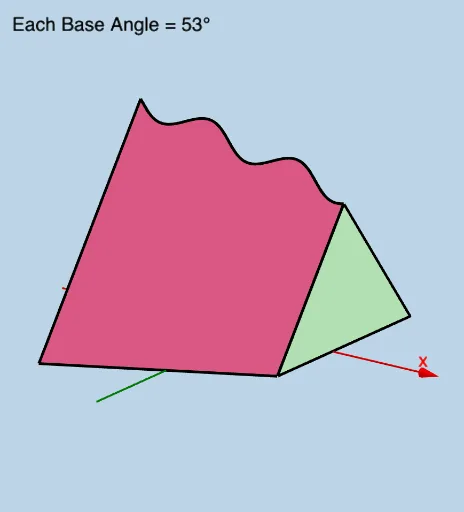
可修改的立体:平行于y轴的等腰三角形截面
几何画板及绘图内容加载中,请稍等……
这个范例演示了一个可修改的立体,其平行于y轴的截面是等腰三角形,且底角可调。涉及的核心数学概念包括立体几何、解析几何和微积分中的截面分析。作图要点使用了GeoGebra命令如Intersect(相交)、Segment(线段)、Midpoint(中点)、Line(直线)、Rotate(旋转)、Ray(射线)、Sphere(球体)、Polygon(多边形)、Textfield(文本框)、Angle(角度)、CurveCartesian(笛卡尔曲线)、Surface(曲面)等。适合高中及以上学生学习和理解复杂几何体及其截面性质。
GeoGebra 命令及参数
Intersect(lower, h, (-8, -14)) → CIntersect(upper, h, (-8, 10.145500033808613)) → BSegment(C, B) → qIntersect(upper, q, (-8, 10.145500033808613)) → GMidpoint(C, G) → TLine(T, T + (1, 0, 0)) → l_1Rotate(C, (-α), G, l_1) → C'Ray(G, C') → f_2Rotate(G, α, C, l_1) → G'Ray(C, G') → e_1Intersect(f_2, e_1) → B_1Segment(H, I) → s_1Midpoint(s_1) → ELine(E, E + (1, 0, 0)) → r_1Rotate(I, (-α), H, r_1) → I'Ray(H, I') → b_1Rotate(H, α, I, r_1) → H'Ray(I, H') → a_1Intersect(b_1, a_1) → A_1Segment(J, K) → q_1Midpoint(q_1) → FLine(F, F + (1, 0, 0)) → cRotate(K, (-α), J, c) → K'Ray(J, K') → p_1Rotate(J, α, K, c) → J'Ray(K, J') → m_1Intersect(m_1, p_1) → ZLine(B, D) → iSphere(B, d) → ePolygon(C, G, B_1) → q1, f_1, g_1, n_1Segment(C, B) → pPolygon(K, J, Z) → q2, l, m, nPolygon(H, I, A_1) → q3, r, s, tTextfield(upper) → InputBox1Textfield(lower) → InputBox2Textfield(a) → InputBox3Textfield(b) → InputBox4Segment(C, G) → k_1Segment(K, Z) → fSegment(J, Z) → gSegment(A_1, I) → c_1Segment(A_1, H) → d_1Segment(C, B_1) → i_1Segment(B_1, G) → j_1Angle(G, C, B_1) → βAngle(B_1, G, C) → γCurveCartesian(t, lower(t) + (0.5 * (upper(t) - lower(t))), ((0.5 * (upper(t) - lower(t))) * tan(α)), t, a, b) → jSurface(u, ((0.5 * (upper(u) - lower(u))) * v) + lower(u), (((0.5 * (upper(u) - lower(u))) * tan(α)) * v), u, a, b, v, 0, 1) → kSurface(u, ((0.5 * (upper(u) - lower(u))) * v) + (0.5 * (lower(u) + upper(u))), (((-0.5 * (upper(u) - lower(u))) * tan(α)) * v) + ((0.5 * (upper(u) - lower(u))) * tan(α)), u, a, b, v, 0, 1) → o