
线性方程与优化问题演示
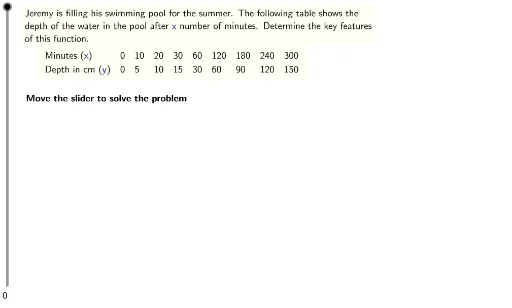
几何画板及绘图内容加载中,请稍等……
本范例通过 GeoGebra 演示线性方程与优化问题的图形化解法。涉及的核心数学概念包括线性方程、对数函数、线性规划、概率统计和线性回归。作图要点提炼自构造摘要,使用了 LaTeX、Corner、If、Zip、Append、TableText 等命令和对象,如 timeDepthratio、depthratio、stepMax、stepper、steps 等,适合高中及以上数学教学或自学,用于理解复杂数学模型的构建与可视化。
GeoGebra 命令及参数
LaTeX(steps) → counterLaTeX("\text{Move the slider to solve the problem}") → text0LaTeX("\text{Use the buttons below to return to the original problem or}\cr\text{randomly generate a similar practice problem.}") → RandomizationTextCorner(1) → ACorner(3) → BIf(direction ≟ 0, "filling", "emptying") → directionWordLaTeX((("\text{Jeremy is " * directionWord) * " his swimming pool for the summer. The following table shows the}\cr\text{depth of the water in the pool after }\textcolor{#000099}{x}\text{ number of minutes. Determine the key features}\cr\text{of this function.}")) → ProblemZip((timeratio * k), k, intervalScales) → TimeIntervalsAppend(0, Sequence[Sum[TimeIntervals, k], k, 1, 8]) → TimesZip((depthratio * k), k, intervalScales) → DepthIntervalsAppend(0, Sequence[Sum[DepthIntervals, k], k, 1, 8]) → DepthValuesIf(direction ≟ 0, DepthValues, Append[DepthValues(9), Sequence[DepthValues(9) - Sum[DepthIntervals, k], k, 1, 8, 1]]) → DepthsLaTeX("\text{Determine whether the function is linear.}") → text1LaTeX("\text{Identify the intercepts of the function based on the information in the table.}") → text3TableText({Append[LaTeX["\text{Minutes (}\textcolor{#000099}{x}\text{)}"], Times], Append[LaTeX["\text{Depth in cm (}\textcolor{#000099}{y}\text{)}"], Depths]}) → ProblemDataLaTeX((((((((("\text{The function intersects the }\textcolor{#000099}{y}\text{-axis at the point }\textcolor{#000099}{" * Yintercept) * "}\text{ as indicated in the table,}\cr\text{and it also intersects the }\textcolor{#000099}{x}\text{-axis at }\textcolor{#000099}{") * Xintercept) * "}\text{.}\cr\text{}\cr\text{Therefore, the }\textcolor{#000099}{y}\text{-intercept is }\textcolor{#000099}{") * Yintercept) * "}\text{ and the }\textcolor{#000099}{x}\text{-intercept is }\textcolor{#000099}{") * Xintercept) * "}\text{.}")) → text4LaTeX("\text{Determine whether the function is increasing or decreasing.}") → text5If(direction ≟ 0, "increasing", "decreasing") → functionWordIf(direction ≟ 0, "increase", "decrease") → yWordLaTeX((((("\text{As the }\textcolor{#000099}{x}\text{-values increase, the }\textcolor{#000099}{y}\text{-values " * yWord) * ". Therefore, the function is}\cr\text{") * functionWord) * ".}")) → text6LaTeX("\text{Determine where the function is positive and negative.}") → text7If(direction ≟ 0, ">", "<") → relationSignIf(direction ≟ 0, 0, Times(9)) → keyXIf(direction ≟ 0, "greater", "less than") → relationWordLaTeX("\text{Determine the relative minimum and maximum of the function.}") → text9If(direction ≟ 0, LaTeX["\text{whatever time Jeremy stops filling the pool, or}\cr\text{when the pool starts overflowing. The problem did not specify when this would be.}"], LaTeX[(("\textcolor{#000099}{" * Yintercept) * "}\text{ before the pool begins to empty.}")]) → relMaxIf(direction ≟ 0, (0, 0), (Times(9), 0)) → relMinLaTeX((("\text{The relative maximum occurs at " * relMax) * "}")) → text10bLaTeX("\text{Identify the domain of the function.}") → text11LaTeX((("\text{We can see from the table that the differences for }\textcolor{#000099}{y}\text{ are always }\textcolor{#000099}{\frac{1}{" * timeDepthratio) * "}}\text{ the}\cr\text{differences in }\textcolor{#000099}{x}\text{, indicating that the rate of change is constant. Therefore, the}\cr\text{scenario described here is linear.}")) → text2LaTeX((((((((("\text{The }\textcolor{#000099}{y}\text{-values are positive for all }\textcolor{#000099}{x}\text{-values " * relationWord) * " than }\textcolor{#000099}{") * keyX) * "}\text{. Therefore, the}\cr\text{function is positive when }\textcolor{#000099}{x ") * relationSign) * " ") * keyX) * "}\text{.}\cr\text{}\cr\text{The }\textcolor{#000099}{y}\text{-values are never negative in this scenario. Therefore, the function is never}\cr\text{negative. }")) → text8LaTeX((("\text{The relative minimum occurs at }\textcolor{#000099}{" * relMin) * "}\text{, because there cannot be a negative}\cr\text{amount of water in the pool.}")) → text10LaTeX((((("\text{The least }\textcolor{#000099}{x}\text{-value is }\textcolor{#000099}{0}\text{, the time when Jeremy starts " * directionWord) * " the pool. The}\cr\text{greatest }\textcolor{#000099}{x}\text{-value is whatever time Jeremy stops ") * directionWord) * " the pool. Additionally, }\cr\textcolor{#000099}{x}\text{ can be any real number because time is continuous.}")) → text12