
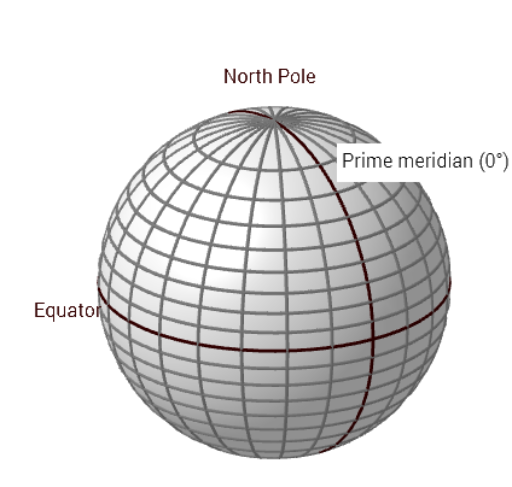
经纬度三维球面演示:参数曲线与坐标网格
几何画板及绘图内容加载中,请稍等……
所属专题
Algebra 1
该范例在三维空间中直观演示了地球经纬度(Latitude and Longitude)的几何构造,通过球体上的参数曲线和正交平面相交路径,展示经线、纬线以及经纬度坐标点的生成过程。核心数学概念包括三维球面坐标、参数曲线、正交平面、旋转与交点计算,以及实数与有理数在坐标表示中的应用。作图要点:使用GeoGebra的Sphere命令创建球体,OrthogonalPlane构造过球心的正交平面,IntersectPath求平面与球面的交线(即大圆或小圆),Rotate实现经度旋转,Plane与Intersect用于定位特定经纬度点,Textfield用于交互输入经纬度数值。该范例适合高中或大学阶段学习立体几何、球面坐标与参数方程的学生,也可用于地理数学或三维可视化教学,帮助理解经纬度与空间点的一一对应关系。
GeoGebra 命令及参数
Sphere(A, 9) → aOrthogonalPlane(D, zAxis) → bOrthogonalPlane(E, zAxis) → cOrthogonalPlane(F, zAxis) → dOrthogonalPlane(G, zAxis) → eOrthogonalPlane(H, zAxis) → fOrthogonalPlane(I, zAxis) → gOrthogonalPlane(J, zAxis) → hOrthogonalPlane(K, zAxis) → iIntersectPath(b, a) → kIntersectPath(c, a) → pIntersectPath(d, a) → qIntersectPath(e, a) → rIntersectPath(f, a) → sIntersectPath(g, a) → tIntersectPath(h, a) → c_1IntersectPath(i, a) → d_1OrthogonalPlane(A, zAxis) → jIntersectPath(j, a) → e_1OrthogonalPlane(L, zAxis) → l_5OrthogonalPlane(S, zAxis) → m_4OrthogonalPlane(R, zAxis) → n_2OrthogonalPlane(Q, zAxis) → oOrthogonalPlane(P, zAxis) → uOrthogonalPlane(O, zAxis) → vOrthogonalPlane(N, zAxis) → wOrthogonalPlane(M, zAxis) → a_1IntersectPath(l_5, a) → f_1IntersectPath(w, a) → g_1IntersectPath(v, a) → h_1IntersectPath(u, a) → k_1IntersectPath(o, a) → p_1IntersectPath(n_2, a) → q_1IntersectPath(m_4, a) → r_1IntersectPath(a_1, a) → s_1Rotate(T, 15°, (0, 0)) → T'Rotate(T', 15°, (0, 0)) → T''Rotate(T'', 15°, (0, 0)) → T'''Rotate(T''', 15°, (0, 0)) → URotate(U, 15°, (0, 0)) → U'Rotate(U', 15°, (0, 0)) → U''Rotate(U'', 15°, (0, 0)) → U'''Rotate(U''', 15°, (0, 0)) → VRotate(V, 15°, (0, 0)) → V'Rotate(V', 15°, (0, 0)) → V''Rotate(V'', 15°, (0, 0)) → V'''Plane(A, B, T) → b_1Plane(A, B, T') → i_1Plane(A, B, T'') → j_1Plane(A, B, T''') → l_6Plane(A, B, U) → m_1Plane(A, B, U') → n_1Plane(A, B, U'') → o_1Plane(A, B, U''') → t_1Plane(A, B, V) → u_1Plane(A, B, V') → v_1Plane(A, B, V'') → w_1Plane(A, B, V''') → a_2IntersectPath(i_1, a) → c_2IntersectPath(j_1, a) → d_2IntersectPath(l_6, a) → e_2IntersectPath(m_1, a) → f_2IntersectPath(n_1, a) → g_2IntersectPath(o_1, a) → h_2IntersectPath(t_1, a) → k_2IntersectPath(u_1, a) → p_2IntersectPath(v_1, a) → q_2IntersectPath(w_1, a) → r_2IntersectPath(a_2, a) → s_2IntersectPath(b_1, a) → t_2Intersect(d_1, r_2, 1) → WIntersect(c_1, r_2, 1) → ZIntersect(d_1, s_2, 1) → A_1Intersect(c_1, s_2, 1) → B_1Intersect(t, s_2, 1) → C_1Intersect(s, s_2, 1) → D_1Intersect(s_2, r, 2) → E_1Intersect(q, s_2, 1) → F_1Intersect(p, s_2, 1) → G_1Intersect(k, s_2, 1) → H_1Intersect(d_1, t_2, 2) → J_1Intersect(t_2, c_1, 1) → K_1Intersect(t_2, t, 1) → L_1Intersect(t_2, s, 1) → M_1Intersect(t_2, r, 1) → N_1Intersect(q, t_2, 2) → O_1Intersect(t_2, p, 1) → Q_1Intersect(k, t_2, 2) → R_1Intersect(c_2, d_1, 1) → T_1Intersect(c_2, c_1, 1) → U_1Intersect(t, c_2, 2) → V_1Intersect(c_2, s, 1) → W_1Intersect(r, c_2, 2) → Z_1Intersect(c_2, q, 1) → A_2Intersect(p, c_2, 2) → B_2Intersect(c_2, k, 1) → C_2Intersect(d_2, d_1, 1) → E_2Intersect(d_2, c_1, 1) → F_2Intersect(d_2, t, 1) → G_2Intersect(d_2, s, 1) → H_2Intersect(d_2, r, 1) → I_2Intersect(q, d_2, 2) → J_2Intersect(d_2, p, 1) → K_2Intersect(d_2, k, 1) → L_2Intersect(e_2, d_1, 1) → N_2Intersect(c_1, e_2, 2) → O_2Intersect(t, e_2, 2) → Q_2Intersect(s, e_2, 2) → R_2Intersect(e_2, r, 1) → S_2Intersect(q, e_2, 2) → T_2Intersect(e_2, p, 1) → U_2Intersect(e_2, k, 1) → V_2Intersect(f_2, d_1, 1) → Z_2Intersect(c_1, f_2, 2) → A_3Intersect(t, f_2, 2) → B_3Intersect(s, f_2, 2) → C_3Intersect(r, f_2, 2) → D_3Intersect(q, f_2, 2) → E_3Intersect(p, f_2, 2) → F_3Intersect(k, f_2, 2) → G_3Point(e_1) → H_3Intersect(g_2, d_1, 1) → I_3Intersect(g_2, c_1, 1) → J_3Intersect(t, g_2, 2) → K_3Intersect(s, g_2, 2) → L_3Intersect(g_2, r, 1) → M_3Intersect(g_2, q, 1) → N_3Intersect(g_2, p, 1) → O_3Intersect(g_2, k, 1) → Q_3Intersect(f_1, t_2, 2) → S_3Intersect(f_1, c_2, 2) → T_3Intersect(f_1, d_2, 2) → U_3Intersect(e_2, f_1, 1) → V_3Intersect(f_2, f_1, 1) → W_3Intersect(f_1, g_2, 2) → Z_3Intersect(g_2, s_1, 1) → A_4Intersect(g_1, g_2, 2) → B_4Intersect(k_1, g_2, 2) → C_4Intersect(f_2, k_1, 1) → D_4Intersect(f_2, h_1, 1) → E_4Intersect(f_2, g_1, 1) → F_4Intersect(s_1, f_2, 2) → G_4Intersect(e_2, s_1, 1) → H_4Intersect(g_1, e_2, 2) → I_4Intersect(h_1, e_2, 2) → J_4Intersect(k_1, d_2, 2) → K_4Intersect(d_2, h_1, 1) → L_4Intersect(g_1, d_2, 2) → M_4Intersect(s_1, d_2, 2) → N_4Intersect(s_1, c_2, 2) → O_4Intersect(g_1, c_2, 2) → P_4Intersect(h_1, c_2, 2) → Q_4Intersect(g_1, t_2, 2) → R_4Intersect(s_1, t_2, 2) → S_4Textfield(l_1) → InputBox1Textfield(l_2) → InputBox2Intersect(t, k_2, 2) → I_1Intersect(s, k_2, 2) → S_1Intersect(r, k_2, 2) → D_2Intersect(k_2, q, 1) → M_2Intersect(p, k_2, 2) → W_2Intersect(k, k_2, 2) → R_3Intersect(f_1, k_2, 2) → T_4Intersect(s_1, k_2, 2) → U_4Intersect(g_1, k_2, 2) → V_4Intersect(h_1, k_2, 2) → W_4Intersect(t, p_2, 2) → Z_4Intersect(p_2, s, 1) → A_5Intersect(r, p_2, 2) → B_5Intersect(q, p_2, 2) → C_5Intersect(p_2, p, 1) → D_5Intersect(k, p_2, 2) → E_5Intersect(f_1, p_2, 2) → F_5Intersect(s_1, p_2, 2) → G_5Textfield(m_{response}) → InputBox3