
等轴测投影几何演示:三维立体图形在二维平面上的投影方法
几何画板及绘图内容加载中,请稍等……
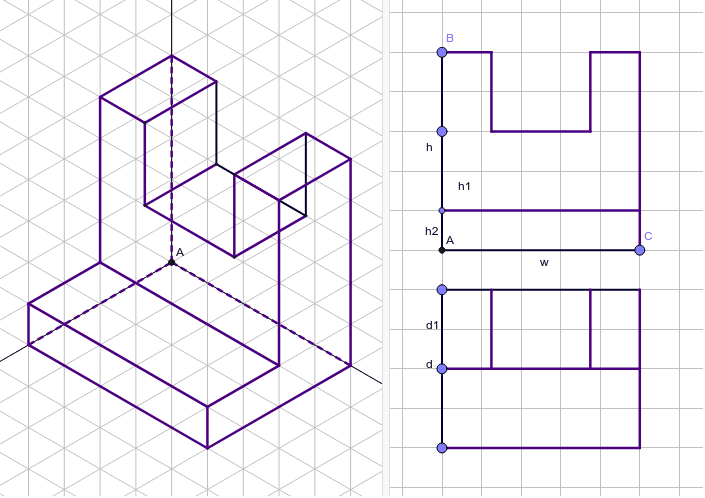
本范例演示等轴测投影如何将三维空间中的立体图形转换为二维平面视图。涉及立体几何、投影变换及空间坐标系的数学概念。作图要点包括利用 GeoGebra 的点、线、射线、线段、圆、中点及交点命令构建几何关系,精确确定投影位置。适合高中或大学几何课程学习,辅助理解空间图形直观图绘制,帮助学生掌握空间想象能力。
GeoGebra 命令及参数
Point(a_3) → COrthogonalLine(A, a_3) → bPoint(b) → FLine(F, a_3) → cLine(C, b) → d_1Intersect(c, d_1) → GPoint(b) → BPoint(b) → JRay(A, D) → eRay(A, C_1) → fRay(A, B_1) → gSegment(A, C) → wCircle(A, w) → h_1Intersect(h_1, g) → C_a,Segment(B, A) → hCircle(A, h) → kIntersect(k, e, 1) → B_aLine(C_a, e) → iLine(B_a, g) → jLine(C_a, f) → lSegment(F, J) → dCircle(A, d) → pIntersect(p, f, 1) → A_2Line(A_2, g) → mIntersect(l, m) → ELine(B_a, f) → nLine(A_2, e) → qIntersect(i, j) → HPoint(h) → OSegment(A, O) → h1Circle(A, h1) → sIntersect(s, e, 1) → PLine(P, g) → tLine(O, w) → a_1Segment(F, G) → e_1Midpoint(B_a, H) → UMidpoint(B_a, U) → VMidpoint(U, H) → WLine(V, e) → j_1Line(W, e) → k_1Intersect(t, j_1) → ZIntersect(t, k_1) → A_1Segment(V, Z) → l_1Segment(Z, A_1) → m_1Segment(A_1, W) → n_1Point(d) → D_1Line(D_1, e_1) → p_1Intersect(d_1, p_1) → G_1Segment(F, D_1) → d1Circle(B_a, d1) → q_1Intersect(q_1, n, 2) → H_1Line(H_1, j) → r_1Line(V, n) → s_1Line(W, s_1) → t_1Line(H, t_1) → a_2Line(H_1, e) → b_2Intersect(r_1, s_1) → KIntersect(r_1, t_1) → I_1Intersect(a_2, r_1) → J_1Line(K, e) → c_2Line(I_1, c_2) → d_2Line(J_1, i) → e_2Line(P, f) → f_2Intersect(b_2, f_2) → K_1Line(B, a_3) → rIntersect(d_1, r) → IMidpoint(B, I) → LMidpoint(L, B) → MMidpoint(I, L) → NLine(M, h) → b_1Line(N, h) → c_1Intersect(a_1, b_1) → QIntersect(a_1, c_1) → ROrthogonalLine(L, w) → f_1Point(h) → SSegment(S, A) → h2Circle(A, h2) → g_1Intersect(g_1, e) → T,Line(S, a_3) → aIntersect(d_1, a) → E_1Line(J, p_1) → i_1Intersect(d_1, i_1) → F_1Intersect(p_1, b_1) → M_1Intersect(c, b_1) → N_1Intersect(c, c_1) → O_1Intersect(p_1, c_1) → P_1Segment(B, M) → g_2Segment(M, Q) → h_2Segment(Q, R) → i_2Segment(R, N) → j_2Segment(N, I) → k_2Segment(I, C) → l_2Segment(S, E_1) → m_2Segment(G, F_1) → n_2Segment(J, F_1) → p_2Segment(D_1, G_1) → q_2Segment(N_1, M_1) → r_2Segment(O_1, P_1) → s_2Segment(B_a, V) → t_2Segment(W, H) → b_3Segment(H, C_a) → c_3Segment(C_a, E) → d_3Segment(E, A_2) → e_3Segment(B_a, H_1) → f_3Segment(H_1, K) → h_3Segment(V, K) → i_3Segment(W, I_1) → j_3Segment(I_1, J_1) → k_3Segment(H, J_1) → l_3Line(T, f) → m_3Intersect(q, m_3) → L_1Line(L_1, g) → n_3Line(T, g) → p_3Intersect(b_2, m_3) → R_1Intersect(k_1, e_2) → S_1Intersect(k_1, e_2) → T_1Segment(L_1, A_2) → r_3Segment(H_1, R_1) → g_3Segment(R_1, L_1) → t_3Line(E, e) → q_3Intersect(n_3, q_3) → Q_1Segment(L_1, Q_1) → s_3Segment(Q_1, E) → a_4Line(R_1, g) → b_4Line(Q_1, f) → c_4Intersect(b_4, c_4) → U_1Segment(Q_1, U_1) → d_4Segment(R_1, U_1) → e_4Segment(J_1, U_1) → f_4Intersect(j_1, d_2) → W_1Segment(A_2, A) → m_4Segment(A, B_a) → n_4Segment(A, C_a) → p_4Line(Z, t_3) → g_4Line(A_1, g_4) → h_4Intersect(c_2, g_4) → V_1Intersect(d_2, h_4) → Z_1Segment(Z, V_1) → i_4Segment(Z_1, I_1) → j_4Segment(K, V_1) → k_4Segment(V_1, Z_1) → l_4Segment(A_1, Z_1) → q_4
AI 绘图提示语参考
绘制一个正方体的等轴测投影。首先建立正方体的顶点,然后通过投影变换将其投影到二维平面上。具体步骤包括创建点、线、射线、圆和线段,并利用交点找到投影点。最终形成一个正方体在二维平面上的等轴测投影图。
以上提示语为根据原始绘图命令整理而来,仅供参考。