
通过参数方程隐式曲线交点求两参数曲线交点
几何画板及绘图内容加载中,请稍等……
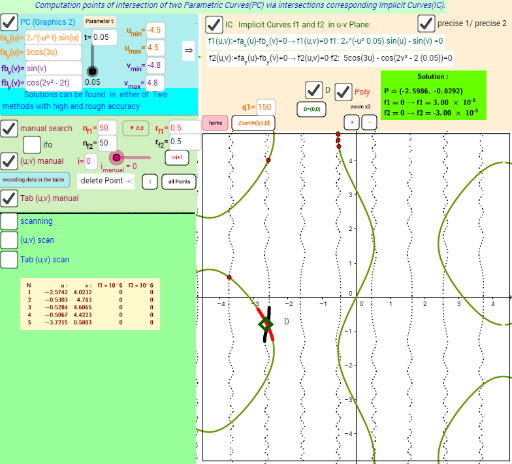
本范例演示了如何通过求解对应的隐式曲线交点来找到两条参数曲线的交点。涉及的核心数学概念包括参数方程、隐式曲线、交点求解和几何关系。作图要点包括使用 GeoGebra 命令如 ImplicitCurve(隐式曲线)、Intersect(交点)、PolyLine(多边形)、Point(点)、PathParameter(路径参数)等。适合高中及以上数学学习者,用于理解参数方程与隐式曲线的关系及交点计算方法。
GeoGebra 命令及参数
ImplicitCurve(f2(x, y)) → bIntersect(Circle[D, r_b], OrthogonalLine[D, Segment[D, ClosestPoint[b, D]]], 1) → Z1_bIntersect(Circle[D, r_b], OrthogonalLine[D, Segment[D, ClosestPoint[b, D]]], 2) → Z2_bImplicitCurve(f1(x, y)) → aIntersect(Circle[D, r_a], OrthogonalLine[D, Segment[D, ClosestPoint[a, D]]], 2) → Z2_aIntersect(Circle[D, r_a], OrthogonalLine[D, Segment[D, ClosestPoint[a, D]]], 1) → Z1_aPolyLine(Zip[ClosestPoint[b, B], B, Z1_b + ((Z2_b - Z1_b) / n_b * Sequence[i, i, 0, n_b])]) → polZbPolyLine(Zip[ClosestPoint[a, B], B, Z1_a + ((Z2_a - Z1_a) / n_a * Sequence[i, i, 0, n_a])]) → polZaElement({Intersect[polZb, polZa]}, 1) → PZPoint(a) → BPathParameter(B) → Pf1BTextfield(Nn) → InputBox4Textfield(e) → InputBox5Textfield(x_{min}) → InputBox6Textfield(x_{max}) → InputBox7Textfield(y_{min}) → InputBox8Textfield(y_{max}) → InputBox9Polygon((x_{min}, y_{min}), (x_{max}, y_{min}), (x_{max}, y_{max}), (x_{min}, y_{max})) → poly1, g1_s, g2_s, g3_s, s4_sTextfield(α) → InputBox2Length(lr1) → llr1Length(lf2) → llf2Textfield(r) → InputBox16CurveCartesian(fa_x(u), fa_y(u), u, x_{min}, x_{max}) → a_cCurveCartesian(fb_x(v), fb_y(v), v, y_{min}, y_{max}) → b_cElement(lr1, i_{manual}) → C_tElement(lr2_bscan, f) → B_{xy}Length(lf1) → llf1Textfield(fa_x) → InputBox17Textfield(fa_y) → InputBox18Textfield(fb_x) → InputBox19Textfield(fb_y) → InputBox20Textfield(n_a) → InputBox21Textfield(n_b) → InputBox22Textfield(r_a) → InputBox23Textfield(q) → InputBox24PolyLine(Z1_a + ((Z2_a - Z1_a) / n_a * Sequence[i, i, 0, n_a])) → poly2_aaPolyLine(Z1_b + ((Z2_b - Z1_b) / n_b * Sequence[i, i, 0, n_b])) → poly2_bbPoint(poly2_aa, e1) → R_aPoint(poly2_bb, e2) → R_bClosestPoint(a, R_a) → R'_aClosestPoint(b, R_b) → R'_bLength(R'_a - R'_b) → dmaxmins2If(Defined[PZ], If[fza2 < fzb2, (f1za2, f2za2), (f1zb2, f2zb2)], (NaN, NaN)) → errorz2If(Defined[PZ], If[fza2 < fzb2, R'_a, R'_b], (NaN, NaN)) → Pz2If(ca, PZ, Pz2) → PZ0If(ca, f11, x(errorz2)) → f110If(ca, f22, y(errorz2)) → f220Length(lZ1_a) → lälZ1_aLength(lZ1_b) → lälZ1_bElement(listxyres, f) → B_tTextfield(r_b) → InputBox13Textfield(α) → InputBox11Element(roots0, f) → ASequence((fa_x(x(Element[lr1, i])), fa_y(x(Element[lr1, i]))), i, 1, llr1) → lr2_aSequence((fb_x(y(Element[lr1, i])), fb_y(y(Element[lr1, i]))), i, 1, llr1) → lr2_bZip(((abs(x(a - b) / x(a)) * 100), (abs(y(a - b) / y(a)) * 100)), a, lr2_a, b, lr2_b) → lr2Element(lr2_a, i_{manual}) → Cxy_tTableText({Join[{{"N"}, Sequence[i, i, 1, Length[roots0]]}], Join[{{""}, Sequence["→", i, 1, f]}], Join[{{" u:"}, x(roots0)}], Join[{{" v:"}, y(roots0)}], Join[{{"f1*10^-6"}, lf1_{Pr}2}], Join[{{"f2* 10^-6"}, lf2_{Pr}2}]}, "vr") → Text2TableText({Join[{{"N"}, Sequence[i, i, 1, llr1]}], Join[{{""}, Sequence["→", i, 1, i_{manual}]}], Join[{{"u:"}, x(lr1)}], Join[{{"v:"}, y(lr1)}], Join[{{"f1* 10^-6"}, lf1}], Join[{{"f2* 10^-6"}, lf2}]}, "vr") → text8Textfield(t) → InputBox1Textfield(f) → InputBox3TableText({Join[{{"N"}, Sequence[i, i, 1, Length[roots0]]}], Join[{{""}, Sequence["→", i, 1, f]}], Join[{{"(x,y)_a"}, lr2_ascan}], Join[{{"(x,y)_b"}, lr2_bscan}], Join[{{"(δx,δy) %"}, lr2scan}]}, "vr") → text12aTableText({Join[{{"N"}, Sequence[i, i, 1, llr1]}], Join[{{""}, Sequence["→", i, 1, i_{manual}]}], Join[{{"(x,y)_a"}, lr2_a}], Join[{{"(x,y)_b"}, lr2_b}], Join[{{"(δx,δy) %"}, lr2}]}, "vr") → text12rTextfield(i_{manual}) → Eingabefeld1Textfield(q2) → Eingabefeld2ImplicitCurve(f01(x, y)) → c
AI 绘图提示语参考
绘制两条参数曲线的交点。首先,绘制两条参数曲线并转换为隐式曲线。接着,找到每条隐式曲线与通过参数曲线上点的垂直线的交点。然后,使用这些交点来绘制参数曲线的近似线段,并找到这两组线段的交点。最后,根据给定的参数和条件,确定最终的交点位置。
以上提示语为根据原始绘图命令整理而来,仅供参考。