
圆周角舞动
几何画板及绘图内容加载中,请稍等……
所属专题
Circles (Theorems)
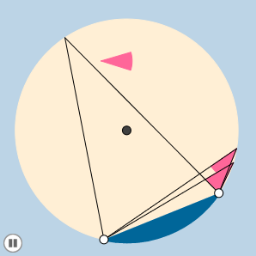
这个范例展示了圆周角的动态变化。它涉及圆周角的基本性质,如圆周角等于其所对弧的一半。通过使用GeoGebra命令如Circle、CircumcircleArc、Rotate等,可以直观地观察到圆周角随圆上点移动的变化。适合初中及以上学生学习圆周角的相关概念。
GeoGebra 命令及参数
Circle(A, B) → cSegment(B, A) → aPoint(c) → CSegment(A, C) → bPoint(c) → DCircumcircleArc(C, D, B) → dCircleArc(A, B, C) → ePoint(d) → ESegment(C, E) → fSegment(E, B) → gCircle(E, 1.5) → hRay(E, C) → iRay(E, B) → jIntersect(h, j) → F,Intersect(h, i) → G,CircleSector(E, F, G) → kSegment(E, A) → lLine(A, xAxis) → mDilate(E, If[0 ≤ n ≤ 1, 1 - n, 0], A) → E'Vector(E, E') → uTranslate(k, u) → k'Line(E, a) → pLine(E, b) → qIntersect(h, p, 1) → HAngle(H, E, B) → αIntersect(h, q, 2) → IAngle(C, E, I) → βDilate(E, If[1 < n ≤ 2, 2 - n, 0], A) → E'_1Vector(E, E'_1) → vTranslate(k, v) → k'_1Rotate(k'_1, If[1 < n ≤ 2, ((n - 1) * β), β], E'_1) → k''Rotate(k', If[0 < n ≤ 1, ((-n) * α), (-α)], E') → k''_1Circle(A, 1.5) → rIntersect(r, a, 1) → JIntersect(r, b, 1) → KCircleSector(A, J, K) → sPoint(d) → LPoint(d) → MPoint(d) → NPoint(d) → OPoint(d) → PSegment(L, B) → tSegment(L, C) → a_1Segment(M, B) → b_1Segment(M, C) → c_1Segment(N, B) → d_1Segment(N, C) → e_1Segment(O, B) → f_1Segment(O, C) → g_1Segment(P, C) → h_1Segment(P, B) → i_1Vector(E, L) → w_2Vector(E, P) → j_1Circle(L, 1.5) → k_1Circle(M, 1.5) → p_1Circle(N, 1.5) → q_1Circle(O, 1.5) → r_1Circle(P, 1.5) → s_1Intersect(k_1, t, 1) → QIntersect(k_1, a_1, 1) → RIntersect(p_1, b_1, 1) → SIntersect(p_1, c_1, 1) → TIntersect(q_1, d_1) → U,Intersect(q_1, e_1, 1) → VIntersect(r_1, f_1, 1) → WIntersect(r_1, g_1, 1) → ZIntersect(s_1, i_1, 1) → A_1Intersect(s_1, h_1, 1) → B_1CircleSector(M, S, T) → t_1CircleSector(L, Q, R) → c_2CircleSector(N, U, V) → d_2CircleSector(O, W, Z) → e_2CircleSector(P, A_1, B_1) → f_2Dilate(E, If[0 < w < 1, 1 - w, 0], L) → E'_2Vector(E, E'_2) → l_1Translate(k, l_1) → k'_2Line(E, a_1) → m_1Point(m_1) → C_1Angle(C, E, C_1) → γRotate(k'_2, If[0 < w < 1, (w * γ), 0], E'_2) → g_2Dilate(L, If[1 < w < 2, 2 - w, 0], O) → L'Vector(L, L') → u_1Line(L, f_1) → n_1Translate(c_2, u_1) → h_2Intersect(k_1, n_1, 2) → D_1Angle(D_1, L, Q) → δRotate(h_2, If[1 < w < 2, ((-(w - 1)) * δ), 0], L') → k_2Dilate(O, If[2 < w < 3, 3 - w, 0], M) → O'Vector(O, O') → w_1Translate(e_2, w_1) → p_2Line(O, c_1) → a_2Intersect(r_1, a_2, 2) → E_1Angle(Z, O, E_1) → εRotate(p_2, If[2 < w < 3, ((w - 2) * ε), 0], O') → q_2Dilate(M, If[3 < w < 4, 4 - w, 0], P) → M'Vector(M, M') → v_1Translate(t_1, v_1) → r_2Line(M, i_1) → b_2Intersect(p_1, b_2, 2) → F_1Angle(S, M, F_1) → ζRotate(r_2, If[3 < w < 4, ((w - 3) * ζ), 0], M') → s_2Dilate(P, If[4 < w < 5, 5 - w, 0], N) → P'Vector(P, P') → u_2Translate(f_2, u_2) → t_2Line(P, e_1) → i_2Intersect(s_1, i_2, 2) → G_1Angle(B_1, P, G_1) → ηRotate(t_2, If[4 < w < 5, ((w - 4) * η), 0], P') → c_3