
运动描述的图形-任务
几何画板及绘图内容加载中,请稍等……
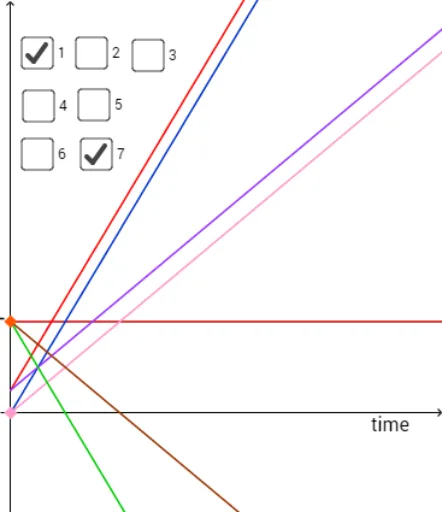
①本范例演示如何通过图形描述运动轨迹,特别是参数曲线和几何变换的应用;②涉及核心数学概念包括参数方程、解析几何、几何变换和三角形性质;③作图要点:使用Line, Point, OrthogonalLine, Intersect, Polygon, Segment, RotateText等GeoGebra命令构建图形,如绘制直线、点、正交线、交点、多边形和旋转文本;④适合高中及以上学生,用于理解参数方程在运动描述中的应用及几何变换的视觉效果。
GeoGebra 命令及参数
Line(C, xAxis) → iLine(D, i) → jPoint(i) → EOrthogonalLine(E, i) → kIntersect(j, k) → FPoint(i) → HOrthogonalLine(H, i) → lPoint(l) → IOrthogonalLine(I, l) → qPoint(l) → JOrthogonalLine(J, l) → rPoint(q) → LOrthogonalLine(L, q) → sIntersect(s, r) → MPolygon(I, L, M, J) → poly1, i_1, l_1, m_1, j_1Intersect(i, l_1) → NIntersect(j, l_1) → OIntersect(j_1, j) → PSegment(H, N) → t_1Segment(P, O) → cIntersect(d, i_1) → QIntersect(m_1, d) → RSegment(Q, R) → eLine(e_2, xAxis) → bLine(c_1, xAxis) → k_1Line(g_4, xAxis) → n_1Line(a_3, xAxis) → i_2Line(b_5, xAxis) → j_2Line(f_4, xAxis) → k_2Point(yAxis) → A_1OrthogonalLine(A_1, yAxis) → l_2Point(yAxis) → B_1OrthogonalLine(B_1, yAxis) → m_2Point(m_2) → C_1OrthogonalLine(C_1, m_2) → n_2Point(m_2) → D_1OrthogonalLine(D_1, m_2) → p_2Intersect(n_2, l_2) → E_1Intersect(p_2, l_2) → F_1Polygon(D_1, C_1, E_1, F_1) → poly2, d_5, c_2, e_3, f_5Intersect(i_2, n_2) → G_1Intersect(j_2, n_2) → H_1Intersect(b, n_2) → I_1Intersect(xAxis, n_2) → J_1Intersect(k_1, n_2) → K_1Intersect(k_2, n_2) → L_1Intersect(n_1, n_2) → M_1Intersect(n_1, p_2) → N_1Intersect(k_2, p_2) → O_1Intersect(k_1, p_2) → P_1Intersect(xAxis, b) → Q_1Intersect(xAxis, p_2) → R_1Intersect(b, j_2) → S_1Intersect(j_2, p_2) → T_1Intersect(b, p_2) → U_1Intersect(i_2, p_2) → V_1Segment(V_1, G_1) → q_2Segment(T_1, H_1) → r_2Segment(U_1, I_1) → s_2Segment(R_1, J_1) → t_2Segment(P_1, K_1) → a_2Segment(O_1, L_1) → b_2Segment(N_1, M_1) → h_3Segment(F_1, E_1) → i_3RotateText("position", 90°) → text4