
正弦与余弦函数的变换作图
几何画板及绘图内容加载中,请稍等……
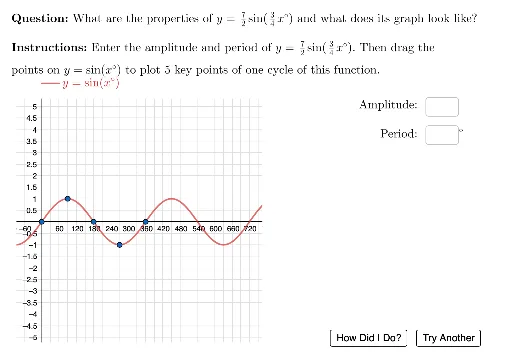
本范例演示正弦与余弦函数的变换,涉及的核心数学概念包括正弦函数、余弦函数及其变换。通过使用GeoGebra命令,如Sequence、If、Point等,可以动态调整函数的相位、振幅和周期,从而观察函数图像的变化。适合高中数学教学和学习。
GeoGebra 命令及参数
Sequence(Sequence[(i, j), i, -45, 735, 15], j, -5, 5, 0.5) → gridSpaceIf(isSinFunc, sin(x°), cos(x°)) → parentFuncPoint(Union[gridSpace, {Element[homeBase, 5]}]) → B6Point(Union[gridSpace, {Element[homeBase, 4]}]) → B5Point(Union[gridSpace, {Element[homeBase, 3]}]) → B4Point(Union[gridSpace, {Element[homeBase, 2]}]) → B3Point(Union[gridSpace, {Element[homeBase, 1]}]) → B2Shuffle(F2:F13) → aValsElement(aVals, 1) → aValShuffle(D2:D8) → bValsElement(bVals, 1) → bValUnicodeToLetter(10003) → cmarkUnicodeToLetter(10007) → xmarkLaTeX(FractionText[abs(bVal)]) → fmtAbsBvalNumToFracNoPhantom(1 / abs(bVal)) → currentStretchFactorLaTeX(If[isSinFunc, "y=\sin(x°)", "y=\cos(x°)"]) → lblParentNumToFrac(bVal) → latexBvalPolygon({(left, bottom), (left, top), (right, top), (right, bottom)}) → viewboxPoint(Union[gridSpace, homeBase]) → activePtLaTeX((((("\text{\(y=" * NumToFrac[aVal]) * If[isSinFunc, "\sin(", "\cos("]) * NumToFrac[bVal]) * "x°)\)}")) → lblFxSequence(startXPos + (i * quarterPeriod), i, 0, 4) → correctXvalsLaTeX(If[bVal > 0, "", "\text{Since \(b \lt 0\), there is a reflection\\in the \(y\)-axis.}"]) → fbHReflectionLaTeX((((("\text{There is a horizontal stretch by a factor \\of \(" * currentStretchFactor) * "\), and the graph has the same \\\(y\)-intercept as \(") * lblParent) * "\).}")) → fbHStretchIf(showFeedback, E21:E22, {"", ""}) → questionMarksLaTeX((((((("\text{Since \(b =" * latexBval) * "\), the period is \\\(\dfrac{360}{\mid b \mid} °=\dfrac{360}{") * fmtAbsBval) * "}°=") * abs(periodValue)) * "^\circ\).}")) → fbPeriodLaTeX((("\text{The base function is \(" * lblParent) * "\)}.")) → fbBaseTextfield(C22) → B22If(D22 ≟ periodValue, correct, incorrect) → E22If(isSinFunc, (aVal * sin(((bVal * x))°)), (aVal * cos(((bVal * x))°))) → translatedFuncZip((A, translatedFunc(A)), A, correctXvals) → correctPtsTextfield(C21) → B21If(amplitudeCorrect, correct, incorrect) → E21LaTeX((((("\text{The amplitude is \(\left\vert a \right\vert = \left\vert " * NumToFracNoPhantom[aVal]) * "\right\vert = ") * NumToFracNoPhantom[abs(aVal)]) * "\)}")) → fbAmplitudeLaTeX(If[aVal > 0, "", "\text{Since \(a<0\), there is a reflection\\in the \(x\)-axis.}"]) → fbVReflectionLaTeX(If[isCorrect, "\text{The points you graphed are correct.}", "\text{You did not graph a correct set of points.}"]) → fbCorrectLaTeX(If[bVal < 0, "\text{Note that this reflection has no effect for a\\cosine function, since the cosine function\\is symmetric about the \(y-\)axis.}", ""]) → fbCosReflectionLaTeX(If[aVal < 0 ∧ bVal < 0, "\text{Note that for a sine function, the reflections \\in the \(x\)-axis and the \(y-\)axis cancel\\each other out.}", If[aVal < 0 ∨ bVal < 0, (("\text{For a sine function, this reflection has the\\same effect as a reflection in the \(" * If[aVal < 0, "y", "x"]) * "\)-axis.}"), ""]]) → fbSinReflectionLaTeX((((("\text{\textbf{Question: }" * MainInstruc) * "\\\textbf{Instructions: }") * SpecInstruc) * "}")) → allInstrucLaTeX(((((((((((fbAmplitude * "\\") * fbPeriod) * "\\") * fbBase) * "\\") * fbVReflection) * "\\") * fbHReflection) * "\\") * If[isSinFunc, fbSinReflection, fbCosReflection])) → fbAllSegment(Element[legendPoints, 1], Element[legendPoints, 1] + (60, 0)) → legendParentSegment(Element[legendPoints, 2], Element[legendPoints, 2] + (60, 0)) → legendTransformedTableText({questionLbls, questionSpacers, questionMarks}, "vr") → tblInput