
在竖直数轴上探索整数
几何画板及绘图内容加载中,请稍等……
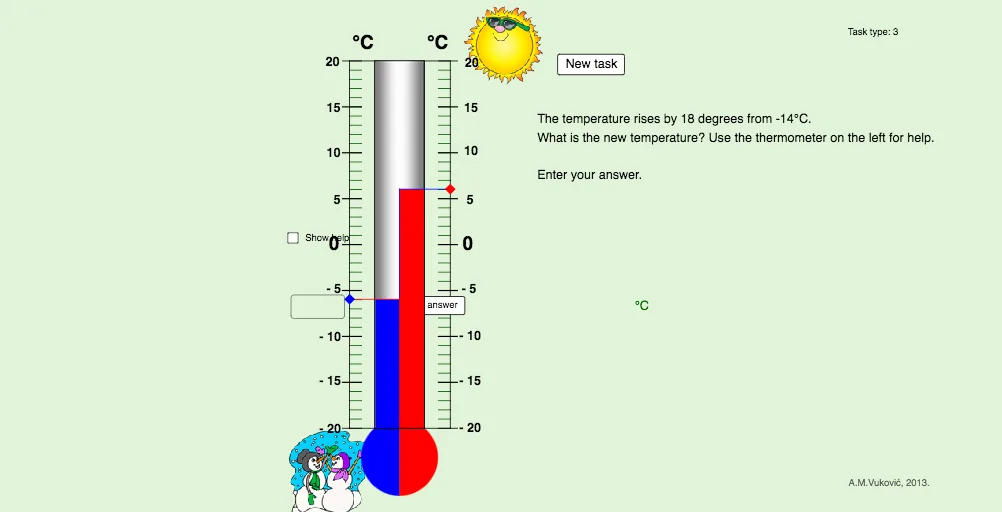
该范例在竖直数轴上动态展示整数的分布与运算,通过可视化方式帮助学生理解正负数、数轴方向及整数序列。核心数学概念包括整数、数轴、序列与数列,以及数轴上的点与线段关系。作图要点:使用GeoGebra的Line、Point、Segment、Sequence等命令构建数轴和整数点,通过Dilate、Mirror、Rotate等变换操作生成对称或旋转图形,利用Textfield和Random实现交互输入与随机生成,结合PolyLine和Text标注数值。适合小学高年级至初中阶段学习整数概念、数轴应用及序列规律的课堂演示或自主探索。
GeoGebra 命令及参数
Line(A_2, A_1) → cPoint(c) → P_0Dilate(B_1, 1 / brPodjela, A_1) → B_pPoint(Circle[A, a]) → BSegment(A, B) → bSequence(Segment[Translate[A_2, Vector[(i * Vector[A_1, B_p])]], Translate[A_1, Vector[(i * Vector[A_1, B_p])]]], i, 1, brPodjela - 1) → lista1Line(B_2, B_1) → dPoint(c) → C_1Point(c) → C_2Point(d) → D_1Point(d) → D_2Dilate(D_1, 1 / brPodjela, C_1) → D_pSequence(Segment[Translate[C_2, Vector[(i * Vector[C_1, D_p])]], Translate[C_1, Vector[(i * Vector[C_1, D_p])]]], i, 1, brPodjela - 1) → lista2Line(B_p, D_p) → ePoint(e) → CLine(C, yAxis) → fPoint(f) → DCircle(D, C) → gMirror(C, D) → C'CircleSector(D, C, C') → hCircleSector(D, C', C) → kSegment(A_1, B_1) → iPoint(i) → ELine(E, xAxis) → jIntersect(f, c) → FIntersect(f, j) → GLine(H, yAxis) → lIntersect(l, c) → IIntersect(l, j) → JPolygon(F, I, J, G) → mnogokut1, f_1, i_1, j_1, g_1Line(K, yAxis) → mSegment(C_2, D_2) → nPoint(n) → LLine(L, xAxis) → pIntersect(p, f) → MIntersect(m, p) → NIntersect(m, c) → OPolygon(O, F, M, N) → mnogokut2, o, f_2, m_1, n_1Segment(A_1, C_2) → qSegment(B_1, D_2) → rSegment(E, G) → sSegment(L, M) → tSegment(A_2, P_0) → a_1Segment(R_1, P_1) → b_1Segment(R_2, P_2) → c_1Segment(R_3, P_3) → d_1Segment(R_4, P_4) → e_1Segment(R_5, P_5) → h_1Segment(R_6, P_6) → k_1Segment(R_7, P_7) → l_1Segment(B_2, P_8) → p_1Point(c) → Q_0Segment(Q_8, D_1) → q_1Segment(Q_7, T_7) → r_1Segment(Q_6, T_6) → s_1Segment(Q_5, T_5) → t_1Segment(Q_4, T_4) → a_2Segment(Q_3, T_3) → b_2Segment(Q_2, T_2) → c_2Segment(Q_1, T_1) → d_2Segment(Q_0, C_1) → e_2Segment(F, C') → g_2Point(i) → PPoint(i) → QPoint(n) → RPoint(n) → SIntersect(c, l) → TIntersect(c, m) → USegment(U, T) → h_2Midpoint(h_2) → VSegment(V, T) → i_2Midpoint(i_2) → WSegment(V, U) → j_2Midpoint(j_2) → ZLine(R, xAxis) → k_2Line(Z, yAxis) → l_2Intersect(m, k_2) → E_1Intersect(l_2, k_2) → F_1Polygon(U, Z, F_1, E_1) → mnogokut3, u_1, z, f_3, e_3Segment(R, F_1) → m_2Line(Q, xAxis) → n_2Line(V, yAxis) → p_2Intersect(n_2, p_2) → G_1Intersect(n_2, l_2) → H_1Polygon(V, G_1, H_1, Z) → mnogokut4, v, g_3, h_3, z_1Segment(Q, H_1) → q_2Line(S, xAxis) → r_2Line(W, yAxis) → s_2Intersect(r_2, s_2) → I_1Intersect(r_2, p_2) → J_1Polygon(V, W, I_1, J_1) → mnogokut5, v_1, w, i_3, j_3Segment(S, I_1) → t_2Line(P, xAxis) → a_3Intersect(s_2, a_3) → K_1Intersect(a_3, l) → L_1Polygon(W, T, L_1, K_1) → mnogokut6, w_1, t_3, l_3, k_3Segment(P, K_1) → b_3Sequence(Random[-20, 20] + (0 * u), i, 1, 10) → Zad1SviBrojeviUnique(Zad1SviBrojevi) → Zad1UniqueShuffle(Zad1Unique) → Zad1Rnd, {-20, -9, 19, -8, 9, 18, 20, -1, 14}Sequence(Element[Zad1Rnd, i], i, 1, 4) → Zad1OdabraniPoint(xAxis) → M_1Point(xAxis) → N_1Point(xAxis) → O_1Point(xAxis) → S_1Line(M_1, yAxis) → c_3Line(N_1, yAxis) → d_3Line(O_1, yAxis) → m_3Line(S_1, yAxis) → n_3Point(yAxis) → U_1Line(U_1, xAxis) → p_3Intersect(p_3, c_3) → V_1Intersect(p_3, d_3) → W_1Intersect(p_3, m_3) → Z_1Intersect(p_3, n_3) → E_2Circle(V_1, 1) → q_3Circle(W_1, 1) → r_3Circle(Z_1, 1) → s_3Circle(E_2, 1) → c_4OrthogonalLine(V_1, p_3) → a_4Intersect(q_3, a_4) → F_2, G_2Intersect(q_3, p_3) → H_2, I_2Polygon(F_2, I_2, 4) → mnogokut7, b_4, d_4, e_4, f_4, J_2, K_2Point(r_3) → L_2Rotate(L_2, 60°, W_1) → M_2Angle(L_2, W_1, M_2) → αRotate(L_2, 300°, W_1) → N_2Angle(N_2, W_1, L_2) → βPolygon(N_2, M_2, 3) → mnogokut8, g_4, h_4, i_4, O_2Point(s_3) → S_2Rotate(S_2, 30°, Z_1) → U_2Angle(S_2, Z_1, U_2) → γRotate(S_2, 330°, Z_1) → V_2Angle(V_2, Z_1, S_2) → δPolygon(V_2, U_2, 6) → mnogokut9, j_4, B_3, k_4, l_4, m_4, n_4, p_4, W_2, Z_2, A_3Point(c_4) → C_3Rotate(C_3, 60°, E_2) → D_3Rotate(C_3, 300°, E_2) → E_3Angle(E_3, E_2, C_3) → εPolygon(E_3, D_3, 3) → mnogokut10, q_4, r_4, s_4, F_3Element(Zad1Odabrani, 1) → Zad1br1Element(Zad1Odabrani, 2) → Zad1br2Element(Zad1Odabrani, 3) → Zad1br3Element(Zad1Odabrani, 4) → Zad1br4If(Zad1br1 > Zad1br2, 1, 0) → Gscore_1If(Zad1br1 > Zad1br4, 1, 0) → Gscore_3If(Zad1br1 > Zad1br3, 1, 0) → Gscore_2If(Zad1br2 > Zad1br1, 1, 0) → Hscore_1If(Zad1br2 > Zad1br3, 1, 0) → Hscore_2If(Zad1br2 > Zad1br4, 1, 0) → Hscore_3If(Zad1br3 > Zad1br1, 1, 0) → Iscore_1If(Zad1br3 > Zad1br2, 1, 0) → Iscore_2If(Zad1br3 > Zad1br4, 1, 0) → Iscore_3If(Zad1br4 > Zad1br1, 1, 0) → Jscore_1If(Zad1br4 > Zad1br2, 1, 0) → Jscore_2If(Zad1br4 > Zad1br3, 1, 0) → Jscore_3If((abs(x(G_3) - x(V_1)) ≤ 0.1 ∨ abs(x(G_3) - x(W_1)) ≤ 0.1 ∨ abs(x(G_3) - x(Z_1)) ≤ 0.1 ∨ abs(x(G_3) - x(E_2)) ≤ 0.1) ∧ abs(y(G_3) - y(U_1)) ≤ 0.1, 1, 0) → GMovedIf((abs(x(H_3) - x(V_1)) ≤ 0.1 ∨ abs(x(H_3) - x(W_1)) ≤ 0.1 ∨ abs(x(H_3) - x(Z_1)) ≤ 0.1 ∨ abs(x(H_3) - x(E_2)) ≤ 0.1) ∧ abs(y(H_3) - y(U_1)) ≤ 0.1, 1, 0) → HMovedIf((abs(x(I_3) - x(V_1)) ≤ 0.1 ∨ abs(x(I_3) - x(W_1)) ≤ 0.1 ∨ abs(x(I_3) - x(Z_1)) ≤ 0.1 ∨ abs(x(I_3) - x(E_2)) ≤ 0.1) ∧ abs(y(I_3) - y(U_1)) ≤ 0.1, 1, 0) → IMovedIf((abs(x(J_3) - x(V_1)) ≤ 0.1 ∨ abs(x(J_3) - x(W_1)) ≤ 0.1 ∨ abs(x(J_3) - x(Z_1)) ≤ 0.1 ∨ abs(x(J_3) - x(E_2)) ≤ 0.1) ∧ abs(y(J_3) - y(U_1)) ≤ 0.1, 1, 0) → JMovedIf(abs(x(G_3) - GscoreTOT) ≤ 0.1 ∧ abs(y(G_3) - y(U_1)) ≤ 0.1, 1, 0) → GTrueIf(abs(x(H_3) - HscoreTOT) ≤ 0.1 ∧ abs(y(H_3) - y(U_1)) ≤ 0.1, 1, 0) → HTrueIf(abs(x(I_3) - IscoreTOT) ≤ 0.1 ∧ abs(y(I_3) - y(U_1)) ≤ 0.1, 1, 0) → ITrueIf(abs(x(J_3) - JscoreTOT) ≤ 0.1 ∧ abs(y(J_3) - y(U_1)) ≤ 0.1, 1, 0) → JTrueIf(GTrue ≟ 1 ∧ HTrue ≟ 1 ∧ ITrue ≟ 1 ∧ JTrue ≟ 1, "Excellent! The correct order!", "This is not the correct solution. Use the thermometer on the left for help.") → Zad1ProvjeraElement(Zad1Odabrani, 1) → Zad2br1Element(Zad1Odabrani, 2) → Zad2br2If(Zad2br1 > Zad2br2, 1, 0) → GreaterTrueIf(Zad2br1 < Zad2br2, 1, 0) → LessTrueIf(GreaterTrue ≟ 1 ∧ ClickedGreater ≟ 1 ∨ LessTrue ≟ 1 ∧ ClickedLess ≟ 1, "Excellent! You have compared numbers correctly.", "You didn't compare numbers correctly. Next time use the thermometer on the left for help.") → Zad2ProvjeraTextfield(Zad3Upisano) → txtPolje1Textfield(Zad4Upisano) → txtPolje2Textfield(Zad5Upisano) → txtPolje3Textfield(Zad6Upisano) → txtPolje4Random(0, 40) → promjKoordKLine(K_3, xAxis) → t_4Intersect(t_4, l) → L_3Intersect(t_4, m) → M_3Polygon(O, I, L_3, M_3) → mnogokut11, o_3, i_5, l_5, m_5Segment(L_3, K_3) → a_5Circle(D, C) → c_5Textfield(Zad7Upisano) → txtPolje5Dilate(O_3, 1 / brPodjela, N_3) → S_3Sequence(Segment[Translate[U_3, Vector[(i * Vector[N_3, S_3])]], Translate[N_3, Vector[(i * Vector[N_3, S_3])]]], i, 0, brPodjela) → lista3Sequence(Random[-20, 20] + (0 * u), i, 1, 8) → Zad8BrojeviElement(Zad8Brojevi, 1) → C1Element(Zad8Brojevi, 2) → C2Element(Zad8Brojevi, 3) → C3Element(Zad8Brojevi, 4) → C4Element(Zad8Brojevi, 5) → C5Element(Zad8Brojevi, 6) → C6Element(Zad8Brojevi, 7) → C7Element(Zad8Brojevi, 8) → C8PolyLine({V_3, W_3, Z_3, A_4, B_4, C_4, D_4, E_4}) → b_5Line(O_3, xAxis) → d_5Line(N_3, xAxis) → e_5Point(xAxis) → F_4Line(F_4, yAxis) → f_5Intersect(f_5, d_5) → G_4Intersect(f_5, e_5) → H_4Polygon(N_3, H_4, G_4, O_3) → mnogokut12, n_5, h_5, g_5, o_4Line(L_4, xAxis) → q_5Intersect(q_5, h_5) → Z_4Segment(L_4, Z_4) → j_5Point(h_5) → U_4Line(U_4, xAxis) → k_5Intersect(k_5, o_4) → V_4Segment(V_4, U_4) → p_5Line(I_4, xAxis) → r_5Line(J_4, xAxis) → s_5Line(K_4, xAxis) → t_5Line(M_4, xAxis) → a_6Line(N_4, xAxis) → b_6Line(O_4, xAxis) → c_6Intersect(r_5, h_5) → W_4Intersect(s_5, h_5) → A_5Intersect(t_5, h_5) → B_5Intersect(a_6, h_5) → C_5Intersect(b_6, h_5) → D_5Intersect(c_6, h_5) → E_5Segment(I_4, W_4) → d_6Segment(J_4, A_5) → e_6Segment(K_4, B_5) → f_6Segment(M_4, C_5) → g_6Segment(N_4, D_5) → h_6Segment(O_4, E_5) → i_6Random(1, 5) → Zad8RndNumElement(Zad8Odgovori, Zad8RndNum) → Zad8AnswerText(Element[Zad8Pitanja, Zad8RndNum]) → Zad8QuestionTextfield(Zad8Upisano) → txtPolje6
AI 绘图提示语参考
画一个垂直数轴,从-10到10,包括正负整数点。首先画一条垂直线作为数轴,然后在数轴上标出0点。接着,使用0点为基准,向上下方向等距生成整数点。使用线段连接相邻的整数点,形成数轴上的整数序列。最后,添加一些辅助线和标记,如垂直线、水平线、圆和圆弧,以增强数轴的可读性和互动性。
以上提示语为根据原始绘图命令整理而来,仅供参考。